
Solok Radjo Cooperative in West Sumatra becomes reference for Agriculture Ministry's Upland programme
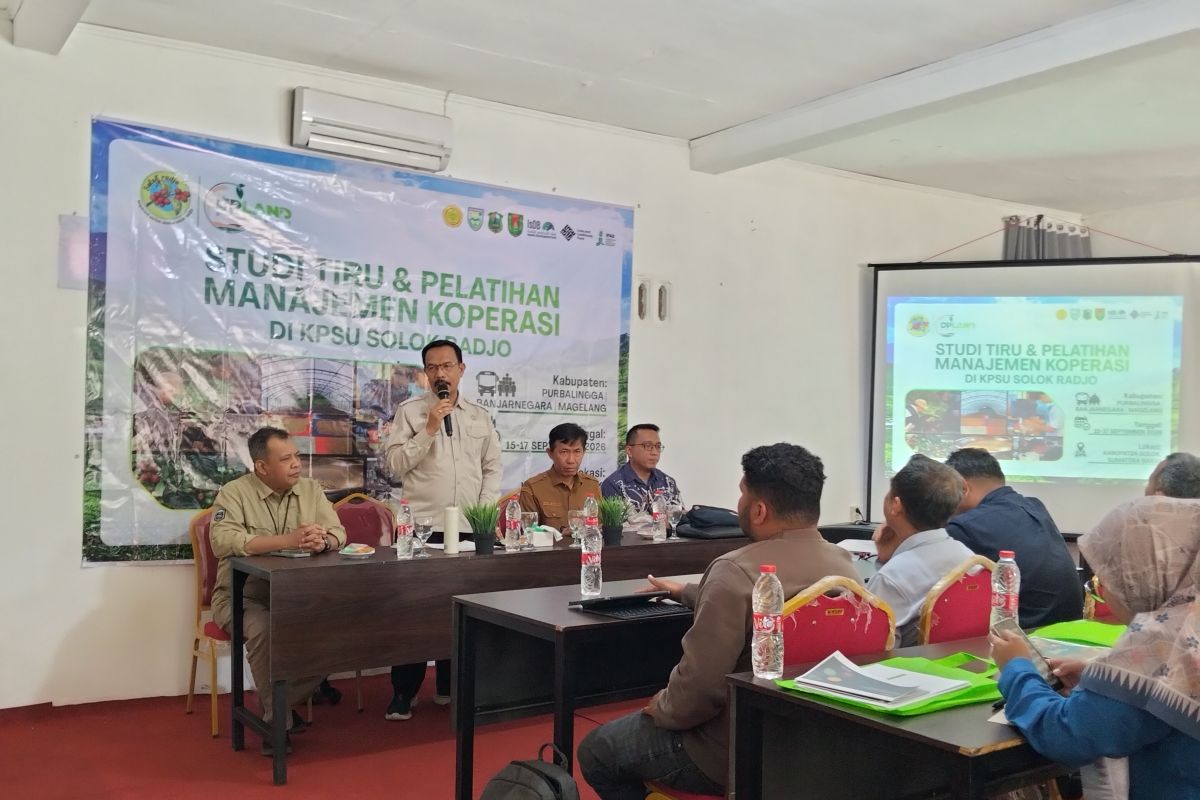
Solok (ANTARA) - The Solok Radjo Cooperative in Solok Regency, West Sumatra, has become a reference for the Ministry of Agriculture in cooperative management learning through the programme The Development of Integrated Farming System in Upland Area (Upland).
Liferdi Lukman, Director of Agricultural Land and Irrigation at the Ministry of Agriculture of the Republic of Indonesia, said in Solok on Tuesday that through the Upland programme, the ministry continues to strengthen farmers’ institutional capacity by nurturing and developing corporate farming cooperatives.
The step is taken so that highland farmers do not only focus on cultivation, but are also able to master the post-harvest, processing and marketing sectors, so that the commodities produced can compete in the global market.
According to him, the government also has a commodity development programme in highland areas that runs in parallel with efforts to strengthen farmer institutions.
He said the Solok Radjo Cooperative attracted the ministry’s attention because it was developed by young people and has been able to manage coffee commodities from upstream to marketing.
“A commodity will develop if it is managed with good management. They must be able to build up the institution,” he said.
The experience of the Solok Radjo Cooperative in building a coffee business chain, he said, is an important lesson for Upland participating cooperatives in developing institutions, increasing product added value and expanding market access.
Elzafina, Head of the Organising Committee for the Benchmarking Study and Cooperative Management Training of KPSU Solok Radjo, said the cooperative was chosen as the benchmarking location because it has experience in developing coffee farming businesses despite land limitations.
“Farmers do not actually have to own their own land, but they must be creative in finding opportunities. One thing the Solok Radjo Cooperative has done is collaborate and work with the forestry sector,” she said.
She noted that the Solok Radjo Cooperative manages around 3,200 hectares of forest area planted with coffee while retaining the existing trees. The model serves as a lesson for other cooperatives in developing agricultural commodities amid limited land.
In addition to land management, the Solok Radjo Cooperative has a well-organised business management system, including daily financial recording and calculations, as well as administration considered to be good.
The cooperative has also diversified its business through the development of tourism, culinary ventures, a coffee factory, a cafe, a restaurant and seven outlets managed through a business entity in the form of a limited liability company.
Furthermore, she said the Upland programme has developed in 14 regencies across seven provinces, with a total of 47 cooperatives.
In the benchmarking activity, nine cooperatives from three regencies attended to learn about the management of the Solok Radjo Cooperative. The participants are agricultural producer cooperatives with different commodities, including coffee, cardamom and pepper.
She hopes participants can adopt the management practices applied by the Solok Radjo Cooperative and adapt them to their respective local conditions so they are able to develop their institutions and cooperative businesses.
Meanwhile, Joni Sandika Putra, Chairman of the Solok Radjo Cooperative, expressed appreciation to the Ministry of Agriculture for choosing his cooperative as the location for the benchmarking study and management training. That trust is a challenge for Solok Radjo to keep improving its capabilities while serving as momentum for learning and growth.
He said the Solok Radjo Cooperative was established in 2012 with a focus on coffee processing and seedling sales. The cooperative began exporting coffee in 2017 and has continued to develop marketing from farmers to consumers by building a coffee ecosystem from upstream to downstream.
The development has had an impact on coffee prices at the farmer level, which have become increasingly competitive. In 2017, the price of cherry coffee was around Rp6,000 per kilogram, whereas currently it reaches around Rp15,000 per kilogram. The Solok Radjo Cooperative now mentors around 580 farmer household heads, down from around 800 before the COVID-19 pandemic.