
Solar Rooftop Installed at Nurul Iman Mosque in Aceh Tamiang to Strengthen Post-Disaster Resilience
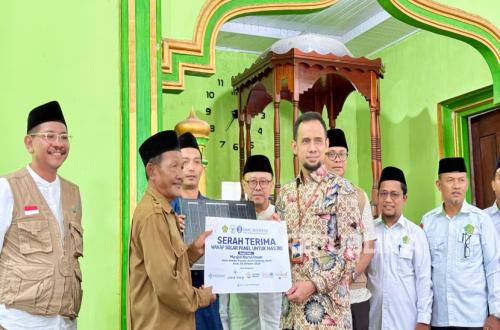
The Indonesian Ministry of Religious Affairs, together with Bank Indonesia and the NUUR+ Consortium, has officially handed over assistance through the Solar Panel Waqf Programme to the beneficiaries of the Nurul Iman Mosque in Kampung Babo, Bandar Pusaka District, Aceh Tamiang Regency, Nanggroe Aceh Darussalam.
This rooftop Solar Power Plant (PLTS) installation, with a capacity of 7,320 Wp, serves as a clean energy solution and strengthens access to reliable electricity in areas prone to natural disasters. Aceh Tamiang Regency, particularly remote areas like Bandar Pusaka District, frequently faces annual threats from natural disasters such as flash floods and landslides, which often lead to disruptions in the main power grid. During disasters, mosques do not merely function as places of worship but also transform into evacuation centres, shelters, and distribution hubs for community aid.
The Director General of Islamic Community Guidance at the Ministry of Religious Affairs, H. Abu Rokertmad, emphasised the importance of this initiative. “The use of solar energy through this waqf collaboration is concrete evidence that eco-theology is a real action. The Ministry of Religious Affairs continues to strive to encourage the emergence of environmentally friendly mosques that are energy-independent, disaster-resilient, and provide broad benefits to the community,” he stated.
Based on data from the Mosque Information System (SIMAS), there are 710,441 registered mosques and prayer rooms nationwide. The Ministry of Religious Affairs aims for 44 per cent of mosques and 28 per cent of prayer rooms to transform into eco-mosques that implement sustainable environmentally friendly principles. Mosques can also be managed as hubs for disaster mitigation adaptation and preparedness.
Disruptions to the electricity supply during emergencies often isolate residents and hinder humanitarian activities. In addition to strengthening disaster resilience, this solar panel system is predicted to generate up to 532 kWh of energy per month, reducing the mosque’s monthly electricity operational costs by up to Rp768,000, and contributing to a reduction of 478 kilograms of carbon emissions.
This programme was realised through the synergy of the NUUR+ Consortium, which consists of various institutions sharing the same vision of promoting energy independence for houses of worship, namely Wakaf Al Azhar, MOSAIC, Enter Nusantara, and Wakaf Salman. Funding for the programme was sourced from donations collected by Bank Indonesia employees, with Enter Nusantara acting as the implementing partner overseeing the installation process and community education.
The Head of the Bank Indonesia Lhokseumawe Representative Office, Yudo Herlambang, stated that Bank Indonesia is playing a part in encouraging inclusive and sustainable economic development in the region. One of the areas being promoted is the strengthening of the Sharia economy and finance, including through the optimisation of waqf potential.
“Productively managed solar panel waqf can support the economic independence of the Ummah, create efficiency, expand social benefits, and ultimately contribute to inclusive and sustainable economic growth,” said Yule.
An Advisory Board member of MOSAIC and Commissioner of the Indonesian Waqf Board (BWI), M. Ali Yusuf, also outlined the great potential behind this movement. He stated, “This collaboration proves that the potential of waqf is very vast. Through cooperation with Bank Indonesia and various partners, waqf now not only impacts the welfare of the Ummah and the prosperity of mosques, but also plays a major role in preserving the earth (hablum minal ’alam). We hope this synergy inspires more parties that protecting the environment and strengthening the economy of the Ummah can be done simultaneously through waqf.”
To ensure the long-term sustainability and reliability of the system, technical training has been provided to the youth and local residents of Kampung Babo. This training equips residents with basic knowledge of daily maintenance, panel cleaning, and handling minor technical issues so that the community can maintain the solar panel facilities independently.
The Village Head of Babo, Khairi Ramadhan, expressed deep appreciation on behalf of the villagers. “We express our greatest thanks for this solar panel assistance. Our area often faces power outages during floods. Having an independent power supply in this mosque not only helps with lighting for worship but also provides peace of mind for residents. Furthermore, with the maintenance training provided to the residents, we are optimistic that we can maintain and utilise this facility to the best of our ability for the long term,” he said.
The monthly electricity cost savings will subsequently be allocated to mosque development activities and community empowerment. Through this initiative, the Nurul Iman Mosque is expected to become a ‘Green Mosque’ role model that is energy-independent, disaster-resilient, and inspires the expansion of the renewable energy waqf movement in other parts of Indonesia. Following Aceh Tamiang, the NUUR+ Consortium aims to expand the benefits of renewable energy waqf to several mosques in North Sumatra and West Java. This step serves as evidence that the synergy of communities and religious institutions can become a vital pillar in accelerating clean energy in the country, contributing to the national target of 100 GW, of which 1 GW is targeted from such initiatives.
Source: jawawa.id (https://jawawa.id/newsitem/solar-rooftop-installed-at-nurul-iman-mosque-in-aceh-tamiang-to-strengthen-post-disaster-resilience-1791413492)
Originally published by Republika (https://rejogja.republika.co.id/berita/tmk4w4291/perkuat-resiliensi-pascabencana-plts-atap-di-masjid-nurul-iman-aceh-tamiang-diresmikan), translated from Indonesian