
Solar Power Can Supply Electricity 24 Hours a Day, as Proven in This Indonesian Region
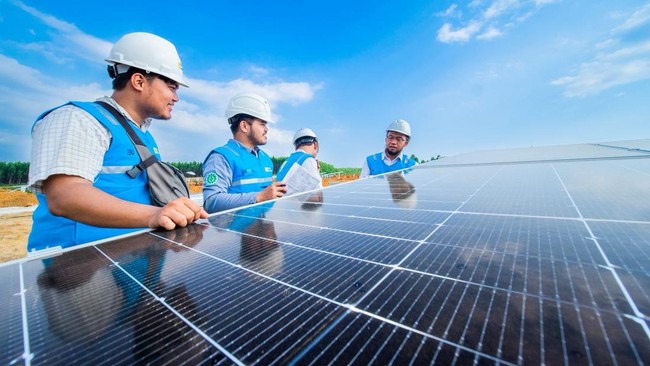
Jakarta — State electricity company PT PLN (Persero) says a solar power plant (PLTS) can reliably operate around the clock in Melaya, Jembrana, Bali.
Combining solar power with a Battery Energy Storage System (BESS) has successfully reduced the use of oil-fired power plants.
PLN Director of Technology, Engineering and Sustainability Edwin Nugraha Putra outlined the success of the 24-hour solar operation at COP31 in Antalya, Türkiye. He said the system captures solar power during the day and stores energy in batteries to supply electricity throughout the day and night.
Before the BESS was introduced, the local electricity network still relied on oil-fired power generation from morning until midday.
With solar power and battery storage in place, some of the electricity generated by the solar plant is fed directly into the system, while the rest is stored in the BESS for use at night.
“This is just an example of what is happening in Bali. From this point, we can see that during the day, starting at 7.30 am, we were still operating oil-fired power plants in Bali, shown in black, until 12 noon,” Edwin said at a CEO Talks event in the Indonesian Pavilion at COP31 in Antalya, Türkiye.
“But by introducing solar power into the system, we can use some of it during the day, while some of it, shown as B, is put into the BESS. We then operate the BESS during the day and at night,” he explained.
Operating the BESS during the day and night allows solar energy to be used steadily for a full 24 hours. The integrated solar and battery system in Bali is intended as a model for electricity systems in other regions.
“This makes it possible for us to feed solar power and BESS into the system for 24 hours. This is an example that we can implement in Bali, in the area known as Melaya, Jembrana, Bali,” he said.
Launched by Prabowo
President Prabowo Subianto officially launched construction of a solar power programme with a total capacity of 100 gigawatt-peak (GWp) on 25 August 2026 in Jembrana, Bali.
Prabowo said the large-scale solar project was expected to provide a key solution for ending imports of crude oil and liquefied petroleum gas (LPG), which weigh on the country’s foreign exchange reserves.
“With 100 GW, we will truly become a nation standing on our own feet. We will not fear developments anywhere in the world. With 100 GW, the geothermal resources we have, the gas fields we have found and rising oil production, we must not import another barrel of oil. God willing, as soon as possible, we must not import a single LPG cylinder either,” Prabowo said at the launch in Bali on 25 August 2026.
He said the 100 GWp target must be completed quickly to reduce dependence on fuel imports used to generate electricity. He also challenged Energy and Mineral Resources Minister Bahlil Lahadalia to accelerate the project, setting a target of completion in less than three years.
Bahlil has said Indonesia’s year-round sunshine gives the country significant potential to generate electricity from solar power. The government plans to build solar plants with a total capacity of 100 GWp across the country.
Bahlil told Prabowo that the megaproject would be carried out on a large scale, with targets divided across the next three years. “Today we are taking a major step towards achieving what the President has consistently directed us to do: national energy self-sufficiency and sovereignty. Indonesia is a country blessed by God with extraordinary resources,” he said at the launch.
As an initial phase, the government broke ground on 5.3 GW of capacity, including 1,000 megawatts (1 GW) in Bali, equipped with battery storage. The Bali project will use state-owned land to speed up construction and enable a shift away from diesel-fired power plants.
“For today, we are breaking ground on 5.3 GW, including 1,000 MW plus batteries for Bali,” Bahlil added.
The electricity generated by the solar plants is expected to cost around US$0.05–0.06 per kilowatt-hour, excluding battery costs.
Bahlil said the 1,000 MW Bali project could help PLN save 600,000 kilolitres of diesel. Bali still relies on diesel-fired power plants, he said.
The Energy and Mineral Resources Ministry estimates that the megaproject will require total investment of US$73 billion, equivalent to more than Rp1,140 trillion.
The government projects that operating the 100 GW solar plants could reduce energy subsidy spending by Rp73.9 trillion a year and create around 5.52 million jobs.
The government will prioritise partnerships with private companies, or independent power producers (IPPs), through a tender process. It is prepared to take over project development through the Daya Anagata Nusantara Investment Management Agency (BPI Danantara) if developers’ bids are not competitive for the state.
Source: jawawa.id (https://jawawa.id/newsitem/solar-power-can-supply-electricity-24-hours-a-day-as-proven-in-this-indonesian-region-1794405174)
Originally published by CNBC Indonesia (https://www.cnbcindonesia.com/news/20261111152640-4-784314/listrik-plts-bisa-dipakai-24-jam-sudah-terbukti-di-daerah-ri-ini), translated from Indonesian