
Sokoguru Policy Series Provides a Platform for Collaboration to Strengthen Energy Security
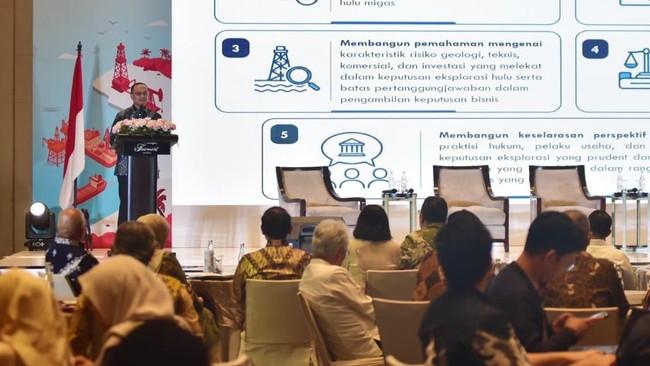
Jakarta, CNBC Indonesia — Discovering new oil and gas reserves is a strategic step towards safeguarding national energy supplies as demand rises. Accelerating exploration requires quality investment, regulatory certainty, technological support and cross-sector collaboration.
These issues were discussed at the Sokoguru Policy Forum, themed “Exploration Emergency: Collaboration Is Essential to Support National Energy Security”, in Jakarta on Wednesday (14 October). Following the successful Sokoguru Policy Forum, public policy discussions are now moving into the next phase through the Sokoguru Policy Series.
The event provides a platform for collaboration among regulators, practitioners, academics and national energy observers. This edition, focused on oil and gas exploration, is intended to generate major ideas, progressive policies and collaborative breakthroughs that can support the continuity of reserves and production, reduce vulnerability in energy supplies, narrow the oil and gas trade deficit and ease the government’s fiscal burden.
Raden Adjeng Sondaryani, Independent Commissioner of PT Pertamina (Persero), said that increasing oil and gas reserves would require breakthroughs such as exploration in frontier areas and deep water, as well as the discovery of new giant fields.
“These discoveries are expected to support energy self-sufficiency and increase added value through domestic downstream processing, in line with the President’s Asta Cita programme,” Adjeng said, according to a written statement on Friday (16 October 2026).
Agung Wicaksono, Pertamina’s Director of Business Transformation and Sustainability, called for stronger governance and investment to address challenges in Indonesia’s upstream oil and gas sector. Well output is declining, while the number of exploration wells drilled remains below target, he said.
“Collaboration is needed to accelerate exploration among regulators, state auditors, legal practitioners, businesses and academics,” Agung said.
The forum also featured a panel discussion with energy-sector experts and stakeholders, including National Energy Council Stakeholder Member Coordinator Satya Widya Yudha; SKK Migas Deputy for Exploration, Development and Working Area Management Rikki Rahmat Firdaus; Searah Muara Bakau Vice-President of Supply Chain Management and Procurement Teddy Wahyu Rahmanto; ReforMiner Institute Executive Director Komaidi Notonegoro; and Amien Sunaryadi, who headed SKK Migas from 2014 to 2018.
The panellists discussed the current state of the oil and gas sector, exploration challenges and ways to accelerate exploration in Indonesia.
Satya Widya Yudha said ASEAN’s position as an exporter of fossil fuels was weakening, while the region’s need for oil imports continued to rise.
“The National Energy Policy provides direction for achieving national energy independence and security, while fulfilling decarbonisation commitments,” Satya said.
He said the situation pointed to a need for more exploration, new reserve discoveries and the optimisation of oil production.
“It is also urgent to accelerate exploration, develop new gas fields and strengthen infrastructure to safeguard national gas supply security,” Satya said.
Rikki Rahmat Firdaus of SKK Migas highlighted the large number of oil and gas basins in Indonesia that remain unexplored. Of the country’s 128 basins, 65 have yet to be explored, he said.
“SKK Migas has launched the Basin to Barrel campaign to accelerate exploration in these basins by providing various facilities,” Rikki said.
Teddy Wahyu Rahmanto, representing oil and gas businesses, outlined the challenges facing exploration in Indonesia.
“Without strong exploration, there will be no sustainable production,” Teddy said.
Amien Sunaryadi, head of SKK Migas from 2014 to 2018, echoed the other panellists, saying exploration was mandated by Article 33(3) of the 1945 Constitution as part of efforts to achieve the greatest possible prosperity for the people.
However, Amien acknowledged that exploration was a high-risk activity and said business decisions needed protection so that risks could be managed without obstructing decision-making.
“Fear of making decisions in the upstream oil and gas sector remains one of the main reasons for the lack of aggressive exploration. Anti-corruption strategies need to be reviewed,” Amien said.
Komaidi Notonegoro, executive director of the ReforMiner Institute, said oil and gas exploration in Indonesia continued to face fundamental obstacles, including complex licensing, regulatory and fiscal uncertainty, and high technical and commercial risks.
“Legal reform is needed, including expediting the passage of the Oil and Gas Law, providing fiscal flexibility, simplifying permits and offering legal protection for good-faith decisions under the Business Judgment Rule,” Komaidi said.
The Sokoguru Policy Forum is intended to continue as a regular venue for collaboration and discussion among practitioners and the national energy community, with the aim of strengthening national energy security.
Source: jawawa.id (https://jawawa.id/newsitem/sokoguru-policy-series-provides-a-platform-for-collaboration-to-strengthen-energy-security-1792126251)
Originally published by CNBC Indonesia (https://www.cnbcindonesia.com/news/20261016110343-4-776766/sokoguru-policy-series-jadi-wadah-kolaborasi-demi-ketahanan-energiri), translated from Indonesian