
Softening words does not change the facts
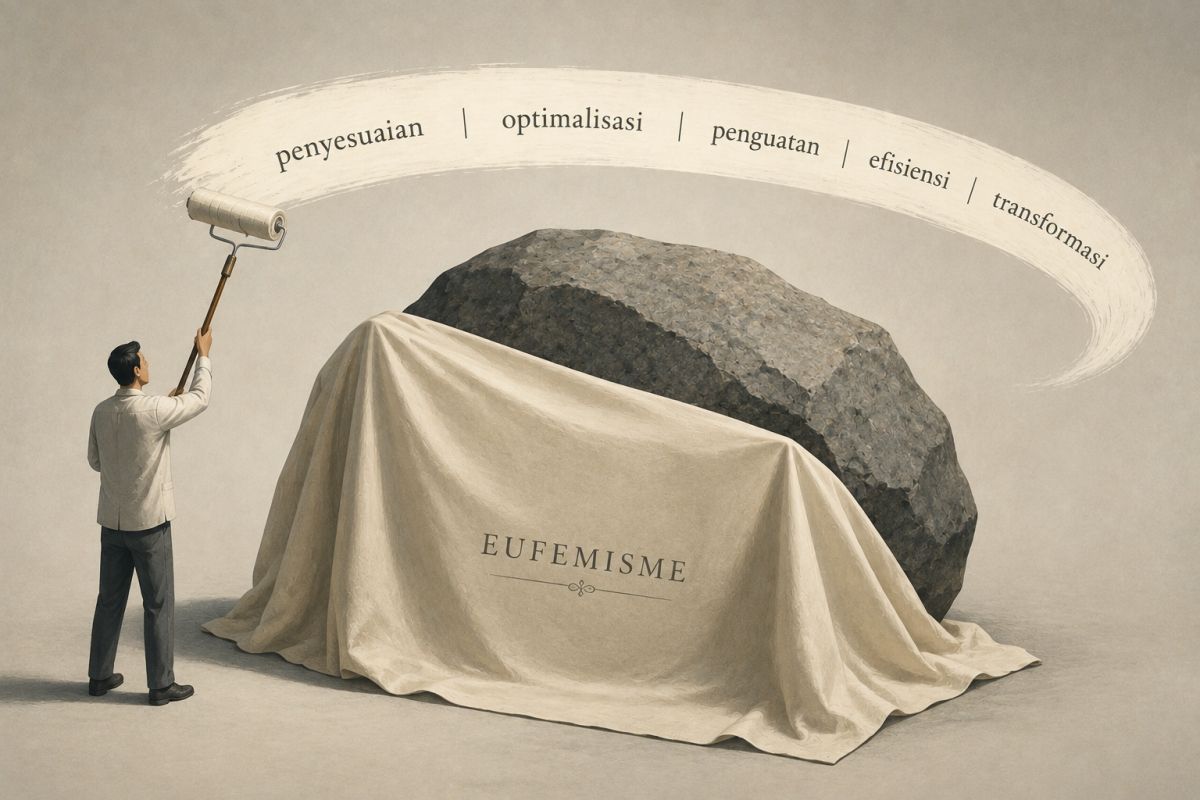
A head of office was asked by a subordinate whether he planned to visit the home of Fulan, an office driver who had just returned from hospital after an accident. The first time he was asked, the head replied, ‘We’ll see later.’ The second time he said, ‘Let him rest first.’ Finally he said, ‘You all go there, represent me.’ All his answers pointed to one thing: no.
At another time and place, a car was hit by a train and its passengers died. Everyone understood that the operator could not be blamed because trains run on dedicated tracks free from other vehicles.
There is a prefix ‘ter-’ in the word ‘tertabrak’. According to Indonesian grammar, that prefix implies an unintentional act. Strangely, the word ‘tertabrak’ is still considered insufficient to represent the train accident incident, so another term emerged: ‘tertemper’.
The car hit by the train was not Fulan’s car. I am not applying the science of forced correlation to link the two different stories — one is merely fictional and the other is a real event.
Besides, it is not the accident itself that I wish to highlight here, but the way we use language. Word choice can determine whether a speaker’s intention is interpreted the same way or differently by the listener or reader.
The word ‘tertemper’ does not exist in the KBBI (the official Indonesian dictionary). It is a special term used by KAI (Indonesian Railways) in its official statements and reports. Its meaning is the same: hit. I do not quite understand whether its similarity in form to ‘tertampar’ (slapped) indicates a semantic relation.
From the story about Fulan and the car hit by a train, we can see how humans are faced with a dilemma when using language. We find it difficult to choose between speaking honestly even if bitter, or lying sweetly.
In certain situations, speaking frankly is indeed riskier than boasting.
I used to be pleased when a friend said ‘you are a bit more handsome’ than the boss. Even though perhaps what he meant was that the boss’s handsomeness was greater than mine. Fortunately, my boss now is a woman.
In everyday communication, we often say things that should not be interpreted literally.