
Soekarno Foundation: Digital space is the geopolitics of the 21st century
Jakarta (ANTARA) – Rommy Soekarno, chairman of the board of trustees of the Soekarno Education Foundation, has warned young people, particularly Generation Z, that the geopolitical landscape of the 21st century has undergone a fundamental shift: from competition over territory and conventional military power to competition over digital space.
“The world is changing. Geopolitics today is no longer just about territorial disputes, military power or energy resources. Global competition has entered two new domains: digital space and outer space. This is the geopolitics of the 21st century,” Rommy said in a statement in Jakarta on Wednesday.
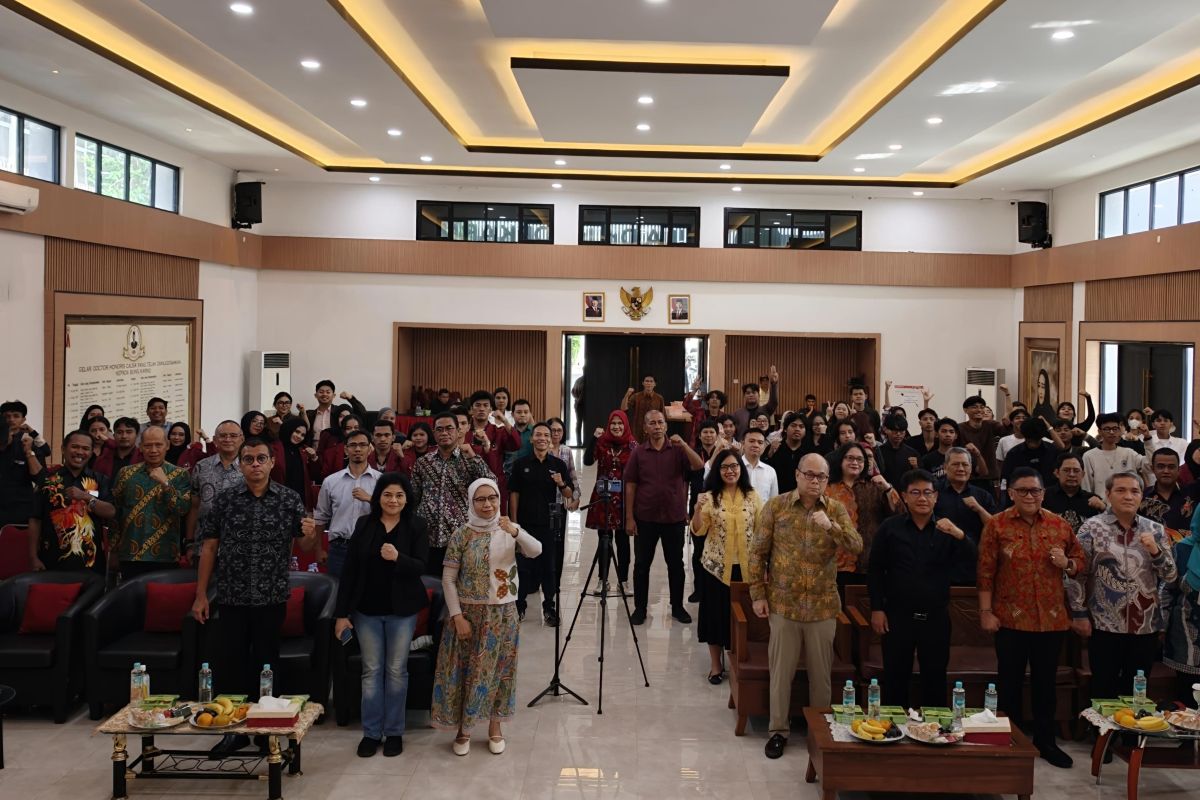
He made the remarks while speaking at a geopolitical literacy training session for Gen Z, entitled “Understanding the World, Strengthening Indonesia”, at Soekarno Hall on the campus of Bung Karno University (UBK) in Cikini, Central Jakarta, on Wednesday.
On the first issue, digital sovereignty, Rommy highlighted data ownership, artificial intelligence (AI), semiconductors and computing infrastructure, which have become key sources of national power.
He issued a strong warning that Indonesia must not lose control of its domestic technology and information assets amid the dominance of global platforms.
“The question is simple: who controls our data? Who controls our technology? And who controls Indonesia’s digital infrastructure? Indonesia must not be geographically independent but digitally subjugated,” he said.
Rommy called for stronger national technological capacity, including cyber resilience, independent command of big data and integrated research in artificial intelligence.
On the second pillar, he highlighted space geopolitics, as thousands of low-orbit satellites increasingly circle the Indonesian archipelago.
Although they offer significant benefits to telecommunications and defence, the presence of foreign satellite constellations requires strict protective regulation to safeguard communications confidentiality and national security.
“Under international law, outer space cannot be claimed as a country’s sovereign territory. However, Indonesia must still protect its national interests through its own technology, regulations and space capabilities,” Rommy said.
In response to these two challenges, Rommy stressed that Gen Z has a crucial role to play and should not regard itself merely as passive consumers or target markets for multinational corporations.
“Indonesia must not be merely a market for the world’s technology. It must become a creator and developer of technology. We need young people skilled in AI, political science, international law, satellite technology and the digital economy,” he said.
He also urged UBK’s academic community to apply Bung Karno’s Trisakti principles—political sovereignty, economic self-reliance and cultural identity—to modern technology, helping to produce a new generation of “young Soekarnos”.
“True independence is not only the ability to defend territory, but also the ability to determine the nation’s future through science and technology. Indonesia must not remain sovereign on Earth while losing control of its future in digital space and outer space,” Rommy said.
At the same event, Andi Widjajanto, who served as governor of the National Resilience Institute (Lemhannas) from 2022 to 2023, discussed technological disruption, including quantum computing and the “black swan” theory of uncertainty.
Andi said global economic and geopolitical competition today is driven by artificial intelligence. However, the world is approaching the Q-Day era, predicted to arrive between 2031 and 2037, when high-speed quantum computers could crack conventional security codes worldwide.
“Q-Day means quantum computing with super-fast processing power, so every code in use today—including personal passwords for email, WhatsApp and your friends’ GoPay accounts—could be broken. At that point, every code is breakable,” Andi said.
The former Cabinet Secretary explained that when Q-Day arrives, existing hardware, motherboards and encryption technologies will no longer be relevant and will have to be replaced by optical quantum technology.
He cited neighbouring Singapore, which has invested US$50 million a year in funding a quantum laboratory at the National University of Singapore (NUS), led by an Indonesian scientist.
Speaking to UBK students, Andi linked this technological leap to Gen Z, who he said had been born into a world repeatedly shaken by unexpected crises, or “black swan” events. These include the 2001 World Trade Center attacks, the 2008 global financial crisis, the 2020 Covid-19 pandemic and the current threat of an energy war.
“Gen Z was born as these black swans were flying, born in difficult times. That is why learning and mastering science and technology will require much greater effort in the future,” Andi said.
He urged UBK students not only to master digital technologies such as AI, but also to take on the historic responsibility of completing the country’s democratic agenda.
Andi reflected on the previous generation’s shortcomings: Generation X had initiated the 1998 Reformasi movement but had failed to complete the consolidation of democracy.
“Generation X succeeded in initiating reform, but we failed to complete it; suddenly, reform took a turn. That is my generation’s debt. I hope it will be you, Generation Z, rather than us, who complete democratic consolidation. UBK, bearing Bung Karno’s name, must be at the forefront,” Andi said.
The training session was also attended by UBK lecturer Hasto Kristiyanto, secretary-general of the Indonesian Democratic Party of Struggle (PDI-P) and the event’s initiator.
Other speakers included Bonnie Triyana, a member of Commission X of the House of Representatives; Margaretha Hanita, a lecturer and researcher at the Republic of Indonesia Defence University; and UBK student respondents Kurnia Aryasatya and Chrisostomos Inuhan.
Source: jawawa.id (https://jawawa.id/newsitem/soekarno-foundation-digital-space-is-the-geopolitics-of-the-21st-century-1793804001)
Originally published by Antara (Indonesian) (https://www.antaranews.com/berita/5832403/yayasan-soekarno-ruang-digital-adalah-geopolitik-abad-ke-21), translated from Indonesian