
SOE Agency Deputy: ESG Is Not Just a Business Strategy but Part of National Resilience
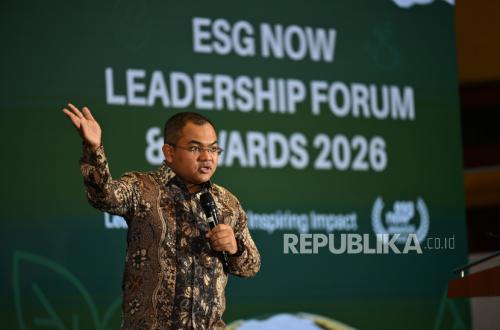
JAKARTA — Tedi Bharata, deputy head of the SOE Regulatory Agency, said the adoption of environmental, social and governance (ESG) principles was important not only for corporate sustainability but also for Indonesia’s national resilience. Sustainability, he said, should be viewed more broadly as part of the nation’s Business Continuity Plan (BCP).
“ESG is the BCP of this nation because state-owned enterprises are part of its corporations. BCP is very important in ensuring that a corporation can continue operating when disruption occurs,” Tedi said at the ESG Now Leadership Forum and Awards 2026, organised by Republika at Hotel Borobudur in Jakarta on Monday (19 October 2026).
Tedi said BCP was generally understood as a tool for ensuring that corporations continued to operate when facing disruption. However, he said the concept was also relevant to the life of the nation.
Indonesia must ensure that business processes and economic activity continue during various disruptions, he said. One example is geopolitical volatility in the Strait of Hormuz, which could affect oil supplies and, in turn, the economy.
“How can this country remain sustainable and continue its business processes if disruption occurs? What I am saying today is that sustainability and ESG are an important part of Indonesia’s national BCP,” Tedi said.
He said such circumstances underscored the importance of building energy resilience by making use of domestic natural resources. Indonesia has abundant resources that should be optimised to reduce dependence on imported energy, he said.
He cited the development of palm oil into biofuel and biodiesel, as well as the use of maize, sugar cane and cassava as energy feedstocks. These commodities, he said, could provide a foundation for strengthening national energy resilience.
“Whereas we used to have to import energy, in the future we can simply grow it. Cassava, maize and sugar cane have been around for a long time, but only now are we beginning to pay greater attention to how what we have can become a bulwark for national energy resilience,” Tedi said.
However, Tedi cautioned that moving from import dependence to stronger use of domestic resources would take time and require the development of an ecosystem. The government and SOEs needed time to increase production of commodities that had not previously been a major focus of the energy supply chain, he said.
“When we do something new, after being used to importing and receiving finished goods, and are suddenly required to change, we have to build the ecosystem. We need to produce more maize and cassava, because they were not previously a major focus. That is not easy,” Tedi added.
He therefore urged all parties to give the government and SOEs time to carry out the transformation. Many SOEs are involved in the supply chains for energy-resilience programmes, he said, making collaboration essential.
Tedi also highlighted changing attitudes among younger generations towards sustainability. Drawing on his previous experience in charge of human resources at SOEs, he said more prospective employees were considering a company’s ESG commitments before deciding where to work.
He recalled SOE recruitment drives, including outreach to LPDP scholarship recipients studying overseas. During interviews, candidates were given the opportunity to ask questions about the companies.
“What do these young people ask? Many are now asking: what are the company’s sustainability programmes? What are its ESG efforts?” Tedi said.
That interest showed that sustainability had become part of young people’s mindset, he said. Candidates from a range of academic backgrounds were also becoming familiar with sustainability and green accounting.
“What does that mean? Companies must make sustainability an important part of their business strategy,” he added.
Tedi said companies without a commitment to sustainability would find it increasingly difficult to attract top talent. By contrast, companies able to make ESG part of their business strategy would be more appealing to younger people.
Alongside environmental issues, Tedi stressed the importance of including human rights in the implementation of ESG. He welcomed the forum’s discussion linking ESG and human rights, saying the issue needed attention from companies, including SOEs.
Tedi called on the private sector, SOEs, central government and local governments to strengthen collaboration in promoting sustainability. He said he was optimistic that collective action on sustainability could reinforce Indonesia’s national resilience.
“God willing, if this is done together with the government, national resilience for Indonesia can become a reality, including independence and resilience in energy and the economy,” Tedi said.
Source: jawawa.id (https://jawawa.id/newsitem/soe-agency-deputy-esg-is-not-just-a-business-strategy-but-part-of-national-resilience-1792497083)
Originally published by Republika (https://esgnow.republika.co.id/berita/tn7eo9490/bp-bumn-esg-bukan-sekadar-strategi-bisnis-tapi-bagian-dari-ketahanan-nasional), translated from Indonesian