
Social Minister: People's Schools Part of Major Strategy to Eradicate Poverty
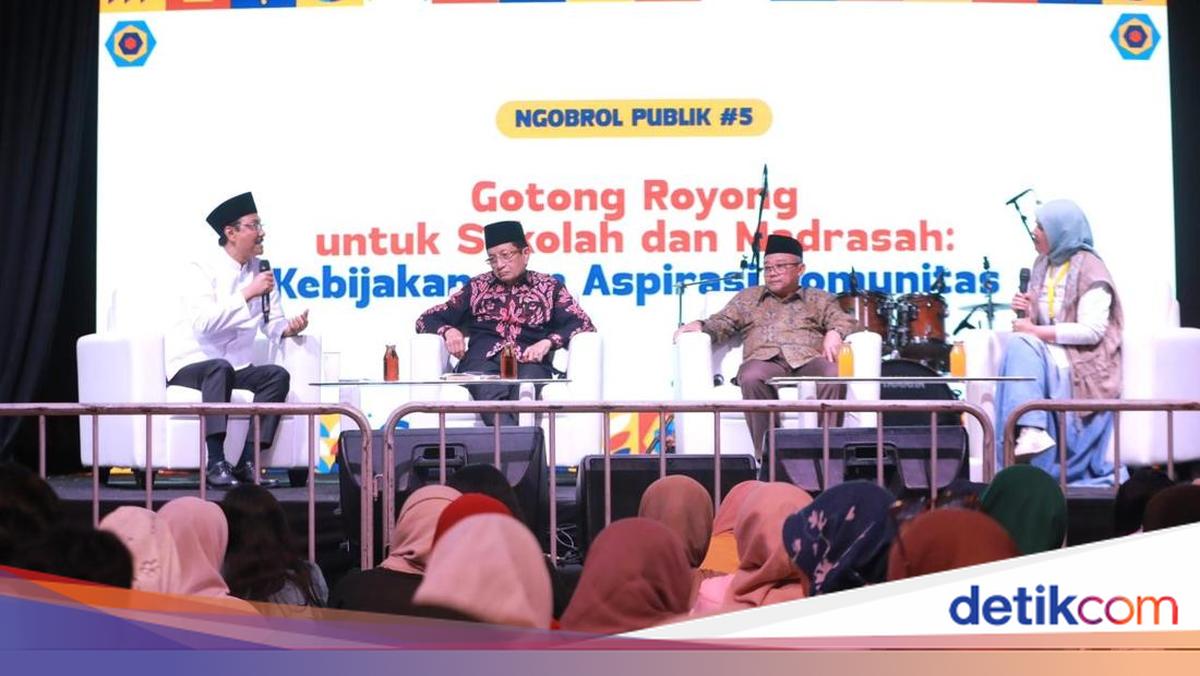
Responding to these challenges, Social Minister Saifullah Yusuf, or Gus Ipul, on National Education Day (Hardiknas), emphasised that the state must be present through comprehensive interventions down to the family level, prioritising the spirit of gotong royong.
This was conveyed by Gus Ipul while attending the Belajaraya forum with Teman 2026, themed ‘Celebrating #KerjaBarengan for an Education Ecosystem’ at Taman Ismail Marzuki on Saturday (2/5/2026).
In the session Ngobrol Publik #5: Gotong Royong for Schools and Madrasahs: Community Policies and Aspirations, Gus Ipul stressed that the People’s Schools programme is a strategic step to reach the most vulnerable groups.
“People’s Schools are part of the major strategy for poverty eradication. We are not only intervening in the children, but also their families. The hope is that when the children graduate, their families will also advance,” said Gus Ipul in a written statement on Sunday (3/5/2026).
He explained that a family-based approach is key to breaking the intergenerational chain of poverty, which has long been one of the root causes of educational issues.
“There are millions of children who are invisible in the system. They are invisible people. They might be around us, but they are not reached by programmes,” said Gus Ipul.
According to him, People’s Schools are positioned as a booster from the very bottom layer to systematically narrow educational disparities.
“If we talk about good education standards, they are certainly high. But how can everyone reach them? The answer is gotong royong. People’s Schools become an instrument to lift from below,” he stated.
Gus Ipul also highlighted new education challenges in the technology era. On one hand, Indonesian children are digital natives, but on the other, there are still access and readiness inequalities.
“We have no choice but to adapt to technology. But with budget limitations, gotong royong is a necessity. The government cannot work alone,” he said.
He emphasised that spaces for public participation must be opened as widely as possible so that policies do not stop at the central level but are truly felt down to the grassroots.
Meanwhile, Minister of Basic and Secondary Education Abdul Mu’ti emphasised that learning success is greatly determined by the environment.
“Almost all learning theories show that learning success is influenced by the environment. A clean learning environment and a comfortable social environment are key,” he said.
He added that bureaucracy must be able to ‘feel the gap’ or fill the gaps that have not been reached, by harnessing community strength.
“The DNA of the Indonesian nation is gotong royong. The challenge is how to mobilise and unite that strength,” he revealed.
On the other hand, Minister of Religious Affairs Nasaruddin Umar highlighted the importance of revitalising madrasahs and strengthening religious education.
According to him, despite facility limitations, madrasahs and pesantren still play a major role in producing quality generations and strengthening communal values.
“Educational institutions that most actualise gotong royong values are madrasahs and pesantren. Around 95 percent are managed privately, and they remain resilient through community strength,” he concluded.
Source: jawawa.id (https://jawawa.id/newsitem/social-minister-peoples-schools-part-of-major-strategy-to-eradicate-poverty-1777776736)
Originally published by detikcom (https://news.detik.com/berita/d-8472024/mensos-sekolah-rakyat-bagian-strategi-besar-pengentasan-kemiskinan), translated from Indonesian