
Social Assistance to Use Facial Scan Technology, State Set to Save Billions
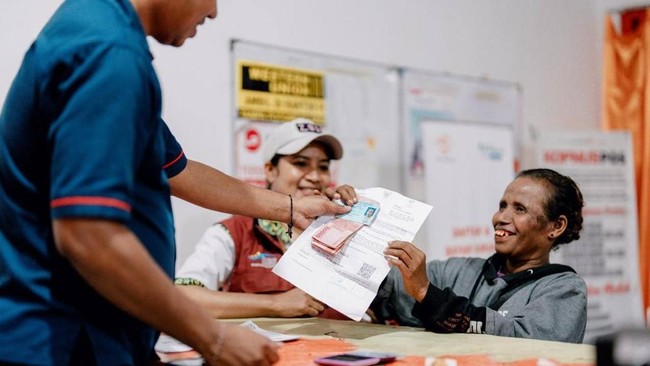
National Economic Council (DEN) Chair Luhut Binsar Pandjaitan has proposed transforming social assistance (bansos) distribution by leveraging artificial intelligence (AI) and integrated government data. According to him, this move can improve the efficiency of the State Revenue and Expenditure Budget (APBN) while ensuring aid is more accurately targeted.
Luhut said the government’s experience identifying various issues through data processing in Banyuwangi has strengthened his conviction that AI utilisation can generate significant efficiencies in state budget management. He assessed that future bansos distribution should no longer focus on subsidising goods, but rather go directly to individuals truly in need, based on government data calculations and mapping.
“So, for example, if this bansos is on target, and then we later provide it not as a subsidy for goods, but as a subsidy for people calculated by the Minister of Social Affairs, that is roughly 5.4 million rupiah,” Luhut said during his speech at the Indonesia Ethical AI Summit in Jakarta, Wednesday (17/6/2026). “But if we keep giving that bansos, then they will become lazy,” he added.
According to him, the government needs to design a scheme that does not make bansos recipients dependent on state aid in the long term. Therefore, the collected data can be used to map citizens with the potential to move up the economic ladder and become entrepreneurs. Luhut explained that aid recipients deemed eligible for entrepreneurship could be grouped into new micro, small, and medium enterprises (UMKM) and gain access to financing through People’s Business Credit (KUR). With more accurate data support, the risk of non-performing loans (NPL) is also believed to be suppressible.
“With the existing data, we can group them later, so they become new UMKM, we can give them KUR, perhaps through a Sharia bank, and the NPL will be lower. Why? Because these people have been profiled by the data as qualified to do this,” he explained. He assessed that this approach not only helps reduce dependency on bansos but also opens up new job opportunities.
Luhut outlined that a digital-based system also prevents various forms of fraud that have frequently occurred. For instance, social protection fund distribution has often been exploited for the interests of certain parties, such as village head candidates. As a result, many residents who should not be eligible for aid ended up receiving it.
“Because previously it was possible. You are not qualified, but ‘Yes, I can arrange it, but vote for me.’ Now you can no longer do that. Why? They have the right, they just use face recognition. It will immediately be known whether they are qualified or not. I think this self-registration, account nomination, sick people, everything on this slide, if you look at it, this can also be implemented,” Luhut said.
The programme, which was piloted in Banyuwangi, is now being implemented in 42 regencies and will then be rolled out nationally in October or November. Luhut stated that the only remaining challenge is the cost of infrastructure, particularly data centres.
“The issue now, yesterday I spoke with Telkom and the team, is the data centre. How do we handle this now? We thought, why not just use Telkom? So no more money is spent. Telkom just does business, the government supports it because the goods belong to the government, rather than building a new one,” he said.