
Social Assistance on Target Thanks to Connected Data
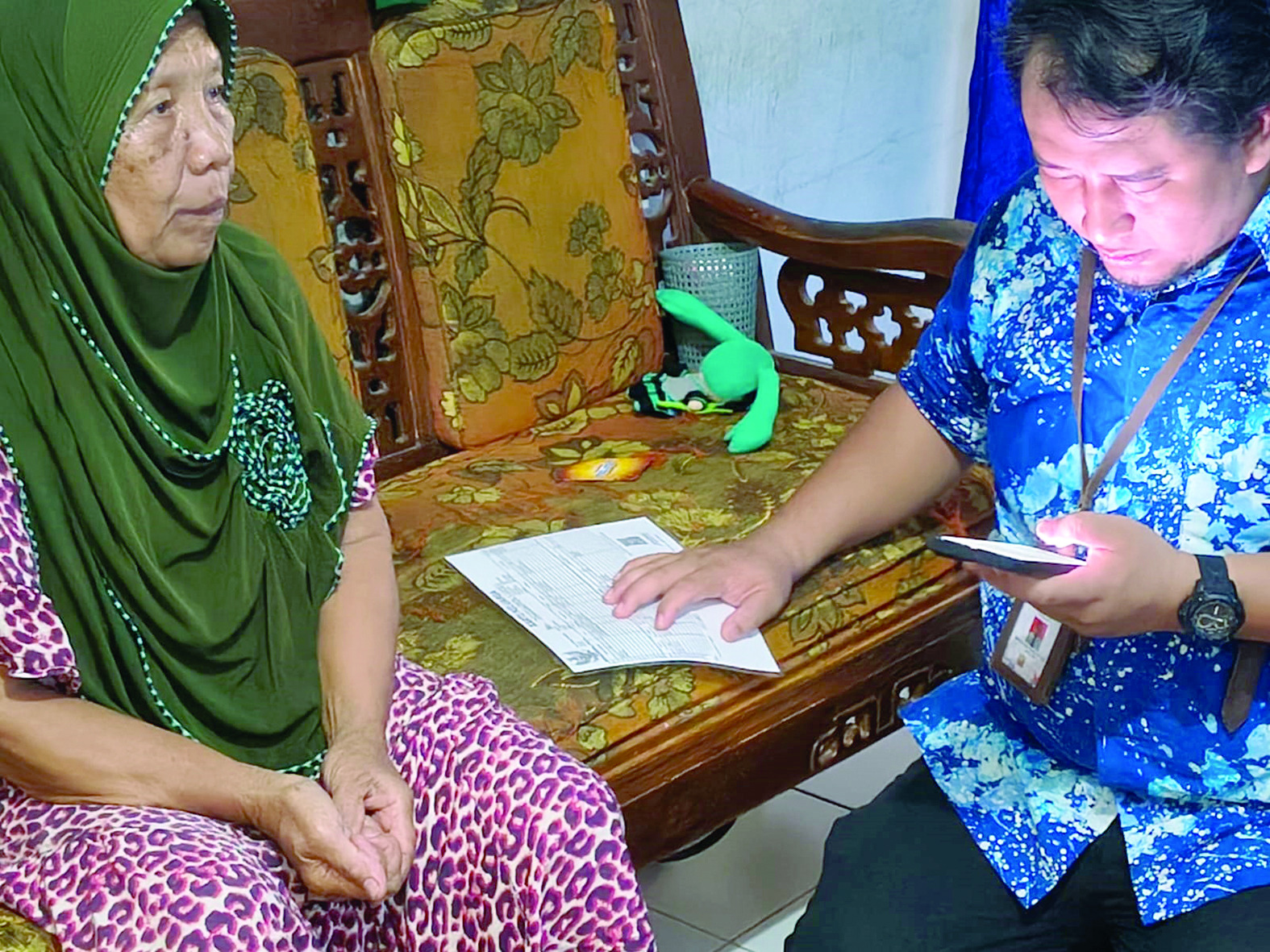
Stories still circulate about social assistance being received by well-off citizens, while those truly in need are overlooked. This issue is not merely about distribution but originates from data that is not yet fully accurate and connected.
Through the Digital Social Protection (Perlinsos) Programme, the government is building a system that integrates data from various agencies to ensure aid recipients can be verified more accurately. With interconnected data, the social assistance distribution process becomes more transparent, faster, and increasingly on target, so that aid is genuinely received by entitled citizens.
This change is beginning to be felt on the ground. In Segobang Village, Licin District, Banyuwangi, Perlinsos facilitator Sucipto said the new system makes the recipient verification process far more objective. Citizen data no longer relies solely on administrative reports but is also verified through integration with various institutions, such as banks, the National Land Agency (BPN), the vehicle registration authority (Samsat), and the state electricity company (PLN).
The system helps reduce errors that have long been a point of contention. Citizens who own assets but were still registered as aid recipients can be identified, while people previously absent from the database now have a greater chance of obtaining their rights according to their actual economic conditions.
Digitalisation also brings transparency to every stage of verification. When changes in economic conditions or asset ownership are found, the data can be updated so that aid distribution is more in line with the real situation of the community.
However, this transformation is not without challenges. In several regions, limited internet access and low digital literacy remain obstacles. Therefore, the presence of Perlinsos agents is a crucial part of the transformation process. They assist the community, especially the elderly, with registration, data updates, and ensuring the entire process runs smoothly.
Hairul, a resident of Segobang Village, has experienced this assistance firsthand. This year, his family was registered as social assistance recipients for the first time after their data was entered into the Digital Perlinsos system. For Hairul, the aid is not just additional income; it helps meet his children’s school needs and his toddler’s requirements. This experience shows that when data is more accurate, aid has a greater chance of reaching families who truly need it.
Behind this change, the Ministry of Communication and Digital Affairs (Komdigi) plays a role in providing the data integration system that forms the foundation of Digital Perlinsos. Data from the Civil Registry (Dukcapil), the Ministry of Agrarian Affairs and Spatial Planning (ATR/BPN), Samsat, the Traffic Corps (Korlantas), the Social Security Agency (BPJS), and various other ministries and institutions are combined as a verification reference for field officers.
Director General of Public Communication and Media at Komdigi, Fifi Aleyda Yahya, emphasised that the digitalisation of social assistance is not merely about moving a manual process to a digital application. “This is a governance reform to strengthen accuracy, increase transparency, and ensure aid is on target. Komdigi’s role here is to provide data-related services,” she stated.
With the integrated system, the citizen verification process can now be carried out much faster than before. In fact, the registration process can be completed in just a matter of minutes if there are no objections or data changes.
The success of the trial in Banyuwangi illustrates that digital transformation not only delivers more modern services but also improves the quality of public services. When data becomes more accurate and connected, social assistance is no longer just distributed, but genuinely reaches those who need it most.
Head of the Government Communication Body (Bakom) of the Republic of Indonesia, Muhammad Qodari, assessed that the digitalisation of social protection is key to realising justice in the distribution of social assistance to the public. “We came to Surabaya to see firsthand President Prabowo’s strategic government programme, namely the Digitalisation of Social Assistance. This programme is intended so that the very large social protection budget truly reaches the target precisely and fairly,” Qodari said.
Qodari, who directly reviewed the implementation of the Social Protection Digitalisation programme in Tambaksari District, Surabaya, noted that the social protection budget, which reaches approximately Rp1,300 trillion or nearly 30 percent of the state budget (APBN), must be accompanied by a system capable of guaranteeing fair aid distribution for all citizens. According to him, the digitalisation of social protection is an important government step to improve aid distribution governance through the use of technology and cross-ministerial and institutional data integration.
Qodari explained that social assistance distribution has so far faced problems, including the existence of citizens who are not entitled but are registered as recipients, while some eligible citizens have not yet been recorded. Therefore, he hopes digitalisation can ensure that the process of data collection and determining aid recipients is carried out based on objective data, so that aid is received by citizens who are truly entitled. “We see that the implementation is almost complete. God willing, in one to two days all heads of households in Surabaya will be registered,” he said.
As of 28 July 2026, Surabaya City is the region with the highest data collection achievement, reaching 99.82 percent of the total 1,001,688 heads of households. Qodari appreciated the collaboration of various regional apparatuses, which he said made the data collection process run quickly and effectively.