
Social Affairs Minister Weighs Expanding Health Premium Assistance to Decile 8, Covering 80% of the Population
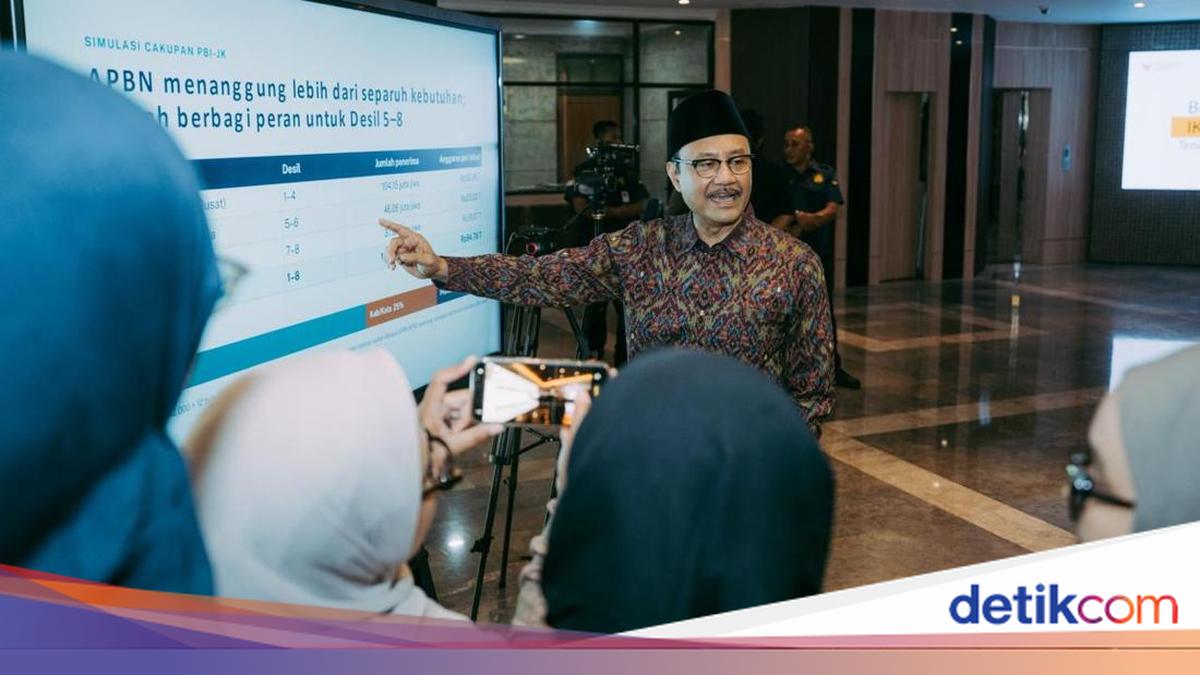
Social Affairs Minister Saifullah Yusuf, known as Gus Ipul, said the government was studying an expansion of the Health Insurance Contribution Assistance scheme (PBI-JK) to include people up to Decile 8 in the National Unified Social and Economic Data (DTSEN).
In simple terms, Deciles 1–8 represent 80 per cent of the population when people are divided into ten equally sized groups by welfare level, starting with the least well-off. This does not mean that everyone in those deciles would automatically receive government assistance with their insurance contributions.
The plan aims to broaden health protection beyond people living in poverty to include economically vulnerable groups who are not yet financially secure.
“Families should not lose their savings, fall into debt or become poor simply because of one serious illness. That is why health protection must reach people who remain vulnerable,” Gus Ipul said in a statement on Thursday (5 November 2026).
He said central government assistance with health insurance contributions had so far been prioritised for poor and disadvantaged people. In practice, however, households above Decile 5 also face economic risks when a family member suffers a serious illness.
This is particularly relevant because an update to the DTSEN in early 2026 led to more than 11 million PBI-JK participants being deactivated, mostly after their welfare status shifted to Deciles 6–10.
“Someone who is not classified as poor today is not necessarily able to afford everything. Faced with a serious illness and high medical costs, they could become poor again. That is what we want to prevent,” he said.
The PBI-JK quota financed through the state budget (APBN) currently stands at 96.8 million people. According to the DTSEN, however, poor and vulnerable people still need health insurance protection.
Gus Ipul said the government was modelling how to divide the financing responsibilities among central, provincial and regency or municipal governments.
Under one proposal, the state budget would cover people in Deciles 1–4, regency and municipal budgets (APBD) those in Deciles 5–6, and provincial budgets those in Deciles 7–8. The division has not been finalised. The government is still considering the fiscal capacity of each region and whether the arrangement should be introduced gradually.
“This is still at the simulation stage. We are discussing how responsibilities between the central and regional governments can be divided more fairly, measurably and sustainably. Expanding protection must not create a burden that regions cannot afford,” he said.
The discussions involve the Finance Ministry, Health Ministry, Home Affairs Ministry and BPJS Kesehatan. Gus Ipul stressed that extending coverage to Decile 8 would not mean that everyone in those groups automatically qualified for government assistance with their contributions.
Each prospective recipient would still be subject to data matching, verification and validation. People whose contributions are the responsibility of their employers—including civil servants, members of the Indonesian National Armed Forces (TNI) and National Police (Polri), and private-sector wage earners—would not be covered by government funding under the scheme.
“The principle is that assistance must reach the right people. Companies must continue paying contributions that are their responsibility. We must protect those who need government assistance. Everything will be based on data that is continuously updated,” Gus Ipul said.
He added that the DTSEN would enable the government to allocate responsibilities more clearly and reduce overlapping funding between central and regional administrations.
The government aims to complete the DTSEN update by the end of 2026. A new budget scheme is expected to be proposed in 2027, in line with President Prabowo Subianto’s direction. Its implementation date will depend on regulatory and budgetary readiness.
Gus Ipul said the proposed transition arrangements prioritised continuity of protection. Current active participants are expected to retain health coverage until the transfer of financing is complete. Meanwhile, inactive participants in Deciles 1–4, particularly those with chronic or catastrophic illnesses, would be prioritised for reactivation.
“People must not lose protection simply because of administrative changes or a transfer of financing. Health services for the public must continue,” he said.
He added that expanding PBI-JK coverage was also expected to support the long-term financing of BPJS Kesehatan and provide greater certainty for healthcare services.
With more stable membership, community health centres and other health facilities could place greater emphasis on early screening, disease prevention and support for patients with chronic conditions.
“Our aim is not merely to help people when they are ill, but also to keep the public healthy. Health protection must be part of efforts to prevent poverty,” Gus Ipul said.
He said the ultimate goal of the reforms was to achieve Universal Health Coverage (UHC), providing sustainable health insurance protection for the entire population.
Source: jawawa.id (https://jawawa.id/newsitem/social-affairs-minister-weighs-expanding-health-premium-assistance-to-decile-8-covering-80-of-the-population-1793879584)
Originally published by detikcom (https://news.detik.com/berita/d-8739984/mensos-kaji-perluasan-pbi-jk-hingga-desil-8-jangkau-80-persen-penduduk), translated from Indonesian