
Social Affairs Minister Urges Neighbourhood Leaders to Improve Social Assistance Data
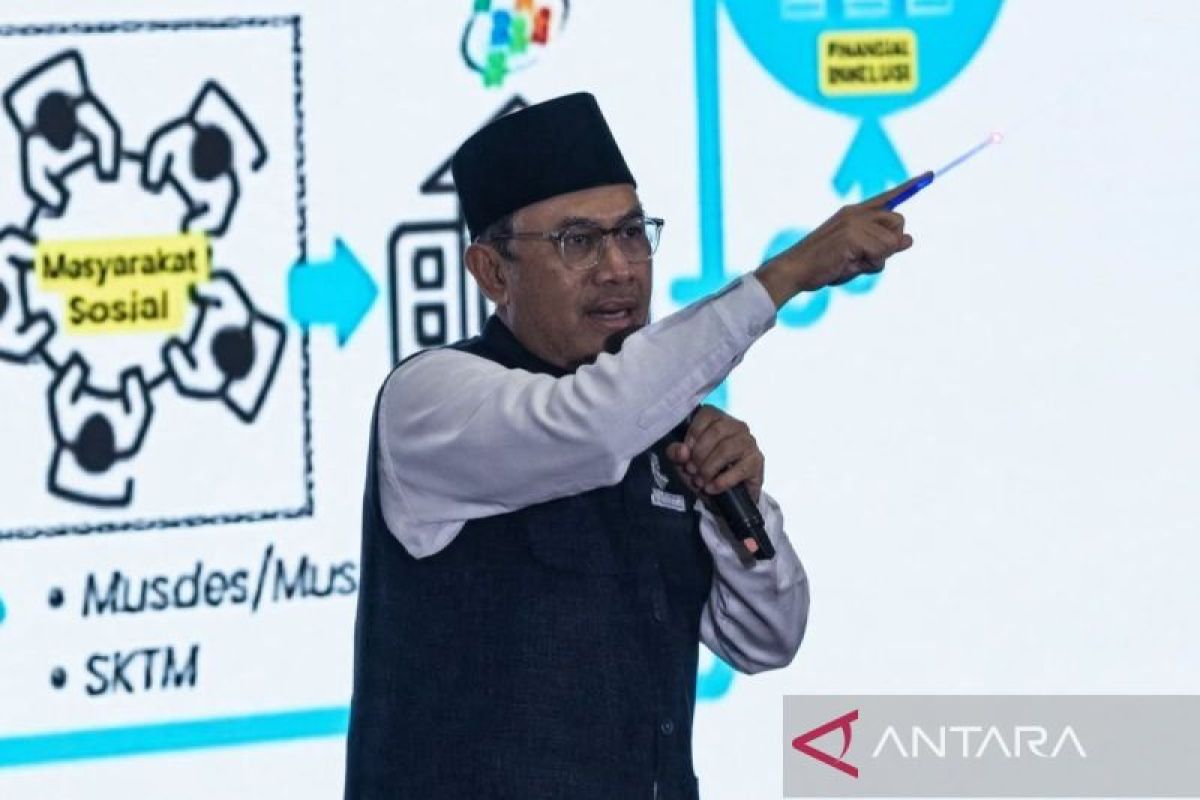
Purwokerto (ANTARA) – Social Affairs Minister Saifullah Yusuf, widely known as Gus Ipul, has urged neighbourhood (RT) and community (RW) leaders to work with local governments to improve the accuracy of social assistance (bansos) recipient data so that aid reaches the intended beneficiaries.
Speaking at a briefing on expanding outreach for Sekolah Rakyat and social protection at Sasana Krida, Satria Sports Centre, in Banyumas regency, Central Java, on Sunday evening, he said improving the data was the first step in ensuring that people in need received social protection and security from the government.
“The President has called on us to start by improving the data, making it a single, unified dataset, and turning this into a shared effort. Let us begin our work with the data,” he said before representatives of neighbourhood and community associations, social protection agents, village officials, social sector workers and other participants.
He said addressing poverty and the needs of neglected children was mandated by Article 34 of the 1945 Constitution, covering social protection and security, social rehabilitation and social empowerment.
Gus Ipul said a Social Affairs Ministry evaluation found that around 45% of data on recipients of the Family Hope Programme (PKH) and staple-food assistance was considered inaccurate.
To address the problem, the government issued Presidential Instruction No. 4 of 2025, mandating the integration of various socioeconomic datasets into the National Single Socioeconomic Data (DTSEN), managed by Statistics Indonesia (BPS).
Data updates are carried out through formal channels, from neighbourhood and community associations to village or sub-district administrations and BPS, as well as through public participation via the Cek Bansos application.
Members of the public can also submit proposals and objections through the service hotline on 021-171 or WhatsApp on 08877-171-171.
The updated data will be grouped into 10 deciles according to socioeconomic welfare, with decile 1 representing the 10% of the population in the worst economic circumstances.
The minister also introduced Digital Social Protection, which links recipient data with various government databases, including population, land and electricity records, as well as those of BPJS Health and BPJS Employment.
The system includes biometric verification using facial recognition to ensure assistance reaches eligible recipients.
He cited a 2025 trial in Banyuwangi regency, where around 80% of residents had been entered into the system. The government is also developing social protection agents to help people register.
“We need many social protection agents to help people in their neighbourhoods. It is called the National Movement to Care for Neighbours. Those closest to us must not be overlooked,” the minister said.
Sekolah Rakyat
In his remarks, Banyumas Regent Sadewo Tri Lastiono said Sekolah Rakyat was an expression of the state’s commitment to providing access to education for children from low-income families.
He said Banyumas had 323 Sekolah Rakyat students in the 2026/2027 academic year: 187 at junior secondary level and 134 at senior secondary level.
He also highlighted the implementation of the Universal Health Coverage (UHC) programme in Banyumas since early 2026. An evaluation found that residents who were financially able were still listed as recipients of BPJS Health contribution assistance.
Sadewo said he hoped coordination with the Social Affairs Ministry would improve data accuracy, ensuring that education and social protection programmes were better targeted.
Source: jawawa.id (https://jawawa.id/newsitem/social-affairs-minister-urges-neighbourhood-leaders-to-improve-social-assistance-data-1793551876)
Originally published by Antara (Indonesian) (https://www.antaranews.com/berita/5825303/mensos-mengajak-rt-dan-rw-perbaiki-data-penerima-bansos), translated from Indonesian