
Social Affairs Minister Socialises National Socio-Economic Single Data in Trenggalek, Urges Targeted Social Assistance
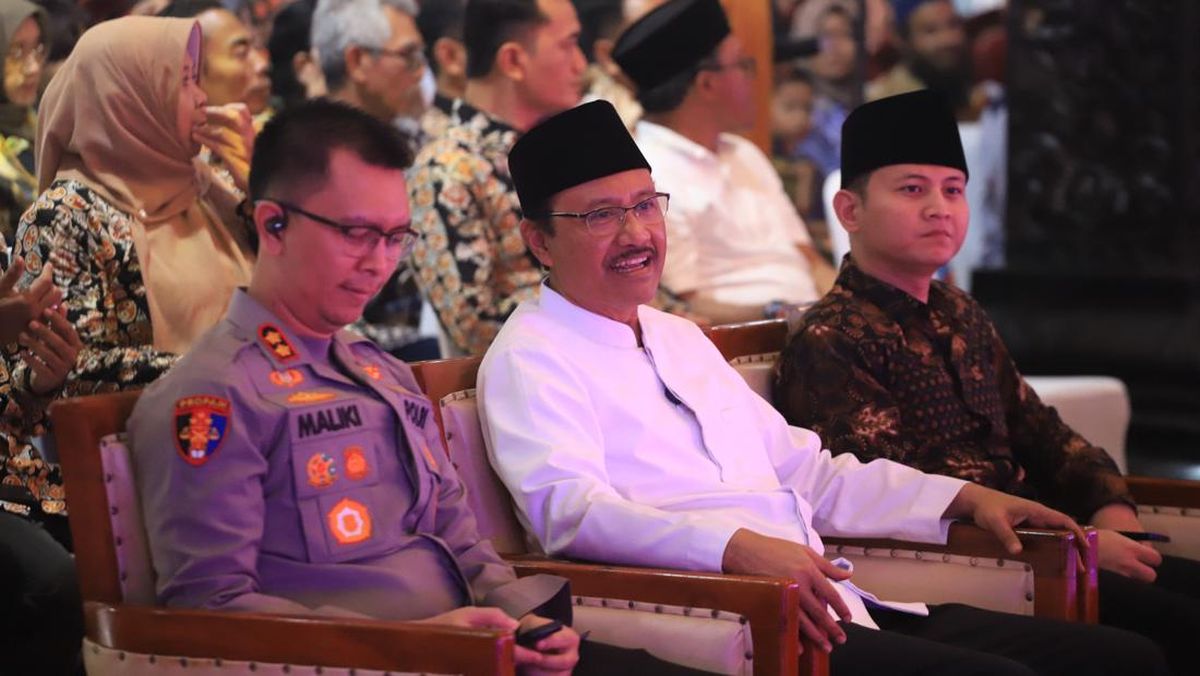
Social Affairs Minister of the Republic of Indonesia, Saifullah Yusuf, conducted a working visit to Trenggalek Regency, East Java, on Sunday (29/3). During the visit, he socialised the National Single Socio-Economic Data (DTSEN) as an effort to improve the targeting accuracy of social assistance.
The Minister, affectionately known as Gus Ipul, stated that data updating is an important step to minimise errors in the selection of social assistance and government subsidy beneficiaries.
“I deliberately came to Trenggalek to meet the Regent and all his staff. The main point is that we want to collaborate,” said Gus Ipul.
The visit was welcomed by Trenggalek Regent Mochamad Nur Arifin along with members of the Regional Leadership Coordination Forum (Forkopimda) and village heads. In addition to the DTSEN socialisation, the Minister also reviewed the development progress of the People’s School in the area.
The man who once served as Deputy Governor of East Java also appreciated the strong commitment of the Trenggalek Regency Government in managing social data. Nevertheless, he emphasised the need for data alignment between the central, provincial, and local governments.
“But we still need to sharpen it so that the data is the same, both at the central, provincial, and local levels. That is why the President issued Presidential Instruction No. 4 of 2025,” explained Gus Ipul.
The Minister said that the Ministry of Social Affairs together with the Trenggalek Regency Government wants to take a systematic and coordinated step in data updating.
Especially since social data is dynamic and continuously changes due to various factors such as births, deaths, population movements, and changes in family economic conditions.
Therefore, coordination across levels from neighbourhood units (RT), community units (RW), hamlets, to social services is considered key to ensuring data remains accurate. Community participation is also needed so that beneficiary data can be continuously updated.
“So that government assistance, whether social assistance or social subsidies, can be received by those who are entitled. As we know, some of our assistance is still not on target,” said Gus Ipul.
Gus Ipul revealed that the targeting inaccuracy rate for assistance programmes such as the Family Hope Program (PKH) and food aid packages is estimated to still reach around 45 percent.
“So we continue to coordinate, we continue to improve, and hopefully with accurate data, the interventions will be on target and have a real impact,” he stated.
He emphasised that data improvement is an important step so that government interventions are on target and provide real benefits to those in need.
In this way, those who are not yet recorded, as well as those who have not been fortunate due to not being included in the development process, can be embraced and included to receive social protection from the government.
At the same time, Trenggalek Regent Mochamad Nur Arifin welcomed the DTSEN socialisation. He explained that Trenggalek has actually had a social data management system since 2016 through the GERTAK Post.
However, he acknowledged that the main challenge currently is integrating local data with the national system, particularly through the Central Statistics Agency (BPS).
“We have already discussed with BPS, later if needed, one of the BPS officers handling that matter will be placed at the GERTAK Post. So that the system is directly integrated,” explained Nur Arifin.
He also requested that every village have a dedicated operator capable of operating the Next Generation Social Welfare Information System (SIKS-NG) to update data periodically.
According to Nur Arifin, changes in community social conditions occur very quickly, so data updates must be carried out routinely. One of the efforts is door-to-door services to villages to assist with population data recording, including for elderly residents who do not yet have ID cards.
“While waiting for the DTKS update process, after we conduct ground checking and it is confirmed that they really need assistance, then we provide the funds, we take them from Baznas. That is what we have been doing,” said the Regent, who is fondly called Mas Ipin.