
Social Affairs Minister Calls for Integrated, Data-Driven Programmes to Tackle Inequality
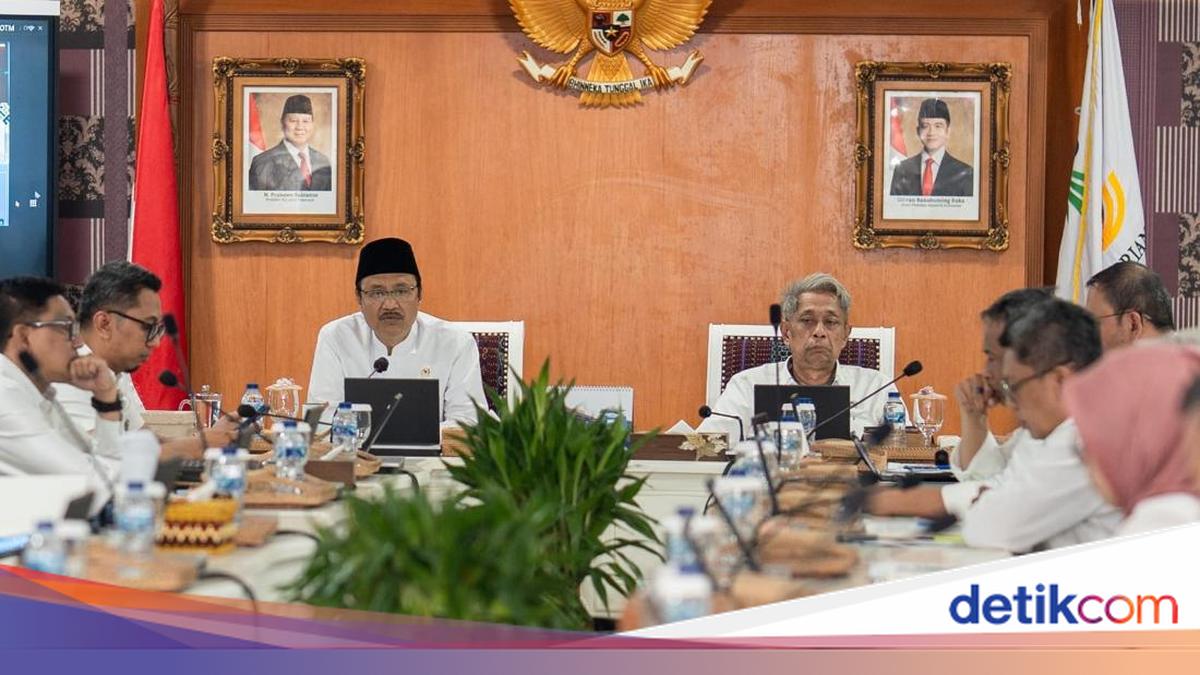
Social Affairs Minister Saifullah Yusuf, known as Gus Ipul, has instructed all levels of the Ministry of Social Affairs to strengthen programme planning with a more integrated approach, based on verified data, and oriented towards solving the problem of social inequality. This is in line with the direction of President Prabowo Subianto.
The message was conveyed by Gus Ipul while chairing a service meeting at the Ministry of Social Affairs office in Central Jakarta today. The meeting was attended by Deputy Minister of Social Affairs Agus Jabo Priyono, Secretary General Robben Rico, Echelon I and II officials, Bureau Heads, Special Staff to the Minister, and Expert Staff to the Minister. Meanwhile, heads of centres and halls across Indonesia participated online.
Opening his briefing, Gus Ipul relayed the results of the Plenary Cabinet Session led by President Prabowo Subianto. According to him, all of the President’s directives need to be translated into concrete actions within the Ministry of Social Affairs.
He stated that national development is a continuous process from one administration to the next. However, there remains a major task that must be resolved together, namely social inequality, which impacts poverty and unequal public access to various services.
“The President reminded us that there is still a major task we must complete, which is inequality. Therefore, all our programmes must be truly directed at answering this problem,” Gus Ipul said in a written statement on Monday (20/7/2026).
According to him, the constitutional mandate, particularly Article 33 and Article 34 of the 1945 Constitution, serves as the foundation for carrying out the Ministry’s duties. The management of state resources must lead to the protection and improvement of the welfare of the poor and abandoned children.
In this context, the ‘Sekolah Rakyat’ (People’s Schools) programme is an important instrument for breaking the chain of intergenerational poverty through education.
“The data must be correct, social assistance must be on target, and Sekolah Rakyat is part of the effort to empower underprivileged families,” he said.
Gus Ipul explained that the Ministry’s services must not stop at one type of intervention. Each beneficiary must receive interconnected services, ranging from data collection, social protection and security, social rehabilitation, to social empowerment according to their respective needs.
“If after receiving social protection they still need rehabilitation, then it must be followed up with social rehabilitation. After that, their empowerment must be considered. If they indeed need residential services, we will prepare them. If not, it can be through home care, home visits, or other appropriate forms of service,” he said.
Therefore, Gus Ipul requested that all work units no longer operate in silos, but instead plan programmes together so that each service complements the others.
“The Ministry of Social Affairs is like a single machine. No one should be running on their own. Directors and work units must communicate with each other and plan programmes together so that services to the community become sharper,” he said.
Gus Ipul also stressed the importance of the role of the Social Welfare Data and Information Centre (Pusdatin) as the data custodian for all Ministry programmes. According to him, all interventions must use verified and updated data so that programme implementation is more targeted.
“The cornerstone is Pusdatin. All programmes must be based on verified data. After that, they are operationalised in strategic programmes, both social rehabilitation and social empowerment,” he said.
He also requested that all centres, halls, and various service points belonging to the Ministry continue to be strengthened so they can become nodes of social welfare services that work measurably, supported by mature planning, consistent execution, and continuous monitoring and evaluation.
Closing his briefing, Gus Ipul reminded all staff to oversee the implementation of Sekolah Rakyat, which is currently entering the construction phase in various regions. He stressed that the entire process must be carried out accountably and free from corrupt practices.
“This is a very decisive period because we are building the foundation of Sekolah Rakyat. All processes must be clean, transparent, and must not be tainted by corrupt practices. That is what we must all uphold,” he concluded.