
Social Affairs Minister Briefs 'Sekolah Rakyat' Principals Ahead of New School Year
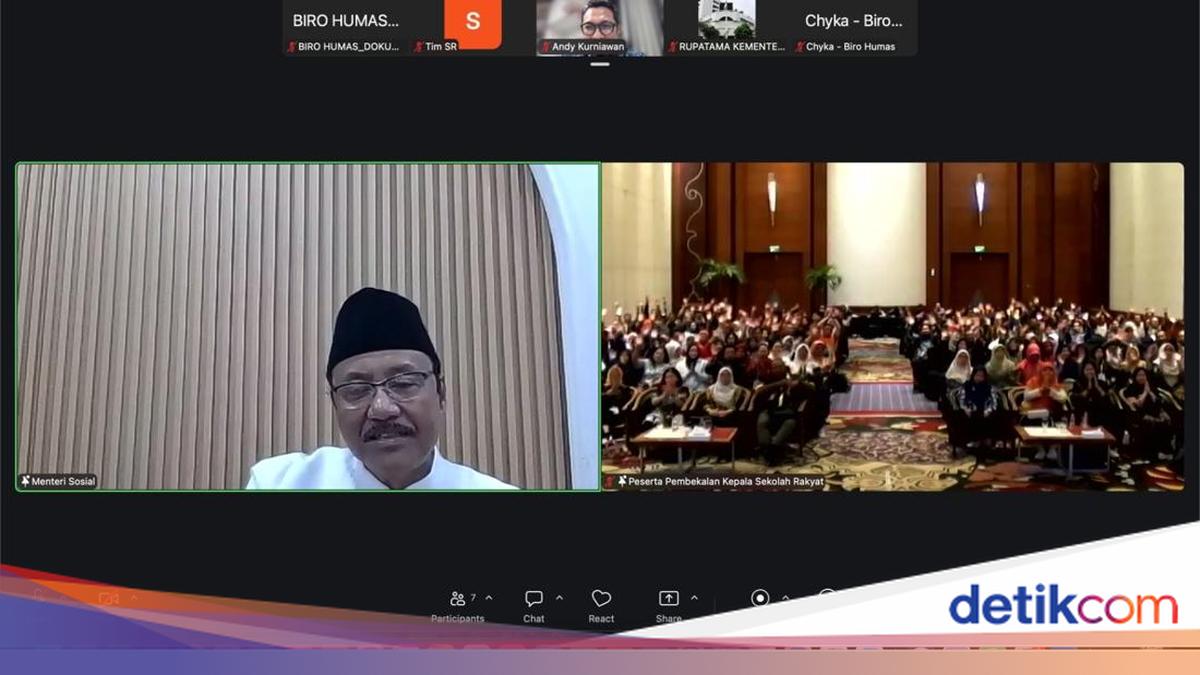
Ahead of the School Environment Introduction Period (MPLS) for the 2026/2027 academic year, Social Affairs Minister Saifullah Yusuf, known as Gus Ipul, has provided a briefing to the principals of Sekolah Rakyat (People’s Schools). The briefing aimed to ensure that the principals are ready to lead their educational units, focusing not only on academic achievement but also on character building and developing the full potential of every student. The directive was delivered online to 191 Sekolah Rakyat principals, comprising 166 principals at existing locations and 25 at new sites, during a Consolidation and Briefing Meeting centred in Kulon Progo, Special Region of Yogyakarta.
Before delivering his address, Gus Ipul presented the results of a survey of 174 Sekolah Rakyat principals, which depicted both optimism and challenges ahead of the start of MPLS. The survey indicated that the principals’ mental readiness level reached 8.95 out of 10, while their confidence in decision-making stood at 8.74 out of 10. A total of 72 per cent of respondents viewed their assignment at Sekolah Rakyat as a motivating challenge, and 94 per cent stated they already possessed a long-term leadership orientation as builders of the education system. Despite this, the survey also revealed significant hurdles. Only 18 per cent of principals stated they were fully prepared for MPLS, 26 per cent were partially ready, 38 per cent were still facing significant obstacles, and 17 per cent admitted they were not ready. Key needs highlighted by the principals included additional teachers and education staff (77 per cent), direct mentoring from the central training centre (61 per cent), budget clarity (56 per cent), and further training and briefing (48 per cent). On the ground, issues such as water supply availability at one permanent Sekolah Rakyat, the finalisation of employment status and principal decrees in several locations, and the completion of permanent building construction were also identified.
Responding to these findings, Gus Ipul asserted that all feedback would be addressed by the Ministry of Social Affairs and relevant working units. He stressed that principals are not alone in facing the challenges of running Sekolah Rakyat. ‘Problems must be faced; do not be afraid of a lack of problems. It is a sign that the country is entrusting us with something great,’ Gus Ipul said in a written statement on Wednesday. In his briefing, he emphasised that the success of Sekolah Rakyat is not measured by the emergence of a handful of high-achieving students, but by the school’s ability to build a system that develops all learners. ‘If 28 children are developing while two are left behind, that is not just a problem of two children. It is a systemic problem. Let us build a system so that all students can be served. No student is left behind,’ he stressed.
According to Gus Ipul, every child has different potential, and all principals must be able to map and develop these talents. Some children excel in sports, arts, languages, leadership, and various other skills. The 24-hour boarding education implemented at Sekolah Rakyat provides ample space for schools to cultivate this uniqueness. He cited examples, stating that each Sekolah Rakyat should have its own identity and strengths, ranging from creative marching teams, choirs, and pencak silat to foreign language drama and public speaking in international languages. He argued that all this potential must become part of the school culture, not merely extracurricular activities. Gus Ipul likened the transformation of Sekolah Rakyat to the journey of a small boat becoming a large ship. He said the principal is the captain who must enhance their leadership capacity as responsibilities grow. ‘The difference between a small boat and a large ship is not the captain, but the size of the waves they must face. Sekolah Rakyat principals must have a big mentality, be brave in making decisions, be visionary, and be able to build systems,’ he stated.
He affirmed that all principals essentially receive the same resources, guidelines, and budget support. He explained that what differentiates the success of each school is the leadership capacity of the principal. Therefore, Gus Ipul urged all principals to shift their perspective from merely working to striving. A Sekolah Rakyat principal is not just an administrative executor but a leader who takes ownership of the students’ future. ‘Striving means being oriented towards real change for students, proactively reading needs, taking the initiative to solve problems, and measuring success by the development of the children served,’ he clarified. Gus Ipul also reminded them that improving the quality of Sekolah Rakyat must begin with improving the quality of the principals themselves. ‘The standard of Sekolah Rakyat will not rise if the personal standard of the principal has not risen first,’ he said. He asked the principals to start building personal discipline before demanding student discipline, to be honest in conveying problems without covering them up, to remain calm under pressure because a leader’s attitude will be emulated by students, and to be brave in evaluating themselves before evaluating their subordinates. Gus Ipul cautioned that if the various standards repeatedly communicated still need to be reiterated, the issue lies not with the students’ ability but because the principals have not made them a priority. ‘I believe your motivation is getting stronger. The spirit to serve these special children is also growing,’ he concluded.
Source: jawawa.id (https://jawawa.id/newsitem/social-affairs-minister-briefs-sekolah-rakyat-principals-ahead-of-new-school-year-1783479158)
Originally published by detikcom (https://news.detik.com/berita/d-8564603/jelang-masa-mpls-mensos-beri-arahan-ke-kepala-sekolah-rakyat), translated from Indonesian