
Social Affairs Deputy Minister Agus Jabo Says People’s Schools Can Break Intergenerational Poverty
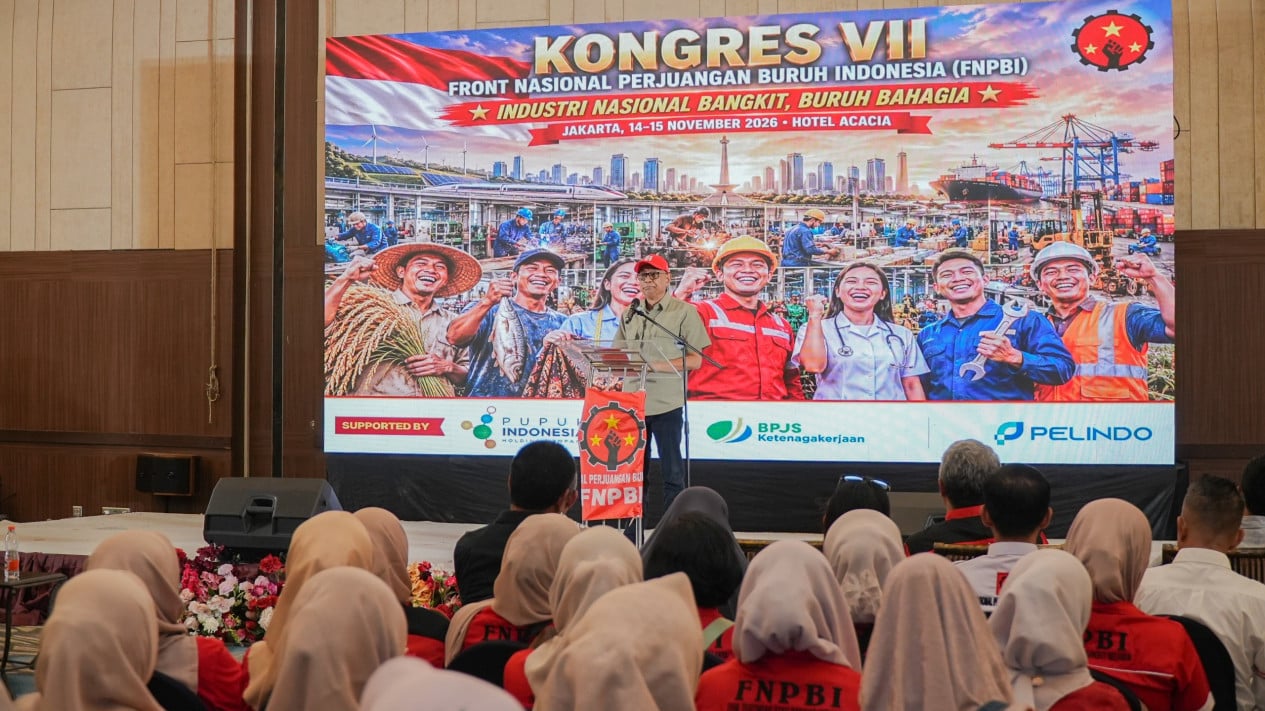
Jakarta — Deputy Social Affairs Minister Agus Jabo Priyono has said that People’s Schools are one of the government’s efforts to break the cycle of intergenerational poverty.
Through the programme, the state provides children from poor families with access to education so that they do not inherit their parents’ economic hardship.
“People’s Schools were established to reach children from poor families so that they do not inherit the poverty experienced by their parents. From primary school onwards, the state takes them in, supports them and guides them towards achieving their aspirations,” Agus Jabo said on Sunday (15 November 2026), at the close of the seventh congress of the Indonesian National Front for Workers’ Struggle (FNPBI) at The Acacia Hotel in Jakarta.
Agus Jabo said People’s Schools were a strategic measure to address poverty, which remains a major challenge in Indonesia, particularly in socio-economic terms.
“We still face a serious poverty problem, especially in the socio-economic sphere,” he said.
Agus Jabo also outlined President Prabowo Subianto’s intention to tackle poverty, including through the use of a single, open and transparent data set.
The data would provide an important basis for ensuring that government policies and programmes reach the people who need them.
“The President wants all poverty data to be disclosed transparently, with nothing concealed. This will enable the government to formulate poverty-alleviation and extreme-poverty eradication programmes that are properly targeted,” he said.
According to Statistics Indonesia (BPS) data for March 2026, Indonesia still had 22.9 million people living in poverty, with monthly per-capita expenditure of Rp600,000 or less.
Poverty also directly affects children’s opportunities to obtain an education. Around 4.1 million Indonesian children are not in school or have dropped out because of economic factors. In addition, about 74 per cent of people living in poverty have an education level of primary school or below.
Economic hardship is a major obstacle preventing poor families from sending their children to school. Some 76 per cent of parents said they could not afford to educate their children.
Meanwhile, more than 64 per cent of children from poor families are at risk of experiencing the same poverty.
Source: jawawa.id (https://jawawa.id/newsitem/social-affairs-deputy-minister-agus-jabo-says-peoples-schools-can-break-intergenerational-poverty-1794757836)
Originally published by VIVA.co.id (https://www.viva.co.id/berita/nasional/1943908-wamensos-agus-jabo-tegaskan-sekolah-rakyat-memutus-rantai-kemiskinan-antargenerasi-agar-anak-tidak-mewarisi), translated from Indonesian