
So, What Exactly is the Board of Peace?
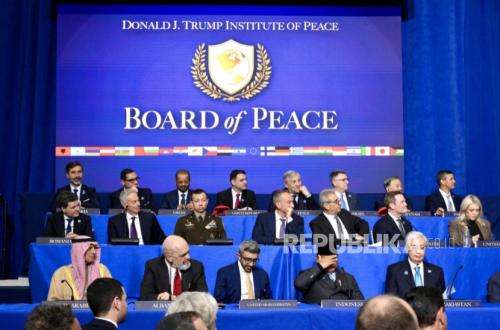
Before the United States, alongside Israel, attacked Iran at the end of February 2026, one incident that shocked the world was the establishment of the Board of Peace (BoP) by the United States. The BoP originated as part of a series of proposals from President Donald Trump to resolve the conflict in Palestine, with its formation receiving approval from the UN Security Council in November 2025.
The establishment of the BoP, particularly Indonesia’s participation in it, has undoubtedly become controversial. One of the biggest issues is the “International Stabilization Force” troops, which seem to perpetuate occupation and instead disarm Palestinian fighters. Moreover, the United States, which leads the BoP’s establishment, is well-known as a supporter of Israel in the occupation and genocide for decades. In fact, Israel is a member of the BoP, but Palestine is not. This criticism has naturally intensified after the United States and Israel attacked Iran, even though the BoP had only just begun its activities and is now paused.
The above criticisms seem to dominate the discourse, and they are indeed very significant problems. Based on that alone, many parties oppose Indonesia’s participation in the BoP and demand that we withdraw. However, at least at a glance, as I observe how the discourse develops, there are aspects of the BoP that are not widely known. My suspicion is that many people do not yet understand the true nature of this entity called the BoP. Therefore, in this article, I wish to convey several important points regarding the BoP that deserve attention.
First, the BoP is an international organisation whose establishment is based on a charter named the Charter of the Board of Peace (BoP Charter). This Charter functions like articles of association, explaining various aspects of the BoP’s functions, structure, and management. Several articles of the BoP Charter will serve as my references to explain what kind of entity the BoP is.
Second, structurally, there is an extraordinary position called “Chairman.” This “Chairman” holds numerous important authorities in the BoP’s functions. For example, Article 2(1) of the BoP Charter states that a country can only join the BoP upon invitation from the Chairman. Furthermore, the BoP also has an Executive Board whose function is to implement BoP decisions, with its members selected by the Chairman and its head nominated by the Chairman as well, according to Article 4(1) of the BoP Charter.
BoP decisions can only be made by majority approval of BoP members if approved by the Chairman, pursuant to Article 3(1)(e) of the BoP Charter. Additionally, according to Article 9 of the BoP Charter, the Chairman has the authority to issue decisions in the form of Resolutions or Directives in implementing the BoP’s mission. Articles 3(2)(b) and 3(4) of the BoP Charter also grant the Chairman authority to form or dissolve subcommittees or sub-entities in the BoP as he wishes. Finally, on this matter, the Chairman’s approval must be sought for any proposed amendments to the provisions of the BoP Charter (Article 8).
Third, the Chairman’s position is explicitly determined in Article 3(2)(a) of the BoP Charter. This position is not elected periodically or democratically, but rather explicitly designates a special individual, none other than President Donald Trump. The only opportunity for someone other than Donald Trump to become Chairman is if Donald Trump voluntarily resigns or is incapacitated according to a unanimous vote from the Executive Board, as per Article 3(3) of the BoP Charter.
The same article also states that the Chairman must always have a designated successor, so ultimately, the only one who can replace Donald Trump is someone chosen by Donald Trump himself. Nevertheless, there is no public information yet on who has been designated by Donald Trump.
Fourth, namely “what” and “where”. Regarding “what”, Article 1 of the BoP Charter outlines the purposes and functions of the BoP. This article is quite lengthy, and among other things, it states that the BoP aims to support stability, restore legitimate and reliable governance, and ensure peace. This is ameliorative language that essentially means the BoP seeks to deploy its military forces and replace regimes in a country, akin to US foreign policy.
Regarding “where”, I have mentioned that the BoP was born in the context of Palestine. The UN Security Council resolution approving the BoP’s formation is also related to Palestine. However, in the BoP Charter, the names “Palestine” or “Gaza” do not appear at all. Meanwhile, Article 1 of the BoP Charter mentions that the BoP’s aims to support stability, restore legitimate and reliable governance, and ensure peace are “…in areas affected or threatened by conflict” (in areas impacted or threatened by conflict). This means it is clearly not limited to Palestine alone and could apply worldwide. Up to this point, hopefully, we can guess who holds the most authority in determining the measures of “impact” and “conflict threat” here.
It seems the BoP has its own version of “active free politics”, namely free to act anywhere by attacking. Precisely like what the United States did with Israel in Iran, although it seems to have failed completely, this reflects how the United States understands peace and regime restoration. It should be noted that the US President, as Chairman, is the highest authority in interpreting, construing, and implementing the BoP Charter (Article 7).
For decades, scholars and diplomats from various countries have strongly criticised the possession and use of the Veto Right in the UN Security Council. Yet, this Veto Right is “merely” an exclusive right to block draft decisions (Resolutions) of the Council, and cannot directly impose certain decisions.