
SNT: A New Hope for Honorary Teachers and Quality Education
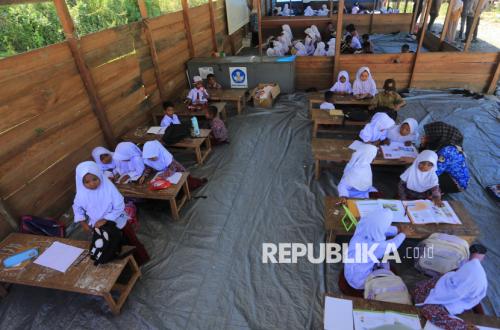
Quality education is a fundamental right of every Indonesian child. However, as an honorary teacher who faces classroom dynamics daily, I see how the quality of education has not yet been fully felt evenly by all the nation’s children. In many remote areas, we are still struggling with a shortage of teachers, a lack of adequate learning facilities, and unequal access to technology.
Amidst these significant challenges, the President’s idea of an Integrated National School (SNT), launched by the Ministry of Primary and Secondary Education, brings a glimmer of new hope for accelerating the equal distribution of excellent education.
This hope is not an empty dream. The Basic Education Data (Dapodik) as of 30 June 2025 and the 2025 Education Report Card note that only 263 out of 7,288 sub-districts (about 4 percent) in Indonesia have both good quality and quantity junior and senior high schools. The Minister of Primary and Secondary Education, Abdul Mu’ti, emphasised that the indicator of a quality school is marked by an ‘A’ accreditation and literacy and numeracy achievements above 75. This figure clearly shows that most regions of the Republic still face a huge wall in providing adequate educational services.
For us educators in the regions, these statistics are not just dry numbers, but a daily reality. We are still witnessing schools with a shortage of subject teachers, a lack of laboratory equipment, frequently disrupted internet access, and children learning amidst limitations.
This empirical condition aligns with national education indicators. The Central Statistics Agency (BPS) for 2025 recorded that Indonesia’s Expected Years of Schooling (HLS) has reached 13.40 years, but the Mean Years of Schooling (RLS) is only at 9.22 years. This means there is a significant gap between the public’s aspiration to send their children to higher education and the socio-economic reality that forces them to drop out of school. This is reinforced by the 2022 PISA results, where the literacy, numeracy, and science abilities of Indonesian students were still below the average of OECD member countries.
From an economic-development perspective, this inequality is deeply worrying. Gary Becker (1964), in his Human Capital theory, stated that education is the most crucial form of investment for increasing a nation’s productivity and economic growth. This is in line with the views of Eric Hanushek and Ludger Woessmann (2015), who proved that improving the quality of learning is directly proportional to a nation’s long-term economic growth. Therefore, equalising the quality of education is not merely a technical schooling issue, but a strategy for cultural and national development.