
Smuggling of Javan Gibbon to Oman Foiled at Soekarno-Hatta Airport
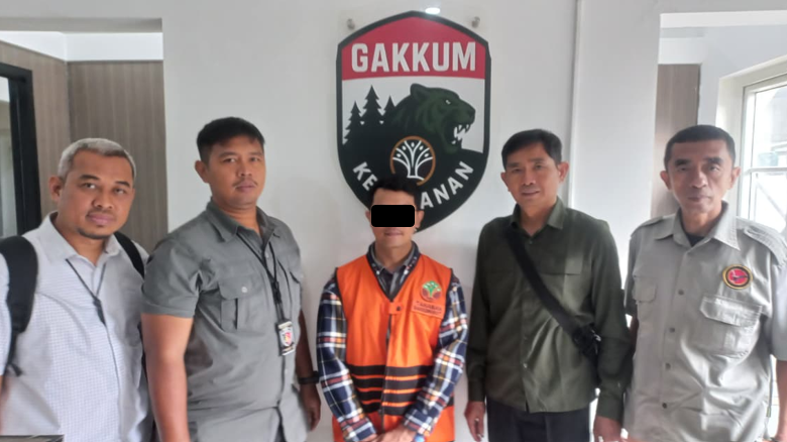
The Ministry of Forestry, through its Law Enforcement Centre for the Java, Bali, and Nusa Tenggara Region, has foiled an alleged wildlife smuggling attempt bound for Oman at Soekarno-Hatta International Airport. Investigators have named a 40-year-old man with the initials AMR as a suspect after he allegedly attempted to transport a Javan gibbon (Hylobates moloch) and a tri-coloured monitor lizard (Varanus yuwonoi) out of the country. The case was uncovered by forestry law enforcement investigators with support from airport security authorities. The initial investigation is probing the origin of the animals, the suppliers, the movement of the wildlife before arriving at the airport, and the possible involvement of other parties in the planned shipment to Oman. The Javan gibbon is a primate endemic to Indonesia that plays a vital role in forest ecosystems, whilst the tri-coloured monitor lizard is an endemic reptile with a limited natural range that is frequently targeted by wildlife traffickers. This case demonstrates that the pressure from illegal wildlife trade targets not only well-known species but also endemic reptiles with high value in the exotic pet market. Attempting to take wildlife abroad without proper procedures and legal documents constitutes a threat to Indonesia’s biological wealth. In many instances, animals reaching the point of shipment have passed through a long chain of capture from the wild, collection, transfer, concealment, and shipping arrangements. The investigation is therefore directed at understanding the full pattern and chain of the animals’ movement. Director General of Forestry Law Enforcement, Dwi Januanto Nugroho, asserted that wildlife smuggling abroad must be viewed as a threat to Indonesia’s biological sovereignty. He stated that the illegal trade in plants and wildlife not only harms the state legally but also depletes biological wealth that should remain alive and performing its ecological functions in nature. ‘Indonesia is one of the world’s homes of biodiversity. When our endemic wildlife is smuggled abroad, what is lost is not just an individual animal, but also a part of our natural heritage, scientific knowledge, and ecosystem balance that is our collective responsibility. Therefore, cases like this must not be read merely as a matter at the airport departure gate. This is part of a larger agenda to safeguard national biological wealth,’ Januanto emphasised on Saturday (27/6). He added that transnational illegal trade in plants and wildlife is constantly evolving, seeking loopholes through transportation, logistics, and digital spaces. ‘Law enforcement must read the pattern, not just the event. The illegal supply chain must be traced, from the poacher, the collector, the financier, the travel arranger, to the recipient in the destination country. This requires cross-ministerial and institutional cooperation, law enforcement officers, airport authorities, and international collaboration. Indonesia’s biological wealth must not become a commodity on the global black market,’ he said. For his actions, AMR is charged under Article 40A paragraph (1) letter f in conjunction with Article 21 paragraph (2) letter c of Law Number 32 of 2024 concerning Amendments to Law Number 5 of 1990 concerning Conservation of Living Natural Resources and Their Ecosystems, in conjunction with Article 79 paragraph (1) of Law Number 1 of 2023 concerning the Criminal Code, in conjunction with Article I paragraph (1) of Law Number 1 of 2026 concerning Criminal Adjustments. Head of the Forestry Law Enforcement Centre for Java, Bali, and Nusa Tenggara, Aswin Bangun, stated that investigators are currently strengthening the evidence against AMR and tracing the animals’ movement prior to arriving at Soekarno-Hatta Airport. He noted that the interception at the airport serves as an entry point to map the source of the animals, their transfer, the shipping plan, and the parties suspected of benefiting from the illegal trade. ‘We are handling this case by looking at the entire sequence of events. The enforcement point is at the airport, but the evidentiary process does not stop there. Investigators are probing where the animals were obtained, how they changed hands, who arranged the journey, and where the animals were to be received. At the same time, we are ensuring the animal evidence is handled according to procedure and receives proper care,’ Aswin said. He stressed that wildlife must not be treated as luggage or a collector’s commodity. ‘Every transport and shipment of wildlife has legal rules and conservation procedures that must be complied with. We urge the public not to buy, keep, ship, or trade wildlife without a valid legal basis. The illegal wildlife trade thrives because of demand, intermediaries, and loopholes that we must close together,’ Aswin asserted. The Ministry of Forestry is calling on the public to view wildlife not as collectibles, entertainment, or trade commodities. Behind every illegally traded animal, there is the possibility of poaching in the wild, separation from its habitat, cruel transport, and a network profiting from the loss of Indonesia’s biological wealth. ‘Therefore, the public is asked not to buy, keep, ship, or promote wildlife without a valid legal basis, and to report any suspicious hunting, transport, keeping, shipping, or sale of wildlife to Ministry of Forestry officers, law enforcement officials, or the Ministry’s official complaint channels,’ he concluded.