
Smart Village Approach Crucial for Strengthening Villages
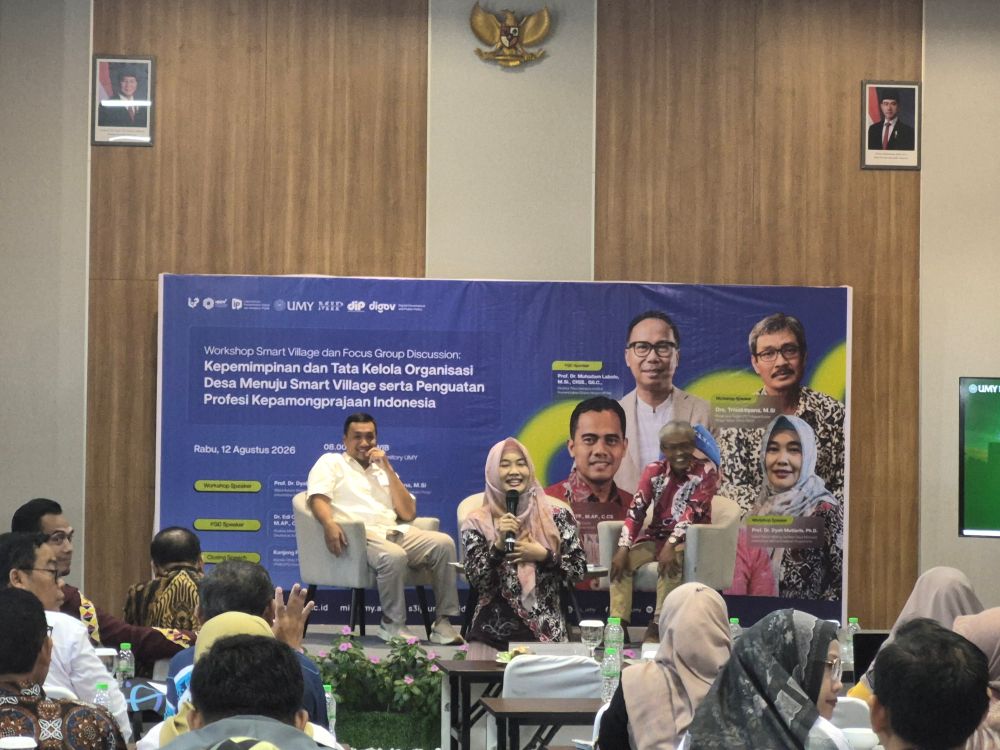
Technological advancement requires all parties to adapt, including villages. However, technology is not the sole determinant of successful transformation at the local level.
Professor of Government Science at Universitas Muhammadiyah Yogyakarta, Dyah Mutiarin, asserted that the Smart Village approach is very important for strengthening villages. However, this approach should not be understood merely as the use of applications or the digitalisation of services.
“Strengthening villages requires clarity of work processes, data quality, apparatus capability, collaboration with the community, service integration, and leadership capable of managing change,” Dyah explained at the Smart Village Workshop and Focus Group Discussion on Strengthening the Indonesian Governance Profession at Mini Hall, UG Floor, Dormitory UMY, on Wednesday (12/8).
She added that technology must be placed in its proper proportion. “Technology is an instrument to improve the quality of governance and services, not an end goal,” she stressed. Dyah, who currently serves as Vice Rector for Human Resources at UMY, made the remarks in her presentation on the foundations of Smart Village.
She said that forums of this kind are very important as a meeting space for universities, practitioners, and government elements to strengthen local government capacity in a directed, professional, and adaptive manner towards digital transformation.
A representative of the Ministry of Home Affairs, from the Directorate of Regional Administration, Dr. Edi Cahyono, S.STP., M.AP., C.CS, conveyed the importance of establishing an official body for apparatus.
“This step is important so that strengthening the governance profession has a clear direction of work and does not stop as mere discourse. We need the formulation of identity, scope of the profession, organisational structure, articles of association and bylaws, code of ethics, and sustainable competency standards,” said Edi.
Meanwhile, the Director of the IPDN Postgraduate Programme, Muhadam Labolo, underlined the need to strengthen professional education to support the competence of apparatus in the field. “Professional education can serve as a bridge between academic knowledge and practical skills in real government situations,” he explained.
Competency certification, he continued, is needed as a mechanism for objective recognition of professional abilities in accordance with applicable standards.
Meanwhile, the Head of the PMK2PS Office of the DIY Regional Government, KPH H. Yudanegara, said that the presence of regional government elements is expected to strengthen the connection between academic discussion, the professional needs of apparatus, and the reality of government administration in the field.
“The ultimate goal is to create a government that is more competent, adaptive, with integrity, data-based, and capable of providing responsive public services,” concluded KPH Yudanegara.