
'Smart joints' enable seamless traffic flow on world's bridges
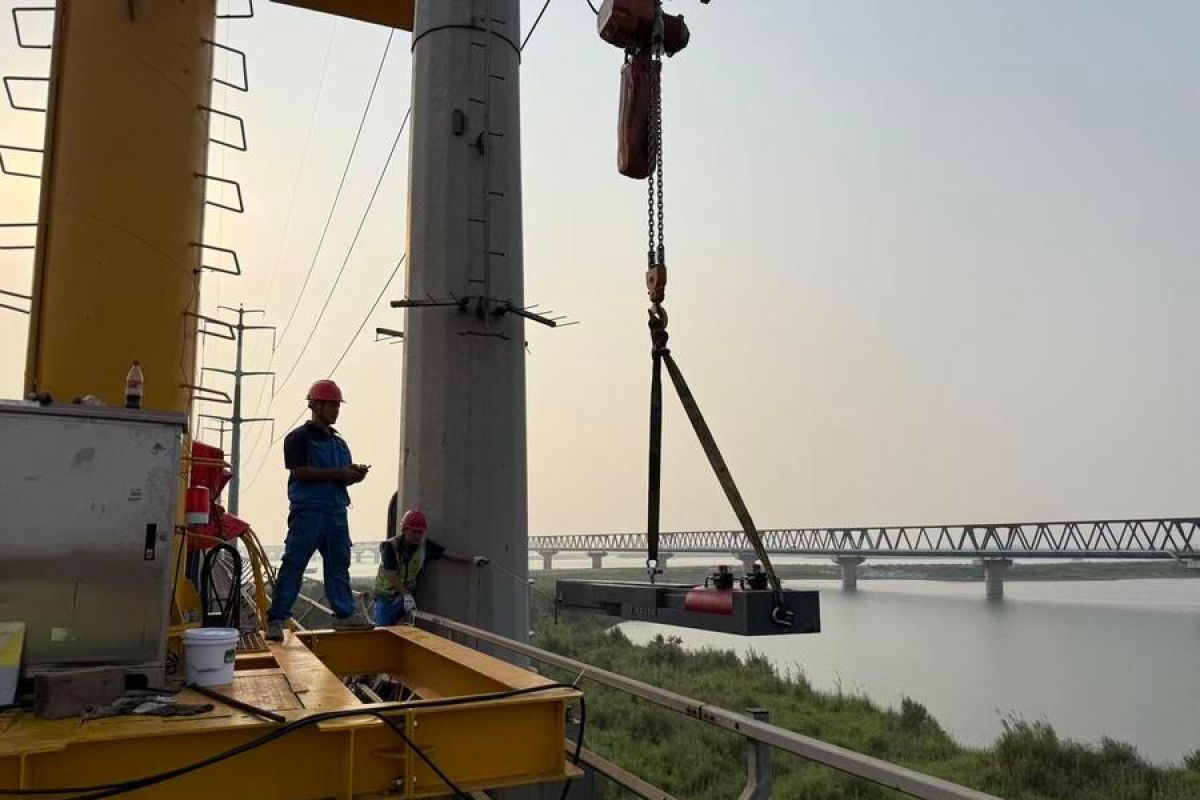
Chengdu (ANTARA) - For decades, engineers have faced a weighty dilemma: how to inspect and maintain crucial bridge components without stopping the flow of traffic.
Now, a Chinese company is helping to change that paradigm.
Intelligent Engineering Connections Incorporated (IEC), based in Chengdu, the capital of Sichuan Province in south-western China, equips bridges around the world with what it calls “smart joints” — high-tech bridge bearings and expansion devices that can be calibrated under full load, detect structural strain in real time, and can even be removed and recycled after use.
The technology has helped IEC’s products reach more than 30 countries and regions, from South Asia to the Middle East and North America.
The company took another major step in its global expansion on Monday (13 July), signing a strategic cooperation and exclusive distribution agreement with Pan Sarawak Holdings Sdn Bhd of Malaysia, which will introduce IEC’s advanced digital twin system for bridge structural health monitoring to the Malaysian market.
Bridge bearings serve as the “crucial joints” in a bridge’s load-bearing system, absorbing external forces from traffic, temperature fluctuations and seismic activity.
Over long periods, bridge bearings in service carry loads continuously, making traditional calibration and inspection methods — which require unloading and removing the bearings — difficult to carry out and disruptive to traffic flow.
To check whether a bridge bearing is functioning properly, engineers usually have to release the load and move the entire structure. This process causes major disruption, is expensive, and often requires road closures.
“Traditional connectors are just the ‘skeleton’ of infrastructure. We want these connectors to become ‘nerves’, capable of sensing and even thinking,” said Wu Dacheng, director of IEC.
IEC has changed this situation. Its technology can now calibrate bearings precisely in place, without needing to release or remove the load.
The technology, officially named the Structural Intelligent Force Measurement/Calibration Device and Safety Monitoring System, was recently recognised as one of the first batch of “outstanding industry” products by the Chengdu government. IEC now holds 170 patents, including 27 Chinese invention patents and three international PCT patents.
Wu said this breakthrough alone has saved millions of dollars in maintenance costs and avoided hours of traffic disruption across various projects.
IEC has also embedded Internet of Things (IoT) sensors into the bearings, which act as a round-the-clock “family doctor” for each bridge.
“With the intelligent structural force measurement, calibration and safety monitoring system we developed independently, bearings can monitor internal forces, displacement, acceleration and other key parameters in real time,” said Zhao Weichao, an IEC engineer.
“If something abnormal occurs, the system not only sounds an alarm but also makes adaptive adjustments. It can detect problems before the structure actually suffers damage,” Zhao explained.
In February 2026, the technology proved its capabilities on the Jamuna Bridge in Bangladesh, one of the largest bridges in the South Asian country. Working in a narrow, confined space beneath the bridge deck, IEC and its local partner retrofitted the bridge structure without stopping a single car crossing above.
“The working space was so narrow that conventional methods were almost impossible,” said Li Shaofang, a manager at CCCC Second Harbour Engineering Company, one of the project’s partners.
“IEC’s smart equipment allowed us to carry out the work with high precision and full control in that confined space without disrupting traffic flow. This technology has great potential for wider application, both in domestic and overseas projects,” Li added.
IEC’s track record spans the globe. Its expansion joints proved able to withstand the desert heat on the Doha ring road, built for the 2022 FIFA World Cup. Its sliding bearings support the complex roof system of SoFi Stadium in Los Angeles, which will host the 2028 Olympics. New service centres are also planned in Singapore and Brisbane.
IEC, one of the leading players in China’s domestic market, has booked orders worth 300 million yuan (1 yuan = Rp2,665) for this year, targeting annual output value growth of 30 per cent.
“We are turning ‘Made in China’ into a label for smart, low-carbon solutions,” said Wu. “This is not just about building bridges. It is about ensuring those bridges last longer, are smarter, and are more environmentally friendly.”