
Smart GRC, Resilient Business: Surveyor Indonesia's Transformation
As a company with core competencies in Testing, Inspection, Certification and Consultation, PT Surveyor Indonesia (Persero) implements Governance, Risk and Compliance (GRC). GRC is no longer positioned merely as a control instrument, but has evolved into part of how the company conducts business and makes decisions.
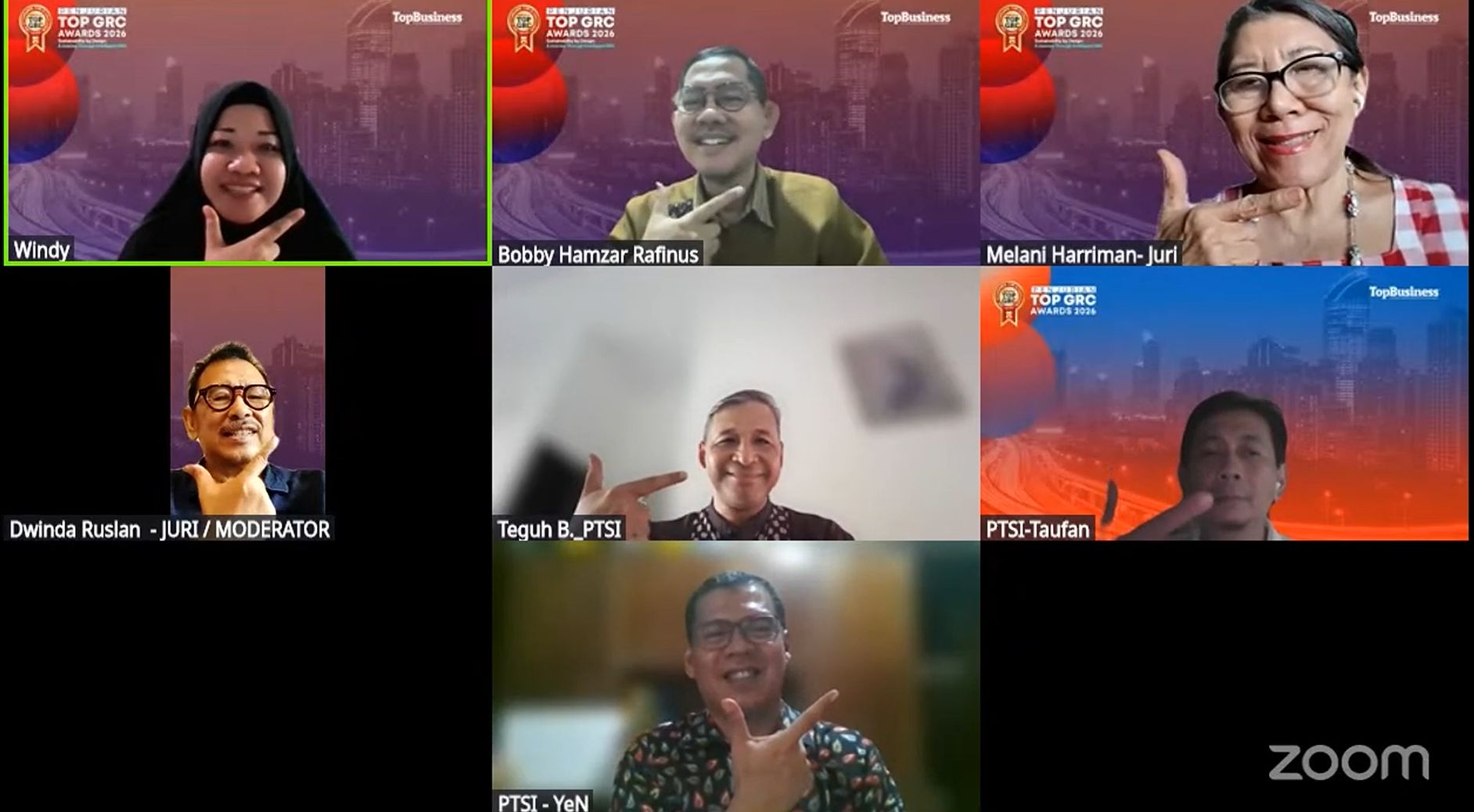
This was conveyed by AVP Corporate Communication Yen Ardhien during the judging of the TOP GRC Awards 2026, held online in Jakarta on Friday (28/8/2026). Also present at the judging were AVP Government & Compliance Teguh B, Government & Compliance Staff Yudhistira A, and Government & Compliance Staff Taufan, as well as Corporate Communication Staff Risty and Jeffa.
According to Yen, the implementation of GRC at PT Surveyor Indonesia is built on the principle that governance, risk and compliance must be embedded within business processes, objectives and Key Performance Indicators (KPIs).
“Through this approach, expansion, product development, investment and business strategy are directed to remain aligned with company values, risk capacity, risk appetite and applicable regulations,” said Yen.
In addition, GRC is positioned as an instrument of continuous improvement. Its implementation is monitored and evaluated periodically to determine the maturity level as well as areas still requiring improvement. At the same time, the company is developing digital integrated monitoring through the alignment of cross-unit reports and the development of an integrated dashboard.
The system is intended to provide current, reliable and accurate information, thereby accelerating business monitoring and providing early warning for management to take corrective action.
This approach is reinforced by risk-based decision making. Each objective owner carries out risk identification, analysis, evaluation, treatment, monitoring and review. Consequently, business decisions are expected to reduce potential legal risks, sanctions, operational disruptions or reputational damage that could hinder the company’s growth.
Furthermore, GRC is used to view opportunities and threats simultaneously, so that risk management does not stop at preventing losses but also helps the company capture business opportunities in a measured manner.
The implementation of GRC is strengthened through governance with a clear division of roles. The Board of Directors or management provides direction and sets policies, work units are responsible for execution, the Governance/Compliance function monitors implementation and compliance, while the Internal Audit Unit (SPI) provides independent assurance. Significant issues, risks or non-compliance are then escalated in stages according to materiality and authority levels.
Within the GRC structure, the GRC Committee serves as the coordinator for controlling integrated GRC implementation. The structure is designed to support planning, execution, evaluation and continuous improvement of the GRC strategic plan. Its implementation also adopts the Three Lines Model, involving the second line as GRC implementers and SPI as evaluator as well as the third line. This strengthening is supported by the Risk Monitoring Committee, Audit Committee, Integrated Governance Committee, Corporate Secretary, SPI, Corporate Planning and Development Division, and the Risk Management Unit.
One concrete example of risk management implementation can be seen in the risk threshold setting for the 2025 Corporate Work Plan and Budget (RKAP). The company set a risk capacity of Rp1,363.3 billion using the Net Working Capital (NWC) approach. From this figure, risk appetite was set at Rp272.7 billion or 20 percent of risk capacity, risk tolerance at Rp299.9 billion or 22 percent, and risk limit at Rp204.5 billion or 15 percent.
Meanwhile, from the compliance side, the company strengthened its commitment through the Business Ethics and Conduct Guidelines and the Whistleblowing System (WBS) Guidelines, jointly endorsed by the Board of Directors and Board of Commissioners. The Compliance function has a dashboard containing active and inactive regulations along with their implementation in each unit. Compliance testing is also conducted annually to ensure business processes operate in accordance with applicable regulations.
The implementation of GRC at PT Surveyor Indonesia is also connected to the ESG agenda. The sustainability commitment is set out in the Sustainability Policy, which is then cascaded into policies on Human Rights, Respectful Workplace Policy, corporate management, HSE and anti-bribery. ESG governance falls under the Sustainability Committee, led directly by the Board of Directors, with members comprising VPs and heads of relevant units. ESG implementation is regulated through the Corporate ESG Implementation Guidelines, covering planning, execution, inspection, reporting and improvement.
Specifically for climate risk, the company uses the TCFD (Task Force on Climate-related Financial Disclosures) framework. Risks are divided into physical risks, both acute and chronic, as well as transition risks related to changes in environmental regulations, carbon tax policies and shifts in market preferences. The next strengthening is directed at establishing ESG/climate-specific Key Risk Indicators (KRIs) so that sustainability risks have an early warning system equivalent to the seven main risk KRIs in the 2025 RKAP.
To strengthen GRC implementation, PT Surveyor Indonesia has introduced technological innovations. One prominent innovation is COMPLAI (Compliance & Legal Review Intelligent System), an AI-based system that helps automate compliance checks and legal reviews of various document types. AI and Large Language Model (LLM) technology are used to understand the content, context, clauses and requirements of documents, then compare them with regulations, internal policies, compliance standards and applicable legal provisions. The system can identify potential non-conformities and risky clauses while providing follow-up recommendations.
Another innovation is ESG Shadow Rating Based on AI, which utilises AI, LLM and OCR to process and analyse ESG information from various documents. There is also SIMARIS (Risk Management Application System). This innovation serves as a company benchmark. SIMARIS was developed as a reliable, informative, user-friendly and integrated risk management platform to support Risk-Based Decision Making. The platform is also equipped with AI utilisation to strengthen analysis and provide risk insights, and is available on both website and mobile platforms, providing ease of access and flexibility for users.
Many achievements have been recorded thanks to the successful implementation of GRC at the company. One is evident in sustainable revenue growth. Revenue from sustainability products and services increased from Rp224.56 billion in 2023 to Rp291.19 billion in 2024, reaching Rp341.17 billion in 2025. In 2025, its contribution reached 16.85 percent, with growth of 17.2 percent in a year.
In addition, there was an improvement in the Risk Maturity Index (RMI) and corporate governance (GCG) scores. The RMI score for the 2023 observation period, for example, was recorded at 2.8, categorised as the Developing + Phase, then increased to 3.2 with the Good Practice Phase category. In the GCG assessment, PT Surveyor Indonesia obtained a score of 91.068 with an excellent predicate in 2024. In the 2025 financial year, the score increased to 93.723, also with an excellent predicate.
The successful implementation of GRC has also enabled the company to expand its contribution to the national carbon ecosystem through its role as an accredited Validation and Verification Body. PT Surveyor Indonesia is recorded as a Greenhouse Gas Emission Validation and Verification Body with KAN accreditation number LVV-018-IDN, with a scope covering organisational verification, project verification and validation, and verification of emission reports.
“By making GRC part of the company’s way of working, GRC is able to play a role, generate value, maintain sustainability and strengthen stakeholder trust,” concluded Yen.