
Smart Buildings: Hospital and Factory Cut Costs and Downtime
The global community is currently facing the increasingly challenging threat of a climate crisis. This is compounded by the fact that the building and construction sector currently accounts for around 37% of global CO2 emissions, consumes about a third of the world’s energy, and is responsible for nearly 50% of global material extraction. This makes the sector one of the largest contributors to the climate crisis.
Meanwhile, Indonesia, through its Enhanced Nationally Determined Contribution (ENDC) document, is targeting a reduction in greenhouse gas emissions of 31.89% through domestic efforts, and up to 43.20% with international support by 2030.
To achieve this target, the Ministry of Public Works and Housing has formulated and regulated the fulfilment of Technical Standards for Green Buildings and Smart Buildings through Government Regulation Number 16 of 2021, further detailed in Minister of Public Works and Housing Regulation Number 21 of 2021. Green buildings must meet resource efficiency performance, with an energy conservation target of 25% and a minimum water conservation of 10%. This standard also mandates the application of environmentally friendly principles from the planning, construction, to the operational stages of the building.
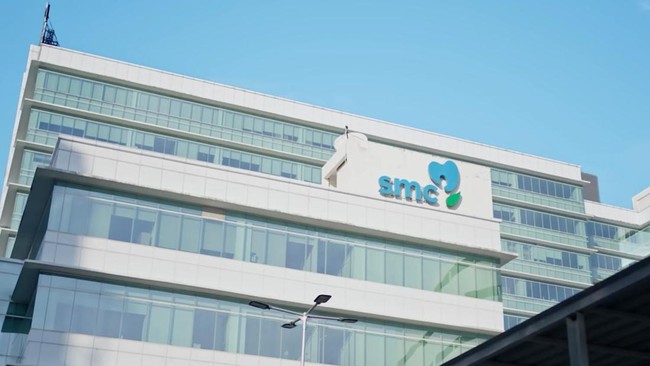
The smart building concept has been adopted by SMC Rumah Sakit Telogorejo in Semarang, Central Java, through a Building Management System (BMS). This system integrates the monitoring of critical utilities, including Heating, Ventilation, and Air Conditioning (HVAC), electrical systems, and Uninterruptible Power Supply (UPS), into a single centralised command centre via Schneider Electric’s EcoStruxure Building Operation platform. The BMS also replaces manual management with real-time monitoring, automatic alerts, and more proactive maintenance, making building management smarter.
Facility Manager of SMC Rumah Sakit Telogorejo, Rio Oktavianus, explained that the implementation of the BMS was initially driven by an annual electricity cost increase of 1% to 1.5%. To address this, the hospital manually scheduled the operation of its HVAC and electrical systems. “We scheduled it so that every morning when outpatients started arriving, around 9 o’clock, we turned the air conditioning on to maximum. The room had to be cold, we turned on the lights, activated the electricity, until later at night, around 7 or 8 pm, we turned it off,” he stated.
However, this effort actually caused energy loss rather than efficiency. According to Rio, the surge in electricity consumption in 2023 and 2024 reached 9%, the largest compared to previous years. “Imagine if it continues to rise by 9% every year. A 9% annual increase is a very significant cost,” Rio stressed.
For this reason, the hospital partnered with Schneider Electric as a provider of Building Management System innovation. SMC Rumah Sakit Telogorejo had previously utilised several other solutions from Schneider Electric. “We use Schneider Electric because it automatically makes our operations easier. We cannot possibly shut down the hospital just to build this system,” Rio explained.
This implementation resulted in a 5% reduction in total electricity expenditure in 2025, simultaneously reversing the 9% annual cost increase trend. Furthermore, EcoStruxure Building Operation reduced the technical response time to anomalies by 60% thanks to automatic alerts, and provided real-time visibility of critical utilities, allowing potential disruptions to be identified and addressed earlier. This implementation helps the hospital improve cost efficiency, accelerate disruption handling, and maintain critical room conditions more consistently without compromising the reliability of medical services.
Similarly, smart building implementation was also carried out by Petrokimia Gresik, which adopted Schneider Electric solutions by implementing the EcoStruxure Transformer Expert, an IoT-based transformer monitoring system that enables real-time condition monitoring. This technology integrates advanced sensors and analytics to provide deep insight into transformer performance, allowing operators to anticipate potential disruptions earlier, reduce downtime, and simplify maintenance.
Petrokimia Gresik also utilises EcoStruxure Asset Advisor for 24/7 monitoring and predictive diagnostics, supported by devices such as MCSET, MV Drive, and PLC M580. This solution enables more accurate data-driven decision-making, improving electrical reliability, energy efficiency, and overall operational stability. To support operations spread across various locations, Petrokimia Gresik implemented EcoStruxure Geo SCADA Expert to monitor and control production and material processing in real-time. This system increases visibility across facilities, accelerates response to changing operational conditions, and drives the transition towards Industry 4.0 through cloud-based connectivity.
SVP of Maintenance at Petrokimia Gresik, Iwan Febrianto, revealed that the use of digital technology is a strategic step in sustainably improving operational performance. “By adopting solutions from Schneider Electric, we have transformed the way we monitor and manage critical assets, thereby improving reliability, reducing the risk of downtime, and empowering our operations with data-driven insights,” said Iwan.