
Small Stories within the Great Journey of JKN
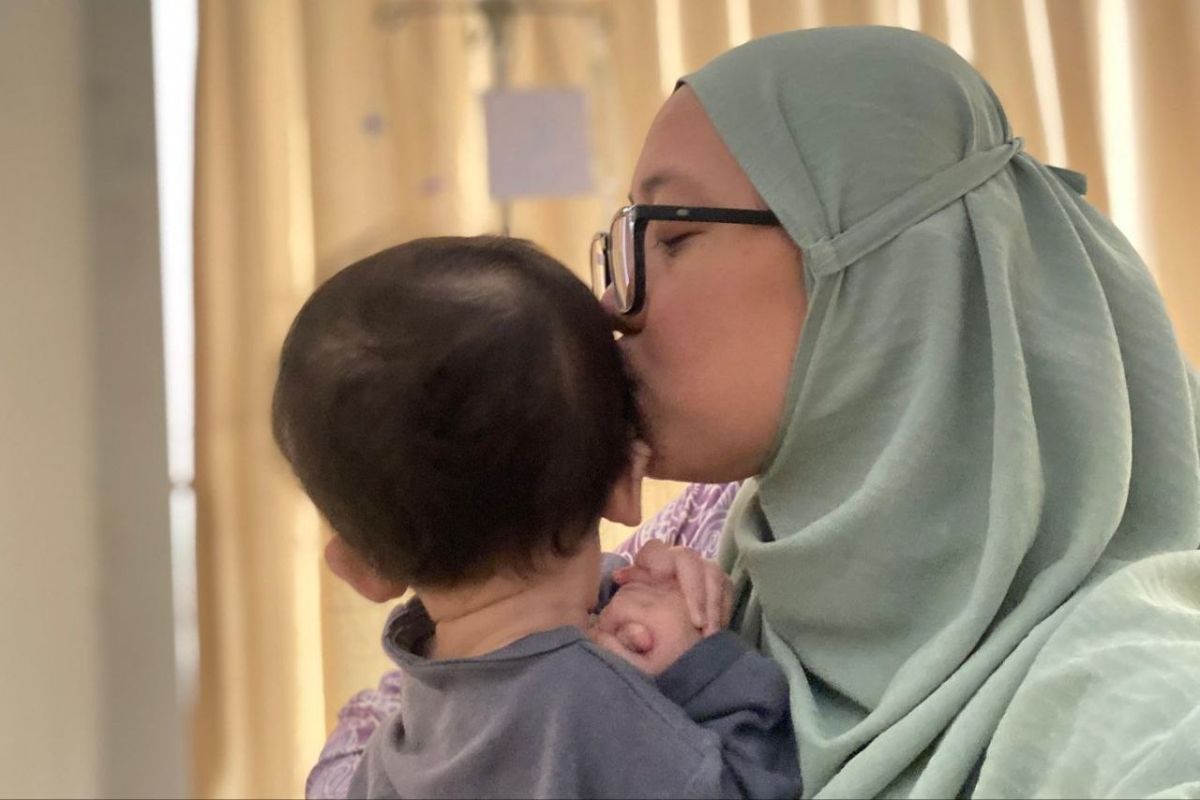
Isa may not yet understand all the figures. Perhaps Aisyah does not either. What makes Aisyah’s steps strong is that there are no hospital service fees to worry about in the fight for Isa’s health.
Jakarta (ANTARA) - July 2026. Almost every few weeks, Aisyah Qurrota Ain returns to the University of Indonesia Hospital (RSUI), Depok. In her arms is Isa Arbei Kencana Jenggala, her youngest son, who is now one year and two months old.
Isa was born with ventriculomegaly, an enlargement of the brain ventricles detected while still in the womb. Fortunately, no fluid accumulation pressing on the brain tissue was found, so no emergency surgery was required. However, his development must be monitored regularly. Last June, Isa even underwent hospitalisation. Recently, their hospital visits have become even more frequent.
“The doctor said he will be referred to RSCM,” Aisyah said softly.
That sentence revived memories that have not yet truly concluded. The hospital is no longer a foreign place for her. It holds memories of her second daughter, Maryam Galimah Syam Saba.
In October 2023, in Citayam, Depok, Aisyah wore a black gamis and hijab. Her eyes were swollen, but a thin smile occasionally appeared when welcoming friends, relatives, and companions who arrived one after another. Their number was almost as many as the guests who attended her wedding in the same place in early 2022.
The difference was, this time they came to mourn. To pay respects to Maryam, who passed away at the age of eight months after a life entirely defined by the struggle against illness.
Aisyability shared that Maryam did not cry when she was born at 35 weeks gestation. The tiny baby was immediately found to have a congenital heart defect.
“A leaky heart. Maryam spent three months in the NICU across three different hospitals after birth.”
Not only that, Maryam was a high-risk infant with several congenital diseases. In her final months, pneumonia struck again, requiring her to be hospitalised for three months at RSUI.
In the midst of those most difficult times, there was one thing that no longer troubled Aisyah’s mind: the cost of treatment.
“Indeed. If we weren’t using BPJS, oh dear,” she said briefly at the end of the story about the struggle to care for Maryam.
As a participant in the National Health Insurance (JKN) programme, she could focus solely on accompanying her daughter until the very last moment. During months of treatment in various hospitals, Aayah admitted she experienced no significant difficulties in the administration or financing of healthcare services.
Yet, eleven years earlier, she experienced a very different story.
January 2012 was the happiest month for Aisyah when her first son, Juan Bhumi Mahameru, was born. The name was chosen with the hope that the child would grow as resilient as Mount Semeru.
However, that happiness lasted only a few months.
In May 2012, Bhumi contracted pneumonia and had to be admitted to the Paediatric Intensive Care Unit (PICU). At that time, Aisyah had no health insurance coverage, including for her baby. All medical costs were covered by donations from friends and relatives.
Eventually, those donations ceased. Bhumi passed away at the age of three and a half months.
A similar story, though in a different situation, was experienced by Hermawan Ramadhan.
In mid-200ability 2009, he was a final-year student at the State University of Jakarta. His eldest sibling had just entered a private university, while his youngest sibling was still in junior high school. His mother, a primary school teacher, was the family’s breadwinner.
Hermawan clearly remembers the mixture of relief, anxiety, and panic when his mother was finally allowed to go home after being hospitalised for almost four weeks due to a stroke at Tugu Ibu Hospital, Depok.
That relief was quickly replaced by confusion. His family had to find a way to settle the remaining hospital bills.
At that time, his mother was indeed a participant in the government health insurance managed by PT Askes, the predecessor to BPJS Kesehatan. However, the system back then still had limited benefits. Services were prioritised in government hospitals, while treatment in private hospitals still required additional costs if the coverage ceiling was exceeded.
Almost a month of hospitalisation exhausted the benefit limit. Medicines whose prices exceeded the Drug Price Ceiling List (DPHO) also had to be paid for out of pocket.
The family’s savings were depleted. Hermawan eventually borrowed money from two of his uncles to settle the remaining hospital bills.
Five years later, his mother suffered another stroke and was treated at the same hospital.
However, Indonesia had changed. Since 1 January 2014, the National Health Insurance (JKN) programme has been operational with much broader coverage, no longer limited to specific groups, but intended for all Indonesian residents.
When his mother was hospitalised again in 2014, Hermawan, who by then had become a teacher at a private school, no longer faced the scheme of out-of-pocket expenses. The list of covered medicines also became more extensive through the National Formulary (Fornas), so the family no longer had to purchase medicine using personal funds, and most importantly, they no longer had to incur debt.
The struggle was long. His mother moved in and out of hospitals several times in 2015, 2016, and 2017 before finally passing away in 2018 at the age of 56. However, at least the financial burden that had gripped the family five years earlier was no longer part of the struggle.