
Small hands open the door to language: Surabaya students develop AI sign language app
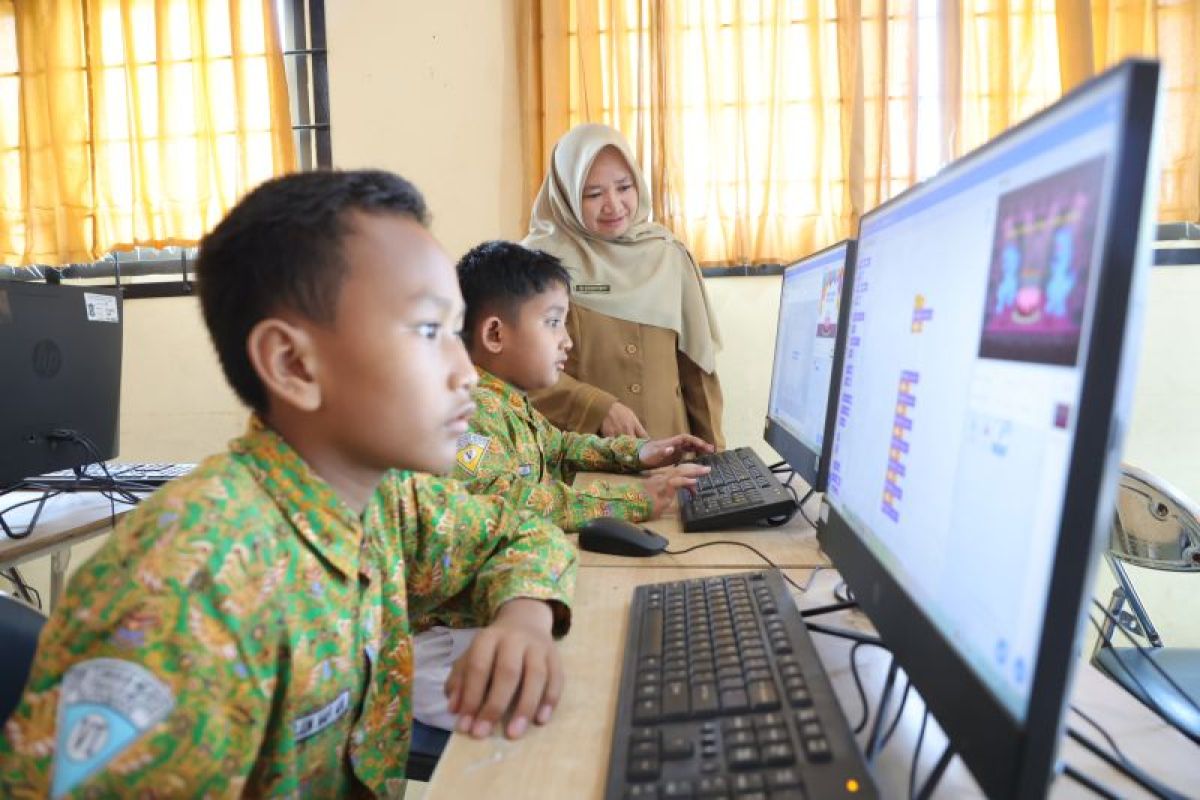
Surabaya (ANTARA) - There is a distance that is not always visible in classrooms, service counters, hospitals, terminals, and public spaces. That distance is not measured in kilometres, but in communication. One person speaks, another uses sign language, yet both often lack a shared language to understand each other. Amid this challenge, five students from SDN Tenggilis Mejoyo I in Surabaya, East Java, arrived with an unconventional approach. They did not wait until adulthood to create technology. With skills still in the learning stage, they developed a sign language translator, an AI-based sign language learning application. The team, called Nebula One and consisting of Arjun, Shaka, Aghna, Siraj, and Shauqi from grades five and six, developed the application over three to five months. They utilised the Pictoblocks platform and machine learning to recognise hand gestures. Their work earned them first prize in the Young Innovators category at Impact Fest 2026. What is compelling is not merely the technology they used. The real value lies in how these children perceive social issues. They discovered that sign language is not just a set of hand movements to be translated by machines. Sign language is a bridge of communication for the deaf community and part of their linguistic identity. Therefore, technology should be present to expand human communication capabilities, not to replace the humans who have long served as connectors. This issue is relevant to the inclusive education agenda. The Surabaya city government has issued Mayor Regulation Number 52 of 2022 concerning Guidelines for the Implementation of Inclusive Education. The regulation covers strengthening human resources, adaptive curricula, facilities and infrastructure, partnerships, and educational unit support. This means the innovation from the SDN Tenggilis Mejoyo I students emerged within a policy ecosystem that already has a foundation. The challenge is how that foundation is translated into evolving practices. Data from Satu Data Surabaya also shows that the city government regularly monitors the number of schools implementing inclusive education and the students participating in inclusive programmes. The dataset is updated through June 2026. In this context, the students’ application becomes more than just a competition project. It can be read as a reflection that inclusive education is not solely about accepting students with special needs in regular schools. Inclusive education also requires an environment where all children can understand one another. There is a small irony in the development of educational technology. On one hand, artificial intelligence is advancing rapidly. On the other, the most basic human challenge—communicating with one another—can still be hindered by a lack of knowledge.