
Sluggish Domestic Market, Indonesia's Car Exports Surge to Break 500,000 Units
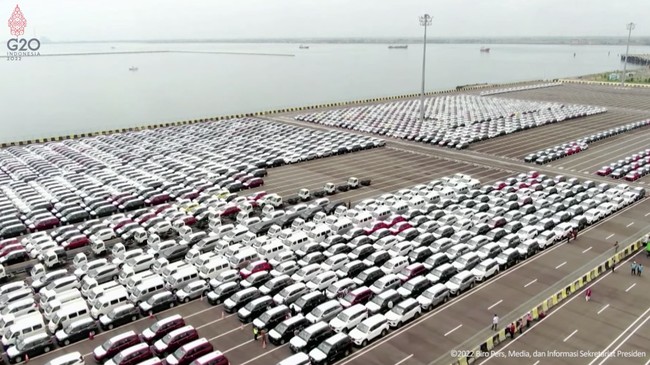
Indonesia’s automotive industry has faced unique dynamics in recent years. Amid a slowdown in the domestic market, export performance has shown a significant surge.
National four-wheeled vehicle production has remained stable above one million units per year. This is supported by increasingly aggressive export strategies from industry players.
Director General of Metal, Machinery, Transportation Equipment, and Electronics Industries (ILMATE) at the Ministry of Industry, Setia Diarta, revealed that Indonesia’s automotive production has surpassed the one million unit mark.
“In terms of production, we actually exceeded 1.1 million last year. Domestic sales were around 804,000, and more than 500,000 for exports,” Setia stated during a discussion at the Industrial Journalists Forum (Forwin) on Wednesday (22/4/2026).
He explained that this shift demonstrates Indonesia’s strength as a global production base, not just a domestic market.
“So with 800,000 production, minus some programmes that indeed have investment commitments, we produce 600,000 that are sold locally and then the remaining around 500,000 is for exports,” he said.
This trend shows that the national automotive industry is able to adapt amid pressures in the domestic market.
“This is at a time when our market may be declining, but on one side it is starting to show Indonesia’s advantages as one of the exporting countries for four-wheeled vehicles,” he clarified.
The government is encouraging Indonesia to be further strengthened as a global export hub by the world’s automotive principals. The export surge from 300,000 to around 500,000 units serves as a clear indicator of the success of this strategy.
On the other hand, the vehicle ownership ratio in Indonesia is still relatively low, opening up growth opportunities in the future.
“Four-wheeled vehicles currently, if we look at the ownership ratio, it’s still 99 per 1,000,” Setia revealed. This potential is seen as the main attraction for investors to continue investing in Indonesia.
“This also serves as a note on how the large market potential still motivates these brand holders to continue production in Indonesia,” he said.