
Sleman Primary School Creates Vegetable Garden from Hundreds of Used Gallons, Uses Free Nutritious Meal Waste as Fertiliser
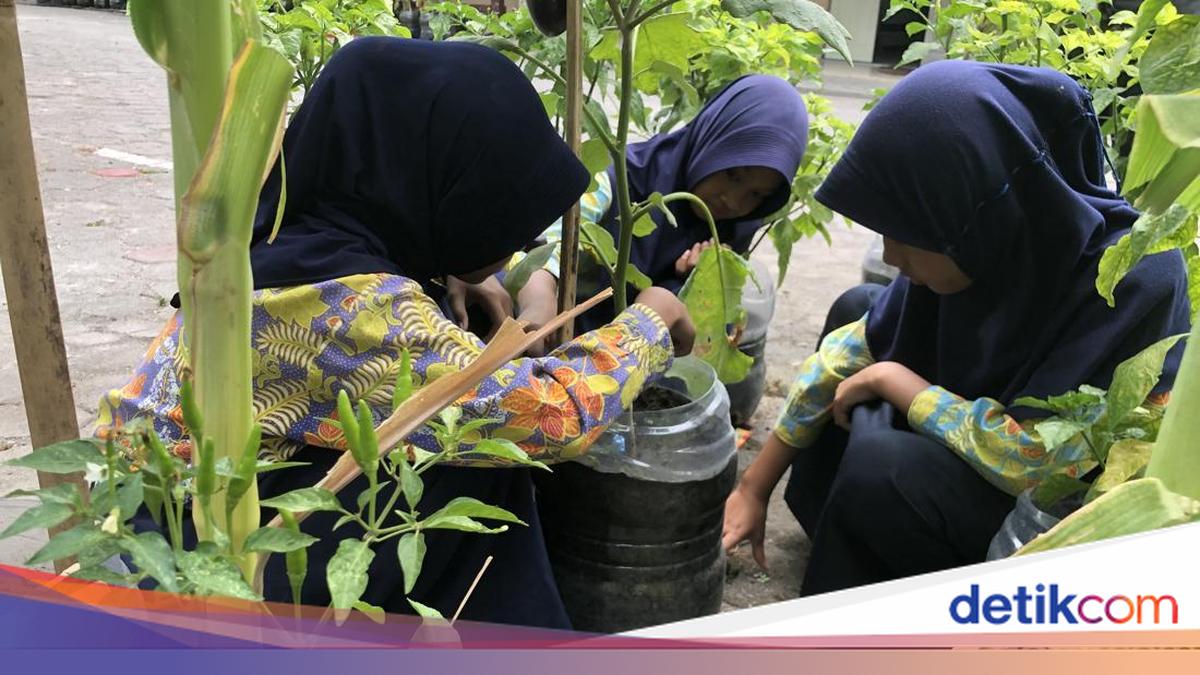
SD Negeri Purwosari in Mlati, Sleman, has found a creative way to utilise hundreds of abandoned water gallons found around the school. They have established a vegetable garden, using waste from the Free Nutritious Meal (MBG) programme as fertiliser.
Observations at the school show that hundreds of used gallons, placed along the field edges and in front of classrooms, serve as planting media for various vegetables, including chillies, aubergations, tomatoes, cucumbers, mustard greens, peanuts, and long beans.
The Headmaster of SD Negeri Purwosari, Zaenuri (42), stated that at least 500 gallons are currently being used as plant pots. The idea was initiated in July 2026, after he noticed the large amount of plastic waste generated by the school.
“There are over 500 gallons. Our school produces a lot of gallon waste weekly because we have six classes and a staff room,” explained Zaenuri when met at the school on Wednesday (7/10/2026).
These gallons have been transformed into a curriculum diversification programme themed around food security. The goal is to introduce students to various types of vegetables and the process of cultivation.
“We are providing agricultural education to the children. This is integrated education; it is not just about agriculture, but we also integrate it with fisheries and livestock,” Zaenuri explained.
“The agricultural system is divided into plots. There are six plots managed by each class. Each plot is the responsibility of the students in that class, guided by their teachers and the class parent associations.”
Utilising MBG Waste
Zaenuri noted that the school did not spend any money to start this programme. The planting medium uses soil from the school grounds, and the initial seeds were sown by the school itself.
Regarding fertiliser, Zaenuri stated that the school utilises waste from the Free Nutritious Meal (MBG) programme to produce liquid organic fertiliser, mixed with other organic waste produced by the school.
“We use liquid fertiliser from MBG waste and other organic waste around us, which we sort. The wet waste is placed in a composter. The composter produces liquid fertiliser, which we harvest periodically and apply by mixing it with water,” he explained.
“Previously, the MBG waste was causing a problem for us as we had no solution. However, through a meeting between the class parent associations, teachers, and guardians, we found a solution to utilise this waste.”
By using MBG waste, the school can produce up to one 25kg bucket of liquid organic fertiliser per week. This amount is sufficient to meet the needs of the school’s gallon garden.
“We can produce one bucket a week because we use not only MBG waste but also old leaves and rotten fruit from our plants and the school kitchen,” he added.
Interestingly, this integrated farm programme does more than just teach students about the cycle between agriculture, fisheries, and livestock. According to Zaenuri, through gardening, students have developed a greater appreciation for their food.
“We aim to provide comprehensive education, from sowing to making composters and homemade insecticides, so the learning is complete for the children. This has increased the children’s awareness in valuing food. Consequently, MBG waste is decreasing, which is our hope—that the MBG programme is well-absorbed. However, some waste like fruit peels remains, which we use for the composter,” Zaenuri continued.
Generating Profit
While the initial idea was for educational purposes and waste management, the vegetable harvest has become abundant over time. Some of the harvest is used by the school for cooking classes, where each class cooks using their own produce.
“Because we plant in such large quantities—over 500 plants—we can harvest up to 5kg every two days, including tomatoes, cucumbers, long beans, and chillies,” Zaenuri explained.
The abundant harvest has recently attracted interest from local residents looking to buy the produce. Starting with class parents, culinary vendors near the school, such as ‘pecel lele’ stalls and ‘angkringan’ (street food vendors), are now willing to purchase the harvest.
“Alhamdulillah, in recent months, we have been harvesting almost every two days. Some of the harvest is used for marketing and it has been selling very well; some orders are even pre-booked,” said Zaenuri.
“Because we use an organic system, there is high demand. Not just from parents, but from various businesses like ‘pecel lele’ vendors. They have even requested tomatoes daily, and for chillies, we are actually running low.”
The revenue from these sales is managed and used for the needs of each class. The students manage everything, including management and marketing, under the guidance of their teachers.
“This has successfully generated almost Rp 1 million. The sales are managed by the students and guided by the teachers. The proceeds return to the class associations and students to be used for the next cycle, such as maintenance and purchasing new seeds, as well as other classroom needs,” concluded Zainturi.
Source: jawawa.id (https://jawawa.id/newsitem/sleman-primary-school-creates-vegetable-garden-from-hundreds-of-used-gallons-uses-free-nutritious-meal-waste-1791359545)
Originally published by detikJogja (https://www.detik.com/jogja/kota-pelajar/d-8696300/sd-di-sleman-bikin-kebun-sayur-dari-ratusan-galon-bekas-sisa-mbg-jadi-pupuk), translated from Indonesian