
Sleman Farmer Shares Tips for Growing Jumbo Pineapples Using Used Water Gallons
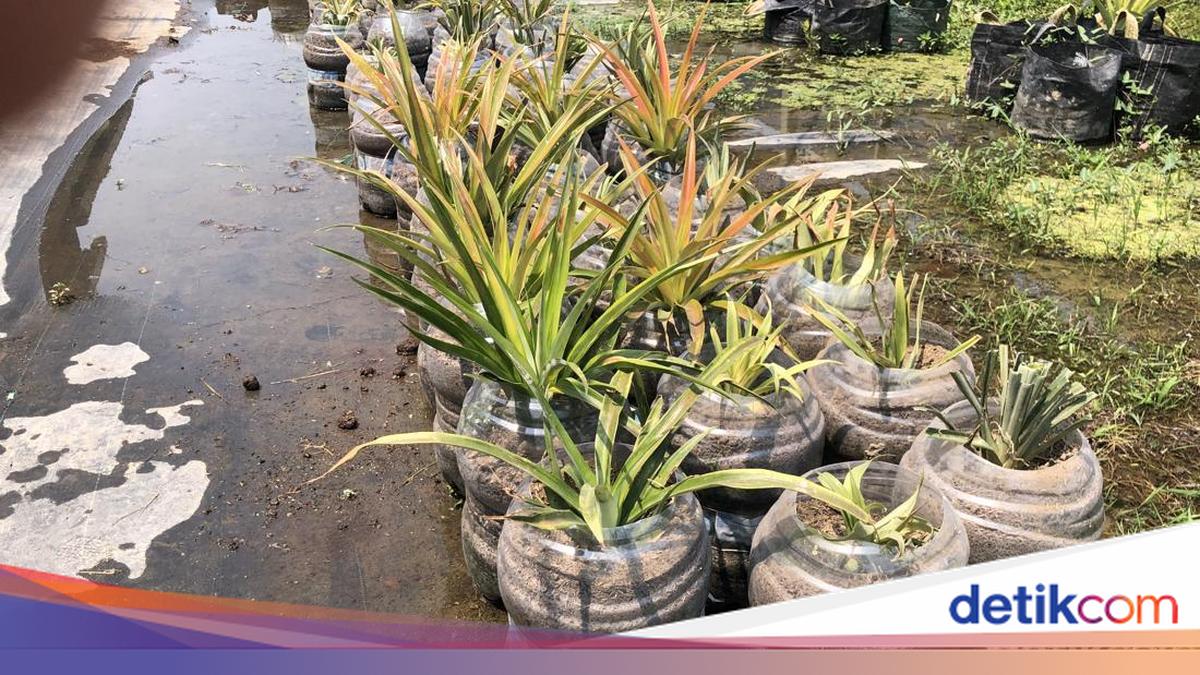
A young farmer from Sleman, Jamaludin Nur Ridho (25), has successfully produced jumbo pineapples weighing up to 5 kilograms using used water gallons as planting containers. He also shared tips for anyone who wants to try.
Jamal’s jumbo pineapple cultivation is located at Kampung Nanas Amargaluwih Jumbo, Padukuhan Barak, Kalurahan Margoluwih, Seyegan, Sleman, precisely at Jamal Farm. The pineapple variety developed by Jamal using used gallon containers is the Smooth Cayenne Philippines type, which is capable of producing jumbo pineapples weighing 2 to 5 kg.
“This pineapple can be developed for urban farming or developed using urban agriculture methods, one of which is planting in gallon containers,” said Jamal when met at Jamal Farm on Sunday (16/8/2026).
“Our tagline is turning waste into rupiah, turning waste into blessings. So piles of gallon waste can be used to cultivate jumbo pineapples,” he continued.
Jamal shared tips for cultivating jumbo pineapples in used gallon containers. He mentioned that cutting the used gallon also needs attention; do not let too much be wasted.
“The first tip is to cut the top side of the gallon, so do not let too much of the gallon be wasted. The first ring on the gallon is what is cut,” he explained.
“The aim is that the bigger or taller the gallon, the more growing medium can be put in,” Jamal continued.
He went on to say that the bottom of the cut gallon should be perforated for water circulation so that it does not become waterlogged.
“Third is the growing medium. There are three growing media for pineapples: fertile soil from bamboo roots, or if not available, ordinary soil is fine. Second is rice husk, preferably burnt because it contains phosphate and potassium, which make the pineapple large and sweet,” Jamal explained.
“Next is organic fertiliser. You can use goat manure or ground and fermented fertiliser, which is better. Mix with a ratio of 1:1:1, mix it, put it into the gallon, and plant the seedling,” he added.
The location where the pineapple in the gallon is placed can also affect plant growth. He said that pineapples in gallons should be placed in a hot location because the hotter it is, the faster the plant flowers and bears fruit; the hotter it is, the faster the plant grows and the sweeter the fruit.
“We are also required to provide fertiliser regularly once a month, just one spoonful. You can use NPK; if you want it to flower, use MKP; if it has already fruited, use KCL to make it sweet and jumbo,” he said.
“Planting pineapples is like a continuous charity. Planting one tree can yield 3 to 7 offshoots (potential seedlings) at harvest,” he said.
Jamal admitted that he has only been using used gallons as a growing medium for jumbo pineapples for two to three years. Although planter bags and pots are still dominant, rows of hundreds of used gallons complete with pineapple plants line Jamal Farm.
He has gone through several trials before finally succeeding in cultivating jumbo pineapples in used gallons. His success has been followed by his neighbours.
“Only in the last 2-3 years, we did trial and error on whether planting pineapples in gallons could work. We tried various research, and the results are starting to be harvested. Many people have started planting using gallons. Initially it was only at Jamal Farm, then residents in Barak I and Barak II hamlets began utilising gallons,” Jamal revealed.
“Alhamdulillah, the harvest results in gallons are also satisfying, averaging 2 kg. If we sell it at Rp 30,000 per kilogram, that is Rp 60,000, with only the cost of a gallon. But for the Smooth Cayenne Philippines type, it can reach 5 kg,” he added.