
Six PDI-P Regional Leaders Urge Residents to Turn Waste into Income
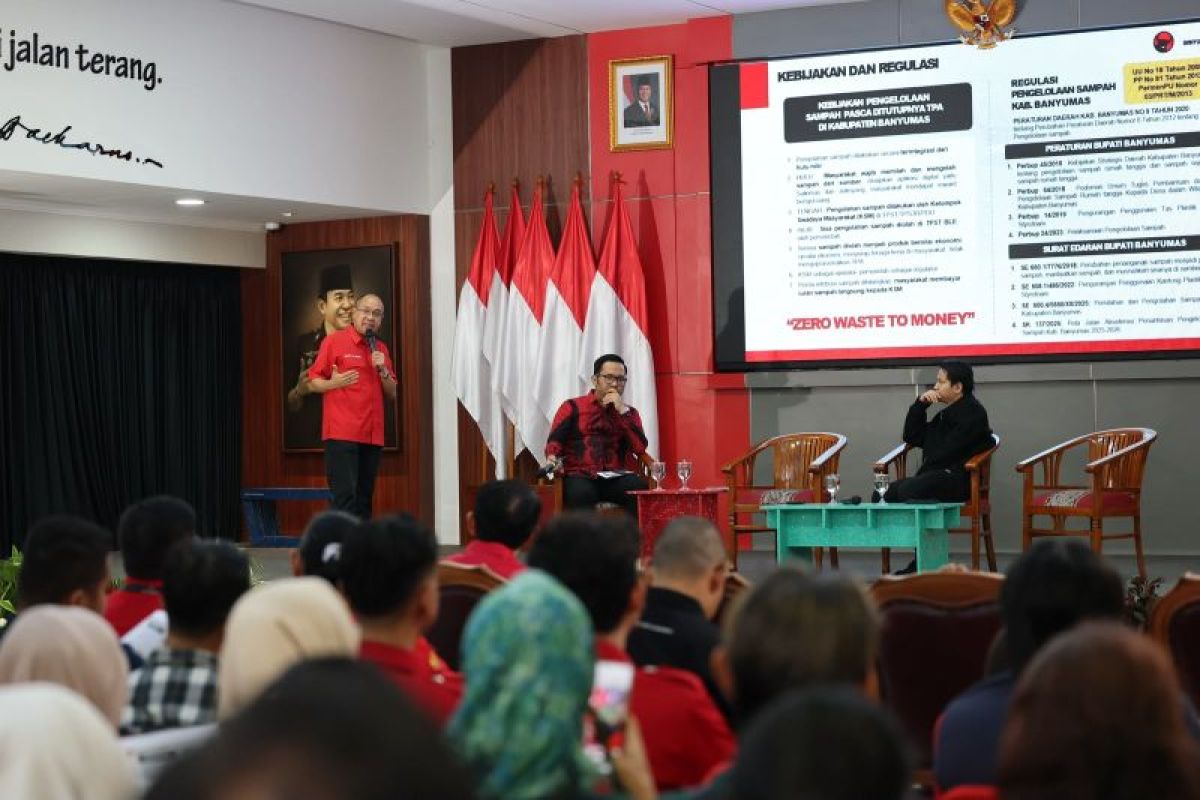
Jakarta (ANTARA) – Six regional leaders from the Indonesian Democratic Party of Struggle (PDI-P) said waste problems cannot always be solved by building expensive facilities. They said the key lies in two things: ensuring residents are involved from their homes and making sure the economic value returns to them.
The leaders were Banyumas Regent Sadewo Tri Lastiono, Trenggalek Regent Mochamad Nur Arifin, Bali Governor I Wayan Koster, Yogyakarta Mayor Hasto Wardoyo, Banyuwangi Regent Ipuk Fiestiandani and Surabaya Mayor Eri Cahyadi, along with PDI-P Central Executive Board chair Basuki Tjahaja Purnama.
Speaking from Yogyakarta, Mayor Hasto Wardoyo began with a budget item that was easy to cut. He redirected nearly Rp3 billion allocated for the purchase of two official cars to buy 600 waste carts.
“I did not use the car-purchase budget to buy cars; I used it to buy carts to collect waste from residents’ homes,” Hasto said in a written statement in Jakarta on Tuesday.
The remarks were made at a talk show on regional leaders’ waste management approaches during the 2026 National Waste Awareness Week (PPSN), themed “Caring for the Earth”, at the PDI-P Party School in Lenteng Agung, South Jakarta, on Tuesday.
The carts are the first link in the Mas Jos (Jogja Community Processes Waste) initiative. Household food scraps are collected in special buckets and sold as animal feed, while edible food from hotels and restaurants is distributed through food banks. The city now has nearly 600 waste banks and 1,000 teba, traditional composting pits.
In Banyumas, the incentive takes the form of wages. All 3R waste processing sites and integrated waste processing facilities are managed by community self-help groups staffed by local residents.
“Women stand on either side of the conveyor feeder. They were initially paid from the regional budget, but can now support themselves. We have around 2,400 workers,” said Banyumas Regent Sadewo Tri Lastiono.
After residents forcibly closed the landfill in 2018, Banyumas built a system that processes waste without a landfill. The regional budget for waste-management operations has fallen from more than Rp30 billion a year to Rp10.8 billion, while waste-related revenue now stands at Rp2 billion to Rp3 billion a month.
“We distribute the fertiliser to farmers for free,” he said.
Trenggalek Regent Mochamad Nur Arifin took the firmest line on residents’ costs. All schools have been turned into waste stations, where students deposit rubbish and receive points: 4.17 points for a plastic bottle, 2.5 for paper, 1.25 for soft plastic and five for used cooking oil. The points are converted into cash every three months, after the waste has been sold.
“I have now returned billions of rupiah to students’ accounts,” Nur Arifin said.
For keeping neighbourhoods clean, he opted for a competition rather than hiring cleaners.
“Instead of paying people to clean up, I offer a prize of Rp200 million. That can cover the whole regency,” said Gus Ipin, as he is commonly known.
He also rejected charging residents a waste fee. “As long as this system is working, I will hold back and will not collect a waste fee from residents, even though there is the principle that polluters must pay. I feel sorry for my people if they are asked to pay a fee,” he said.
Banyuwangi Regent Ipuk Fiestiandani said her region’s waste-management rate rose from 24 per cent in 2021 to nearly 69 per cent in 2025 through 33 3R waste processing sites. However, she acknowledged that building facilities was not enough.
“When public awareness is absent, all of that is pointless,” Ipuk said, referring to a fresh accumulation of 7.5 tonnes of rubbish in Kali Mati, Muncar, which occurred two weeks after the area had been cleaned.
Bali Governor I Wayan Koster has taken a regulatory approach: Bali banned plastic bags, straws and polystyrene under Governor Regulation No. 97/2018, then prohibited drinks in containers smaller than one litre from April 2022.
“A company sells a product and makes a profit, but we in the regions are left with the waste,” he said.
Surabaya Mayor Eri Cahyadi described a regional leader’s role as that of an orchestra conductor. The city has involved 1,360 neighbourhood units (RW) in composting and teba initiatives, with the goal of turning every RW into a zero-waste neighbourhood by 2027.
Basuki Tjahaja Purnama, responding to the forum, called for the proven approaches to be documented so they would not remain merely local experiences. “There is no need for more studies; these approaches have been proven. If we want to manage waste, we must set targets,” he said.
PPSN 2026 organising committee chair Patricia Hutapea said the movement is rooted in small habits exemplified by PDI-P chair Megawati Soekarnoputri.
“The spirit of Caring for the Earth grows from the example set by Ibu Megawati Soekarnoputri. She teaches us through everyday habits filled with care,” Patricia said.
Source: jawawa.id (https://jawawa.id/newsitem/six-pdi-p-regional-leaders-urge-residents-to-turn-waste-into-income-1794318698)
Originally published by Antara (Indonesian) (https://www.antaranews.com/berita/5844859/enam-kepala-daerah-pdip-ajak-warga-olah-sampah-jadi-rupiah), translated from Indonesian