
Six Months to Convince MSCI
Six months is not enough to put together a new set of rules, and that is not what is being awaited.
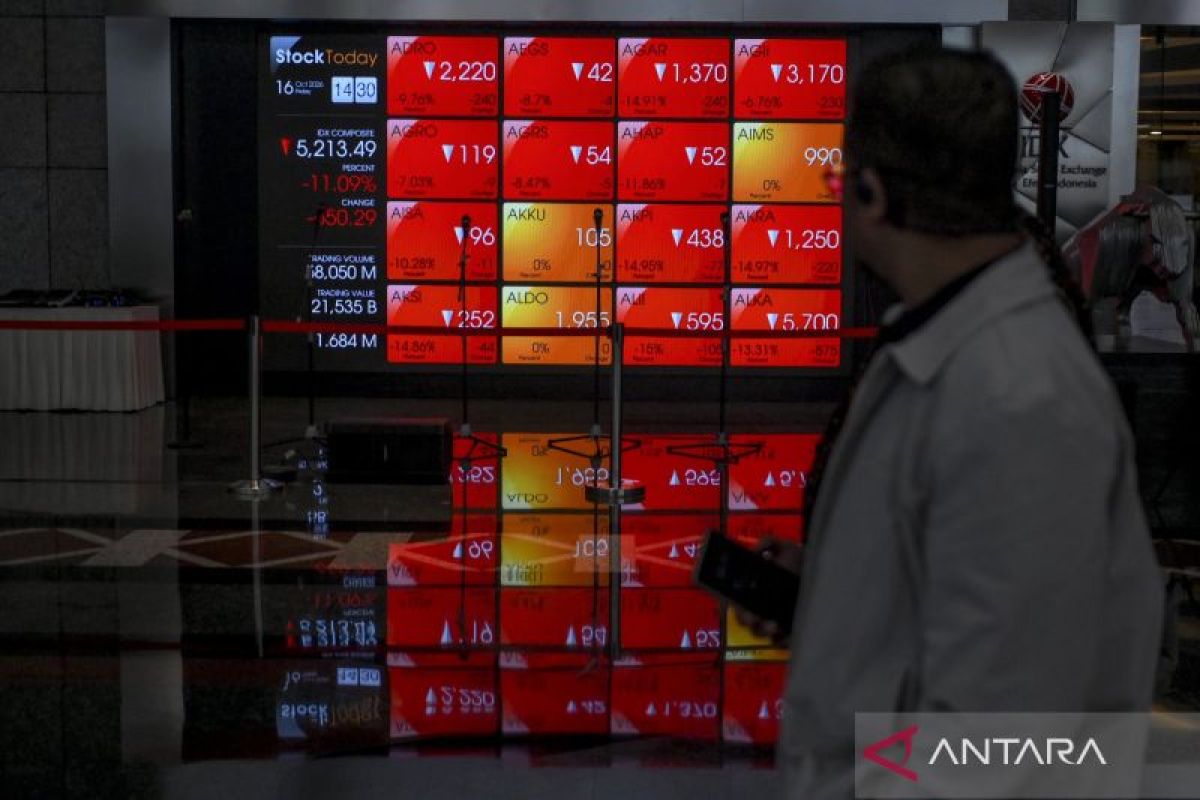
Jakarta (ANTARA) – On Friday morning, 16 October, retail investors’ stock-trading apps “caught fire” shortly after the market opened. The Jakarta Composite Index (JCI) immediately fell by 8.01 per cent, prompting the Indonesia Stock Exchange (IDX) to impose a trading halt.
By the market’s close that evening, the index stood at 5,185.10, down 11.57 per cent in a single day. The last time it suffered a daily fall of that magnitude was during the 1998 crisis.
The trigger came from New York a few hours earlier. MSCI, the index provider whose benchmarks are used by global investment funds, opened a consultation on moving Indonesia from the emerging-market group to standalone-market status, a category outside its main index families.
Standalone-market status would place Indonesia’s capital market alongside those of Jamaica, Panama and Palestine.
The reasons cited by MSCI did not concern economic growth or listed companies’ profits. According to MSCI, global market participants were concerned about persistently opaque share ownership structures and suspected coordinated trading that distorts price formation.
For anyone active in the stock market, neither issue will sound unfamiliar. Almost every active market participant has seen large-cap shares multiply in value in a short period, while the proportion of shares genuinely available to the public remained small.
A question usually confined to investor discussion groups has now appeared in an official document from the world’s largest index provider: who is really setting prices on the Jakarta exchange?
The key term is free float: the proportion of shares available for public trading. On paper, the figure is recorded in company reports. In practice, some shares listed as publicly owned may be held by parties connected to the controlling shareholder.
This loophole prompted MSCI, from January 2026, to freeze several changes to Indonesian stock indices, including increases in foreign inclusion factors, and to stop adding new companies to its recommendations for global institutional fund managers.
On the same day the index plunged, the Financial Services Authority (OJK) disclosed findings from investigations showing how the loophole operated.
Hasan Fawzi, OJK’s Chief Executive for Capital Markets, Derivatives Finance and Carbon Exchanges, said that shares offered in the initial public offerings of two Barito Group companies, PT Barito Renewables Energy Tbk (BREN) and PT Petrindo Jaya Kreasi Tbk (CUAN), had from the outset been allocated to groups connected to their controlling shareholders.
Those parties received very large guaranteed allocations while concealing their identities, concentrating ownership within particular groups.
In the case of PT Dian Swastatika Sentosa Tbk (DSSA), OJK found planned and structured market manipulation by individual and institutional clients operating through several brokerage firms, causing the share price to rise abnormally.
Administrative fines amounted to Rp1.5 trillion in the DSSA case, Rp500 billion for BREN and Rp100 billion for CUAN. The investigation covered securities-company directors, custodian banks and recipients of guaranteed allocations, while OJK continues to trace the flow of funds.
For retail investors, the findings explain an experience that has long been difficult to prove. When most of a company’s shares are controlled by one circle, the price on screen is formed by a very limited supply, rather than purely by the forces of supply and demand.
Retail investors who enter later are buying from a pool whose size and ownership they have never truly known.