
Six Months into Iran War, Trump and the World Face Six Painful Consequences
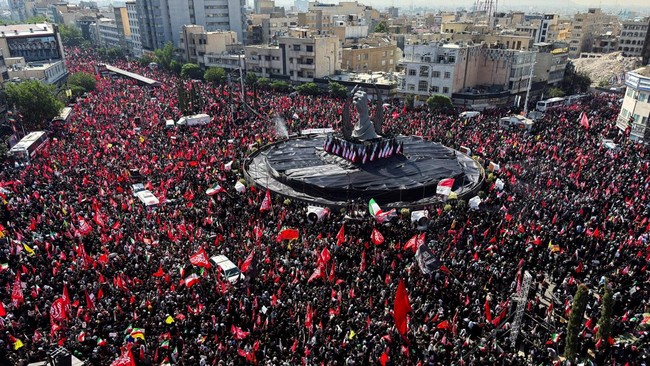
Six months after the United States and Israel launched strikes on Iran, the conflict that President Donald Trump initially called a ‘small trip’ has turned into a protracted war with no clear exit in sight. Iran has not surrendered, while disruptions in the Strait of Hormuz continue to pressure the global economy.
Now, the US is beginning to rely again on economic pressure after military operations failed to force Tehran to make concessions. US Secretary of State Marco Rubio told allies that Washington likely will not launch new strikes ‘for now’.
Here are six consequences facing Trump and the world during the Iran war, as cited by Reuters on Friday (28/8/2026).
- Trump Faces Political Pressure
The war has become a political burden for Trump. A Reuters/Ipsos poll shows Trump’s approval rating has fallen from 40% to 33% since the conflict began, amid rising fuel prices that contradict his campaign promise to lower the cost of living.
Only 31% of Americans say they support the conflict. This low level of support could become a problem for the Republican Party ahead of the November midterm elections, when the party is trying to maintain its slim majority in Congress.
The conflict has also widened divisions among Republican members over whether military pressure on Tehran should continue.
- Global Economy Shaken
The war has battered energy markets because the Strait of Hormuz, a strategic waterway about 34 kilometres wide, handles roughly one-fifth of the world’s energy supply. Shipping disruptions briefly sent oil prices soaring and raised concerns about a global economic slowdown.
However, the impact so far has been more limited than the worst-case scenario. The International Monetary Fund now forecasts global economic growth of 3% this year, down from a projection of 3.3% in January.
Major economies are considered more resilient to energy shocks than during the 1970s oil crisis, partly due to more efficient energy use and strong investment and spending, including in the artificial intelligence sector.
- Iran Battered, but Not Defeated
The strikes have caused major damage to Iran’s military and economy. The US military commander for the Middle East, Admiral Brad Cooper, said in May that US forces had destroyed 161 Iranian warships and disabled 82% of its air defence systems.
However, Tehran still has the ability to launch drones and missiles and to maintain disruptions to shipping in the Strait of Hormuz. The war has also worsened Iran’s economic conditions. Food inflation reached 128% year-on-year in July, according to the Statistical Centre of Iran.
Politically, the conflict has actually reduced internal divisions and strengthened the government’s actions against opposition groups.
- Middle East Increasingly Unstable
The US and Israel’s goal of reducing the Iranian threat has instead created new uncertainty in the region. Iranian missile and drone strikes against Gulf states allied with the US have hit military and diplomatic facilities and disrupted aviation.
Disruptions to Iranian shipping, coupled with Houthi actions against Saudi-linked traffic in the Red Sea, have raised insurance and transport costs. The impact has spread to supply chains and the economies of Gulf states.
- Iran’s Nuclear Programme Slows
US and Israeli strikes damaged three Iranian enrichment facilities and a number of sites suspected of being linked to the weapons programme. US intelligence in May estimated that the time Iran needs to produce enough fissile material for one nuclear bomb has now stretched to up to one year, compared with about six months before the war.
Even so, the actual state of Iran’s nuclear programme remains difficult to ascertain because UN inspectors have not returned to some sites. The International Atomic Energy Agency has also been unable to verify the whereabouts of about 440 kilogrammes of uranium enriched to 60%. Iran has long denied developing nuclear weapons.
- US Military Readiness Also Drained
The war has also strained US military capabilities. Eighteen US military personnel have been reported killed and more than 750 others wounded, while a Congressional Research Service report says 42 US military aircraft have been lost during the conflict.
Ammunition stockpiles are a major concern. Reuters reported that the US has used nearly its entire global stockpile of certain types of precision missiles. The Centre for Strategic and International Studies estimates that as of July the US had used about 65% of its Patriot interceptors and reduced its stock of THAAD interceptors by at least 38%.
Washington has also deployed warships, fighter jets and other assets to the Middle East from Europe and the Asia-Pacific, meaning the Iran war is beginning to raise questions about US military readiness to face threats in other regions.
Source: jawawa.id (https://jawawa.id/newsitem/six-months-into-iran-war-trump-and-the-world-face-six-painful-consequences-1787892645)
Originally published by CNBC Indonesia (https://www.cnbcindonesia.com/news/20260828092812-4-763014/6-bulan-perang-iran-trump-dan-dunia-hadapi-6-konsekuensi-pedih), translated from Indonesian