
Six Key Things to Watch from the Fed That Could Turn Markets Upside Down
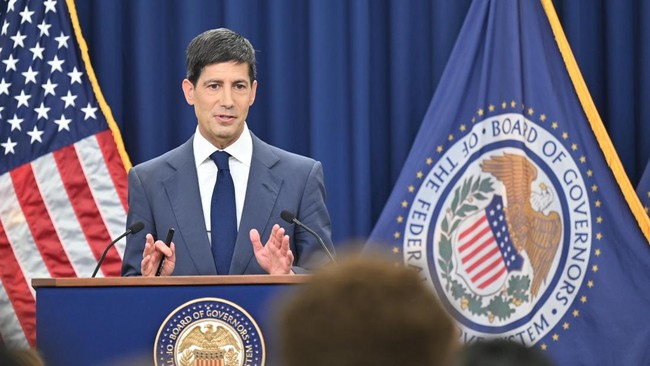
Jakarta, CNBC Indonesia – The US central bank, the Federal Reserve (Fed), is holding a monetary policy meeting on 27–28 October 2026. The outcome of the Federal Open Market Committee (FOMC) meeting is due to be announced at 01:00 WIB on Thursday (29 October 2026).
Unlike at its meeting in September, markets expect the Fed to leave its benchmark interest rate unchanged this time.
At the September FOMC meeting, the Fed raised interest rates by 25 basis points (bps) to 3.75%–4.00%. It was the first increase since 2023 and marked a shift in policy after the US central bank cut rates throughout 2025.
Investors are now focused not only on whether rates will rise again, but also on how long the Fed will maintain its current tight policy.
CME FedWatch data show a roughly 90% probability that rates will remain at their current level.
Even so, markets still expect another rate increase before the end of the year.
1. The rate decision: hold or raise again?
The first thing markets are waiting for, of course, is the Fed’s decision on its benchmark interest rate.
Most market participants expect the federal funds rate to remain in the 3.75%–4.00% range, following the 25-bps increase in September.
However, the state of the US economy still gives the Fed reasons to raise rates again.
Inflation remains well above the 2% target, while rising oil and fuel prices could make goods and services more expensive.
On the other hand, several Fed officials have indicated that the central bank has time to assess economic developments before making its next decision.
Fed Vice Chair Philip Jefferson, for example, has highlighted the rise in US Treasury yields, which has tightened financial conditions.
Higher bond yields make borrowing more expensive, meaning that households and businesses are already feeling some of the effects of monetary tightening even if the Fed does not raise rates again.
Therefore, holding rates in October would not necessarily mean the Fed was beginning to ease policy.
Markets will instead seek clarity on whether the decision is merely a temporary pause before another increase.
2. Signals of a December rate increase
After the October decision, investors’ attention will turn to the year’s final FOMC meeting, scheduled for 8–9 December 2026.
Ahead of the October meeting, CME FedWatch data showed markets assigning a probability of about 76.3% to the Fed raising rates at least once by December.
That expectation is consistent with the September FOMC meeting, when most Fed officials still saw a need for an additional rate increase before the end of the year.
In the September projections, the median forecast for the Fed’s rate at the end of 2026 was around 4.1%, equivalent to a target range of 4.00%–4.25%.
That is higher than the current range of 3.75%–4.00%.
One point to note is that the October FOMC is not scheduled to publish updated economic projections or a new dot plot.
The dot plot shows individual Fed officials’ estimates of the future direction of interest rates. It was last updated in September and is due to be updated again in December.
As a result, clues about the possibility of another rate increase will come mainly from the FOMC’s official statement and Fed Chair Kevin Warsh’s press conference.
If the Fed signals that another increase is still needed, expectations of a December rise could strengthen.
Conversely, if the Fed begins to express concern about a slowing economy, markets may scale back their expectations for another increase.
3. Kevin Warsh’s remarks and the Fed’s policy direction
Another key issue is how Kevin Warsh explains this monetary policy decision.
Since taking the helm at the Fed, Warsh has been known to favour a less explicit approach to forward guidance – the practice of a central bank giving clear indications of the likely future direction of interest rates.
In Warsh’s view, providing too much guidance too far in advance risks making it appear that the Fed is committed to a particular decision, even though economic conditions can change at any time.
That stance has made Warsh’s communications a particular focus for investors.
This is especially so given that several Fed officials have already indicated that a rate increase in October is not especially urgent.
Markets will watch to see whether Warsh shares that view or adopts a firmer stance on inflation.
In its September statement, the Fed reaffirmed its commitment to bringing inflation back to the 2% target more quickly.
If it reiterates that message in October, markets may interpret it as a sign that the Fed has not finished raising rates.
However, if Warsh focuses more on the risk of an economic slowdown and the need to wait for further data, investors may see room for a more cautious policy.
The wording of the FOMC statement and Warsh’s answers at the press conference could therefore have a greater impact on markets than the decision to hold rates itself.
4. The Fed’s view of inflation and the US economy
Developments in US inflation are a major reason why markets still expect rates to rise in the coming months.
According to the Bureau of Labor Statistics (BLS), US consumer inflation reached 3.7% year on year in September 2026, up from 3.4% in August.
On a monthly basis, consumer prices rose 0.6%, faster than the 0.4% increase in August.
Energy was the biggest source of pressure. The energy price index jumped 20.4% year on year, while petrol prices rose 34.2%.
This was linked to a surge in global oil prices amid geopolitical tensions in the Middle East.
Higher energy costs also risk spreading across the economy, particularly through increased transport and distribution costs and higher production expenses.
But the Fed faces another equally important issue: the state of the labour market.
BLS data show that the US economy added just 29,000 jobs outside agriculture (non-farm payrolls) in September 2026. The unemployment rate stood at 4.2%.
These two developments present the Fed with a challenge.
On the one hand, high interest rates are still needed to bring inflation down. On the other, if policy is too tight, economic growth and job creation could weaken further.
Markets will be watching how much attention the Fed gives to both problems.
If Warsh emphasises high inflation and the need to maintain price stability, the likelihood of another rate increase could grow.
Conversely, if the weakening labour market receives greater attention, the Fed may choose to slow the pace of monetary tightening.
5. Differences of opinion within the Fed
Alongside the rate decision, markets will also pay attention to the FOMC officials’ vote.
In September, all 12 voting members supported the 25-bps increase.
That degree of agreement may not be repeated in October.
Some economists expect two or three officials to dissent if the FOMC majority decides to hold rates.
Cleveland Fed President Beth Hammack and Dallas Fed President Lorie Logan are among those considered more likely to favour a rate increase.
Both have previously voiced concern that the current rate may not be high enough to bring inflation down sustainably.
Markets will therefore look not only at the final decision, but also at how many FOMC members actually favour tighter policy.
If several officials vote for a rate increase, that could strengthen the view that October’s hold is only temporary.
Conversely, if the decision is unanimous, investors will consider whether that reflects shared caution or a change in views about inflation risks.
6. Kevin Warsh’s independence amid pressure from Donald Trump
The October FOMC meeting is also taking place in a politically sensitive environment.
It will be a test of Kevin Warsh’s independence as Fed chair, particularly amid pressure from US President Donald Trump over interest rate policy.
Trump has repeatedly called for lower rates to help boost economic activity.
However, in September Warsh led the decision to raise rates by 25 bps, contrary to Trump’s preference for looser monetary policy.
That move helped ease some market participants’ concerns about the Fed’s independence.
Even so, the issue is not fully resolved. Trump has again sought to remove Fed Governor Lisa Cook, while communications between the White House and the central bank’s leadership continue to draw attention.
The timing adds to the significance of the meeting: the October FOMC decision will be announced only days before the US midterm elections, scheduled for 3 November 2026.
Investors will watch how Warsh responds to questions about political pressure and whether monetary policy decisions are genuinely based on economic conditions.
The Fed’s independence is important for maintaining market confidence in US monetary policy.
If investors begin to doubt the central bank’s ability to make decisions independently, uncertainty could rise, particularly in bond and foreign exchange markets.
Source: jawawa.id (https://jawawa.id/newsitem/six-key-things-to-watch-from-the-fed-that-could-turn-markets-upside-down-1793181153)
Originally published by CNBC Indonesia (https://www.cnbcindonesia.com/research/20261028133853-128-780214/6-hal-paling-ditunggu-dari-the-fed-dunia-bisa-dibuat-jungkir-balik), translated from Indonesian