
Single-Door Export Policy Not Aimed at Countering Singapore's International Oligarchy
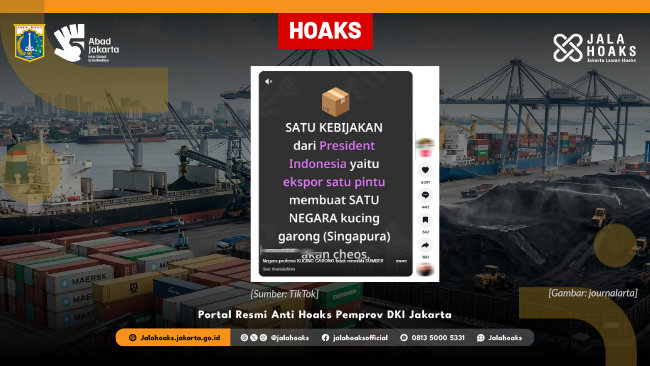
A post circulating on TikTok claims that Indonesia’s single-door export policy is intended to fight an international oligarchy from Singapore.
Based on the findings of the Jalahoaks team, as reported by tempo.co (17/06/2026), Anthony Budiawan, an economics and investment observer from Political Economy and Policy Studies (PEPS), explained that the majority of Indonesian commodity exports are shipped directly to destination countries. Consequently, the appointment of PT Danantara Sumberdaya Indonesia (DSI) as the sole exporter is not meant to curb foreign dominance.
“Many mining exports today are carried out directly to importing countries such as China, no longer through Singapore,” Anthony explained.
In addition, as reported by antaranews.com (24/05/2026), Fakhrul Fulvian, an economist at Trimegah Sekuritas Indonesia, assessed that President Prabowo Subianto’s policy requiring strategic commodity exports to go through a single door, namely the state-owned enterprise PT Danantara Sumberdaya Indonesia (DSI), has the potential to strengthen state revenue.
“This decision seeks to improve the governance of natural resource exports while increasing state revenue through stronger oversight of misinvoicing practices in national commodity trade,” Fakhrul said in a statement received in Jakarta.
Through a Government Regulation (PP) on the Governance of Natural Resource Commodity Exports, the government requires the sale of a number of strategic commodities through DSI as the sole exporter. The commodities in question include palm oil, coal and ferroalloys. This centralised policy is intended to ensure that the trading process runs more transparently, orderly and accountably.
According to Fakhrul, the main objective of the policy must be understood as an effort by the state to fix export governance problems, particularly misinvoicing and under-invoicing practices that have the potential to reduce state revenue from strategic sectors. Strengthening the narrative and communication of the policy is important so that market players fully understand the government’s policy direction.
As reported by cnnindonesia.com (10/06/2026), Singapore’s Minister for Trade and Industry, Gan Kim Yong, stated that he respects Indonesia’s export governance policy. He expressed hope that trade flows between the two countries continue to run smoothly. Gan affirmed that Singapore will continue to cooperate with Indonesia so that Indonesia remains an attractive investment destination for businesses from the Lion City.
“We will continue working with Singapore businesses to find ways to cooperate with Indonesia, ensuring exports to Indonesia and access to Indonesian exports continue to flow freely,” Gan said at a press conference following the Indonesia-Singapore Six Bilateral Economic Working Groups (6WG) meeting in Jakarta on Monday, 9 June 2026.
The claim that Indonesia’s single-door export policy is aimed at fighting an international oligarchy from Singapore is untrue. In fact, Indonesia’s single-door export policy is not an effort to confront any particular country, but rather an effort by the state to improve export governance.