
Singapore’s Full Response, from Minister to Prime Minister, to Indonesia’s Gas Supply Cuts
Jakarta, CNBC Indonesia – Singapore’s government says Indonesia’s short-term reduction in natural gas exports will have little effect on electricity prices in the city-state. The cut in Indonesian supply is said to represent less than 2% of Singapore’s total daily gas needs.
Singapore’s Minister for Energy, Trade and Industry, Tan See Leng, said current supplies remain sufficient to meet domestic demand.
Speaking to reporters after the People’s Action Party (PAP) conference on Sunday (25 October 2026), Tan said the impact of the supply cut on electricity prices was expected to be limited.
“In the short term, prices will not be affected much. If anything, we should be looking at global prices, because most of our gas unit prices are pegged to movements in several major global indices,” he said, according to Channel News Asia.
He added that the Singapore government regards energy as crucial to the economy, sustainability and the country’s survival. It has therefore prepared contingency measures to keep energy supplies secure and avoid dependence on a single source.
“We have always viewed energy as a very important part of our economy, sustainability and also our survival. Energy is fundamental to all of us. That is why we have put in place contingency measures and safeguards to ensure our energy supply is diversified,” Tan said.
Indonesia began reducing natural gas exports to Singapore on Saturday (24 October 2026), redirecting more supply towards domestic electricity needs.
A spokesperson for Singapore’s Energy Market Authority (EMA) had previously said the reduction amounted to 31 million standard cubic feet of gas per day, equivalent to 17 billion British thermal units (BTU) per day, for 18 days.
Tan said Singapore had several layers of protection against supply disruptions. These include diversifying its sources of natural gas, maintaining liquefied natural gas (LNG) facilities as a reserve, and ensuring Singapore GasCo is ready to import more LNG if needed.
Singaporean power generators are also required to maintain adequate diesel reserves in case of a larger disruption to gas supplies.
“I would like to urge all Singaporeans to remain calm and carry on as usual. We have faced supply reductions like this before without significant difficulties, and the government will continue to ensure the reliability and resilience of Singapore’s energy supply,” he said.
Beyond natural gas, Singapore is exploring alternative energy sources, including biomethane, geothermal and solar power. The government is also studying the potential use of nuclear energy, although it has not made a decision on that option.
Tan said the government would leave it to Gas Supply Private Limited (GSPL), a wholly owned subsidiary of state investment firm Temasek and Singapore’s gas importer, to examine any legal or other measures available under its commercial contracts.
“From the government’s perspective, in building a reputation and trust, I think fulfilling contracts … is the foundation,” Tan said.
Singapore Prime Minister Lawrence Wong made a similar point at the PAP conference on Sunday, saying all parties that have signed commercial gas supply contracts are expected to meet their obligations.
He added that Singapore’s gas importer would take the necessary steps to protect its rights and interests.
Singapore obtains natural gas through pipelines from Indonesia and Malaysia, as well as LNG imports from international suppliers. In 2025, pipeline gas accounted for 43% of Singapore’s total gas imports, while LNG made up the remaining 57%.
Haze issue
Asked whether the gas supply reduction was a direct response by Indonesia to comments by some Singaporean leaders about haze, Tan said Indonesia had restricted gas exports to Singapore in the past as well.
He said similar restrictions had occurred earlier this year because of pipeline repairs and maintenance.
“In fact, I think they also restricted supplies earlier this year, before this incident. But I think the reason then was pipeline repairs; they were carrying out maintenance work and so on,” he said.
On the timing of the supply reduction, which came close to Singapore International Energy Week, Tan said the decision was Indonesia’s to make.
“Whether they choose to restrict gas supplies so close to Singapore International Energy Week, I think that is a decision they have made themselves. So I am not in a position to comment on that,” he said.
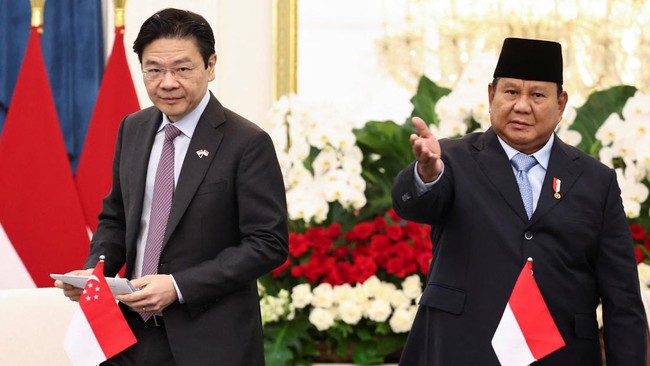
Tan also responded to questions about whether there might be other factors behind the supply cut beyond the reasons given by Indonesia. He stressed that relations between the two countries remained good at the highest levels of government, particularly between President Prabowo Subianto and Wong.
According to Tan, those ties have been built on a strong partnership over many decades.
“We understand that they may have domestic supply needs and certain constraints, which we can understand,” he said.
He added that the Singapore government would continue to monitor developments closely, as discussions about next steps remained at an early stage.
“The precise details of the way forward, I think this is still at an early stage, and we will continue to monitor the situation very closely,” Tan said.
Source: jawawa.id (https://jawawa.id/newsitem/singapores-full-response-from-minister-to-prime-minister-to-indonesias-gas-supply-cuts-1792968633)
Originally published by CNBC Indonesia (https://www.cnbcindonesia.com/news/20261025221124-4-779280/respons-lengkap-singapura-dari-menteri-hingga-pm-soal-pasokan-gas-ri), translated from Indonesian