
Singapore Targets Solar Energy Capacity of 4 GWp by 2035
SINGAPORE – Singapore has set a target of 4 gigawatt-peak (GWp) of solar capacity by 2035, extending its previous target of 3 GWp by 2030. With land in short supply, the government is looking to rooftops, vacant land, water surfaces and building façades for solar panel installations.
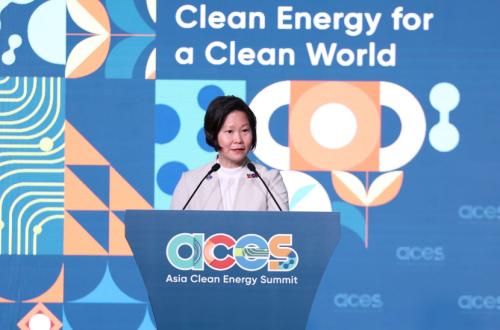
Gan Siow Huang, Minister of State at the Ministry of Foreign Affairs and the Ministry of Energy, Trade and Industry, said making use of available space must go hand in hand with technological development. The two approaches are expected to open up sites that have previously been difficult to use for solar panels.
“We will harness solar energy wherever possible across Singapore,” Gan said at the opening of the Asia Clean Energy Summit (ACES) 2026 on Tuesday (27 October 2026). The forum is being held as part of Singapore International Energy Week.
More than 5,000 Housing and Development Board (HDB) residential blocks and public buildings have been fitted with solar panels through the SolarNova programme and other government initiatives. More than 8,000 solar panel installations have also been recorded in the private residential sector.
The Energy Market Authority (EMA) has launched tenders to install solar panels at public facilities, including car park shelters. The tenders also cover building-integrated photovoltaics (BIPV), which incorporate solar panels into building components.
The needs of various government agencies will be consolidated to create larger-scale projects. The EMA will also work with the Sustainable Energy Association of Singapore (SEAS) to help homeowners find solar panel installation providers.
To make use of vacant land, the government is developing containerised solar panel systems. These allow power plants to be installed quickly and flexibly, with capacity added as needed.
JTC, the agency responsible for developing industrial estates, is testing solar panels on a canopy spanning two buildings at Woodlands East Industrial Estate. The project, undertaken with EDP APAC, makes use of previously unused space between the buildings.
JTC has also launched two innovation challenges to develop solar panels for building façades and containerised solar systems with mobile batteries. The technologies are expected to supply electricity to construction sites and temporary workplaces that still rely on diesel generators.
Solar panel installations are also being explored on the roofs of heritage buildings, in partnership with the Singapore Land Authority and the Swiss Technology Innovation Centre. Any installations must preserve the buildings’ architectural character.
Despite the ongoing expansion, Gan said Singapore’s domestic solar potential remains limited. By 2050, solar power is expected to meet only around 10 per cent of the country’s electricity needs.
Singapore is therefore also relying on plans to import low-carbon electricity from neighbouring countries. On Monday (26 October 2026), the EMA granted Sembcorp Utilities conditional approval to import 1.3 gigawatts of electricity from or via Peninsular Malaysia.
The project is expected to draw on several low-carbon energy sources, including offshore wind from Vietnam and solar power from Malaysia. With this addition, three electricity import projects from Peninsular Malaysia have received conditional approval, with total capacity of 2.2 gigawatts if all are implemented.
Singapore and Malaysia are also studying the construction of a second electricity interconnector, with the feasibility study expected to be completed in early 2027. Meanwhile, Singapore and Indonesia agreed on a bilateral roadmap in July 2026 covering commercial projects and arrangements for cross-border electricity transmission.
Energy Association of Singapore chairman Edwin Khew said accelerating Southeast Asia’s energy transition would require the development of electricity grids and energy storage. He said the region is expected to account for 20–25 per cent of global energy demand growth through 2035, despite having around 9 per cent of the world’s population.
Citing projections by the International Energy Agency (IEA), Khew said Southeast Asia’s fossil fuel import bill could rise from US$80 billion in 2024 to about US$245 billion by 2035 under current policies. The increase makes supply security and energy costs significant economic concerns for the region.
Khew said the ASEAN Power Grid is becoming increasingly necessary to connect renewable energy generation with demand centres. The network would also enable cross-border electricity trade to expand as energy needs grow.
Source: jawawa.id (https://jawawa.id/newsitem/singapore-targets-solar-energy-capacity-of-4-gwp-by-2035-1793177592)
Originally published by Republika (https://ekonomi.republika.co.id/berita/tnlsui416/singapura-targetkan-kapasitas-energi-surya-4-gwp-pada-2035), translated from Indonesian