
Singapore ranks first for regional leadership as Trump tops Southeast Asia concerns: Survey
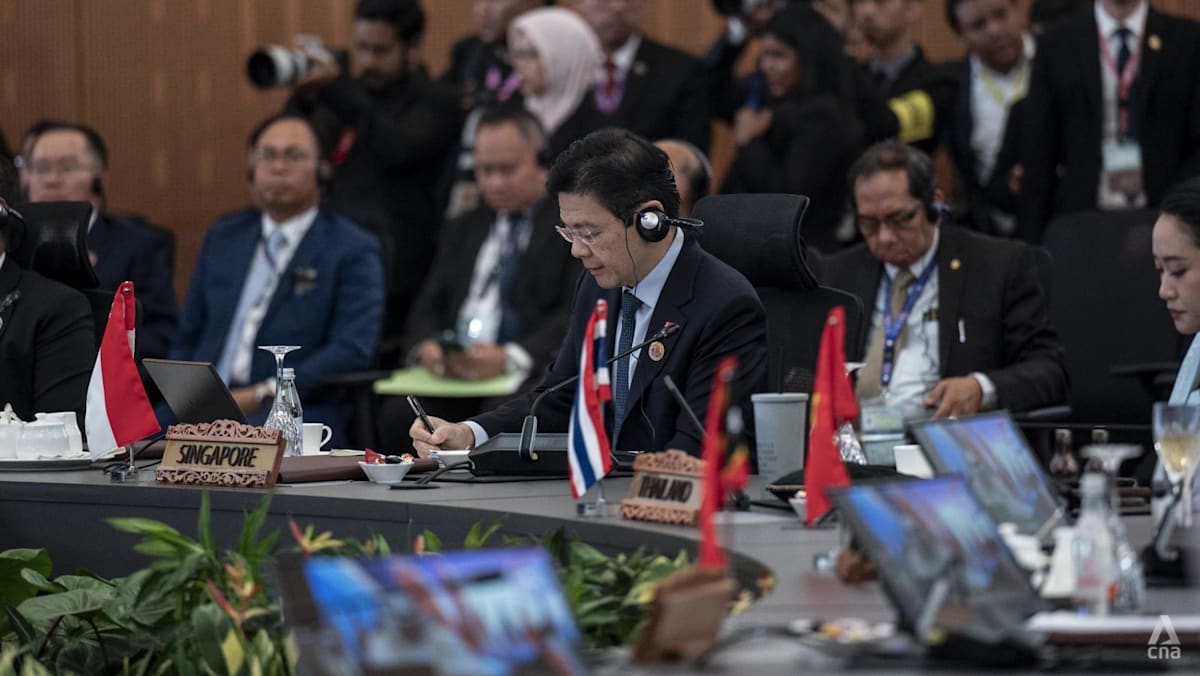
Singapore ranks first for regional leadership as Trump tops Southeast Asia concerns: Survey
For the first time, more respondents have confidence in ASEAN upholding the rules-based order than the United States, according to an annual poll by Singapore think tank ISEAS-Yusof Ishak Institute.
SINGAPORE: Singapore has topped a poll for showing the strongest leadership in addressing key regional challenges, according to an annual think tank survey, which also identifies the United States leadership under President Donald Trump and global scam operations as key concerns among Southeast Asian respondents.
For the first time, the Association of Southeast Asian Nations (ASEAN) overtook the US as the most trusted actor to uphold the rules-based order.
In the latest annual The State of Southeast Asia survey by ISEAS-Yusof Ishak Institute released on Tuesday (Apr 7), over three in 10 (31.3 per cent) of respondents recognised Singapore as the leading contributor in tackling key regional challenges, followed by Indonesia (22.2 per cent) and Malaysia (21.3 per cent).
Some of the regional challenges highlighted were climate change and intensifying economic tensions between major powers. Respondents were asked to select a country other than their own.
Singapore emerged as the top choice among respondents from six ASEAN member states - the Philippines (50.7 per cent), Malaysia (49 per cent), Thailand (45 per cent), Indonesia (38.1 per cent), Vietnam (36.4 per cent) and Cambodia (28.0 per cent).
The survey polled 2,008 people including researchers, private sector representatives, non-governmental organisations, government officials and international organisations personnel across the 11 members of ASEAN. It was conducted online between Jan 5 and Feb 20 this year.
Among respondents who selected Singapore, its economic leadership in influencing regional discussions stood out as the key reason. This was most evident in Indonesia, where more than half or 56.4 per cent cited this factor.
“This underscores Singapore’s reputation as a key economic driver within ASEAN,” said the survey authors.
Indonesia ranked second overall as a leading contributor in the region and is the top choice among respondents from Myanmar, Brunei and Laos.
The most commonly cited reason for choosing Indonesia was its ability to build consensus within ASEAN, selected by 31.7 per cent of respondents.
This reflects a strong perception of Indonesia as a key mediator within ASEAN, the survey authors said.
Singapore and Indonesia also topped the rankings in the previous two editions of the survey, though the question then asked which members had contributed most to ASEAN’s long-term development - a different framing from this year’s question on regional leadership.
Malaysia ranked third and is the top choice among respondents from Singapore, with more than half voting for it this year.
Respondents pointed to Malaysia’s strong leadership during its ASEAN chairmanship.
This shows that Malaysia’s ASEAN chairmanship in 2025 has “significantly shaped” regional views on its leadership role, the report said.
Malaysia’s tenure as ASEAN chair was marked by several notable developments, including a ceasefire between Thailand and Cambodia brokered by Prime Minister Anwar Ibrahim in Putrajaya in July last year, which experts regarded to be a diplomatic success.
Anwar’s subsequent move to invite Trump to the ASEAN Summit in October also boosted Malaysia’s global visibility, experts earlier told CNA.
Trump had previously made only a single appearance at the regional summit - the 2017 meeting in Manila - during his presidency from 2017 to 2021.
US LEADERSHIP UNDER TRUMP TOPS GEOPOLITICAL CONCERNS
Meanwhile, the US leadership under Trump overtook the South China Sea issue as the top geopolitical concern for ASEAN with over half or 51.9 per cent of respondents citing it as their government’s key concern among eight geopolitical events surveyed in the State of Southeast Asia 2026 survey
“This perception demonstrates regional anxiety about inconsistencies in policy and the credibility of long-term commitments under Trump’s leadership,” said the survey authors.
This was the top concern among respondents from Singapore, with nearly 80 per cent citing it as a preoccupation, reflecting the country’s sensitivity to its high trade exposure to the US and the risks posed by global economic and strategic volatility, the report said.
Global scam operations ranked as the second-highest geopolitical concern, with respondents from Timor-Leste considering it as their top concern.
Aggressive behaviour in the South China Sea moved down two spots and is in third place this year. But similar to last year, anxiety over the contested waters was most pronounced in the Philippines, one of the claimant states, where 87.7 per cent of respondents ranked it as the top concern.
Respondents from other claimant states like Vietnam (66.8 per cent) and Brunei (63.2 per cent) also said it was a top preoccupation.
The Thailand-Cambodia border conflict emerged as the most pressing concern for Thai (88.9 per cent) and Cambodian (66 per cent) respondents, which the authors said was “not surprising” given the bilateral issues that continue to arise along the border.
Concerns over the border conflict are also high in several other member states, mostly in Vietnam and Malaysia, which suggests that there are anxieties about “potential spillover effects of the dispute that could undermine regional stability”, the survey found.
ASEAN TOOK “ACTIVE STEPS” TO MEDIATE THAI-CAMBODIA CONFLICT
Nearly four in 10 (38.9 per cent) respondents agreed that ASEAN has taken active steps to mediate the border crisis through the convening of ministerial meetings and the deployment of diplomatic engagement.
Among the examples cited were the Foreign Ministers’ Statement, the Extraordinary Cambodia-Thailand General Border Committee (GBC) Meeting and the Kuala Lumpur Peace Accord.
This sentiment was strongly felt in Timor-