
Singapore in Emergency State, Government Urges Citizens to Remain on High Alert
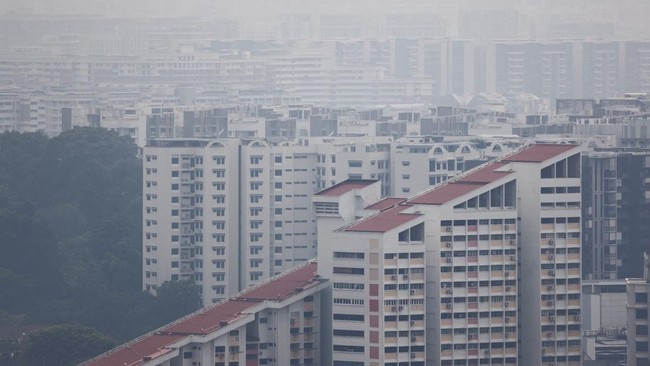
Singapore’s National Environment Agency (NEA) issued an air quality warning on Saturday morning, noting that levels have fallen into the unhealthy category across the western, central, and eastern regions. This deterioration is a direct impact of forest fires occurring in Indonesia.
According to Channel News Asia, the 24-hour Pollutant Standards Index (PSI) reached 103 in the central region by 7:00 pm. Earlier at 6:00 am, the western and eastern regions were also categorised as unhealthy, with PSI readings of 103 and 102, respectively.
By 7:00 pm, the western region’s reading decreased to 91, and the eastern region dropped to 83. Meanwhile, other areas remained in the moderate category, with PSI levels of 78 in the north and 79 in the south.
The 24-hour PSI has been in the unhealthy category (101-200) since Friday morning. This marks the first time the index has exceeded this level since 8 October 2023.
This situation prompted the NEA on Friday to begin issuing daily haze alerts, including 24-hour PSI forecasts, to assist the public in planning their activities and events for the following day.
Singapore is likely to continue being affected by transboundary haze if the fires in Indonesia persist, with 24-hour PSI forecasts expected to fluctuate between the upper end of the ‘moderate’ range and the lower end of the ‘unhealthy’ range.
Reports indicate that most surrounding areas remained dry on Saturday. During this period, plumes of moderate to thick smoke from southern and central Sumatra, as well as various parts of Kalimantan, continued to be blown by the wind towards Singapore.
The NEA predicts that dry conditions will persist in Singapore and the surrounding region in the coming days, with dominant winds blowing from the south-east or south.
For reference, the 24-hour PSI serves as the daily air quality indicator in Singapore and forms the basis for the daily health advisories issued by the NEA. This index is calculated based on six air pollutants: PM2.5, PM10, ozone, sulphur dioxide, nitrogen dioxide, and carbon monoxide.
Meanwhile, the hourly PM2.5 reading is the hourly average of PM2.5 pollutant levels. PM2.5 refers to fine particles with a diameter of 2.5 micrometres or smaller, which is the primary pollutant during haze events that poses significant health risks.
While the 24-hour PSI represents the average over the last 24 hours, the 1-hour PM2.5 reading reflects the air quality at a specific point in time.
A 24-hour PSI reading is considered ‘very unhealthy’ if it falls within the 201-300 range, and ‘hazardous’ if it exceeds 300.
In a previous joint press release issued on behalf of agencies within the haze Task Force (HTF), the NEA stated that task force members have implemented their respective action plans and advisories to protect the health and well-being of the community.
The NEA’s daily haze advisories will include 24-hour PSI forecasts, which the public can use to plan their activities and events for the next 24 hours.
Source: jawawa.id (https://jawawa.id/newsitem/singapore-in-emergency-state-government-urges-citizens-to-remain-on-high-alert-1788670385)
Originally published by CNBC Indonesia (https://www.cnbcindonesia.com/news/20260906080801-4-765401/singapura-sudah-darurat-pemerintah-minta-warga-siaga-penuh), translated from Indonesian