
Singapore Dollar Quietly Hits Rp14,000 as Many People Cash In
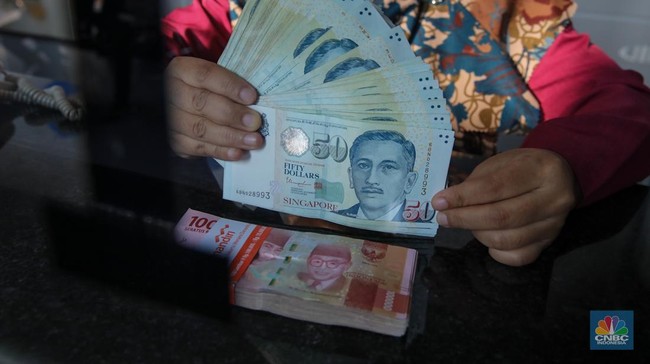
Jakarta, CNBC Indonesia — The Singapore dollar has become one of the currencies attracting strong trading interest among Indonesians. As the rupiah weakens, people are taking the opportunity to sell the Singapore dollars they hold.
The trend was evident at several money changers in Jakarta on Monday (19 October 2026).
Aris Permana, a supervisor at PT Daffa Indo Valuta, said more people were coming in to sell Singapore dollars than US dollars.
“At the moment, many people are selling Singapore dollars. Some are selling US dollars too, but not as many as Singapore dollars, because it is the Singapore dollar—not the US dollar—that has risen significantly,” Aris told CNBC Indonesia on Monday (19 October 2026).
The increase in Singapore dollar sales is linked to the currency’s rising value against the rupiah.
Refinitiv data showed that the Singapore dollar closed at Rp14,084 per SGD on Monday (19 October 2026), up 0.14%. The daily gain was modest, but the currency has strengthened 8.70% against the rupiah since the beginning of the year.
Over the past year, it has gained 10.06% against the rupiah.
This year, the Singapore dollar also reached its strongest level against the rupiah on record. On 30 July 2026, it closed at Rp14,106 per SGD.
The rise is bad news for the rupiah, but good news for people holding Singapore dollars as savings.
For example, someone holding S$20,000 at the end of 2025 had assets worth about Rp259.15 million at the prevailing market exchange rate.
That value has now risen to around Rp281.70 million.
This represents an increase of about Rp22.54 million in less than 10 months, before accounting for exchange-rate spreads and conversion fees.
The increase in sales, however, raises an important question: what is making the Singapore dollar more expensive against the rupiah? Is Singapore’s currency strengthening, or is the rupiah weakening?
Why is the Singapore dollar getting stronger?
The Singapore dollar’s rise against the rupiah has not happened without cause. Several factors affect the two currencies, from Singapore’s central bank policy to Indonesia’s economic conditions and financial markets.
Unlike Bank Indonesia (BI), which uses interest rates as its main tool to control inflation, Singapore’s central bank, the Monetary Authority of Singapore (MAS), relies more heavily on managing the exchange rate.
In April and July 2026, the MAS accelerated the pace at which the Singapore dollar was allowed to strengthen against a basket of its trading partners’ currencies.
In its latest decision, on 14 October 2026, the MAS maintained that policy to help contain increases in imported goods prices.
Singapore depends substantially on goods from overseas. Maintaining a strong currency is therefore one way to help control domestic prices.
When the Singapore dollar strengthens, imported goods priced in certain foreign currencies can become cheaper.
The rupiah, meanwhile, continues to face pressure from domestic and global financial-market conditions.
Geopolitical tensions, high global oil prices and investor concerns about the Indonesian stock market following an announcement by MSCI have also affected the rupiah.
While these factors influence exchange-rate movements, demand for Singapore dollars from Indonesian households and businesses is also worth noting.
The close economic ties between the two countries mean that demand for SGD comes not only from tourists but also from trade, investment, education and medical treatment.
From tourism to business: sources of demand for Singapore dollars
Several activities generate demand for Singapore dollars in Indonesia.
- Tourism
Tourism is one source of demand for Singapore dollars.
According to the Singapore Tourism Board (STB), 2.4 million visitors from Indonesia travelled to Singapore in 2025.
This made Indonesia Singapore’s second-largest source of visitors, after China.
Indonesian tourists also spend substantial sums there.
From January to September 2025, Indonesian visitors spent S$2.09 billion in Singapore, excluding certain entertainment and tourism categories.
This made Indonesia the second-largest source of tourism receipts for Singapore.
The money went on hotels, food, transport and shopping, among other things.
The level of spending shows how tourism creates significant demand for payments in Singapore dollars.
- Trade and imports
Trade between Indonesia and Singapore is another source of foreign-currency demand.
The two countries have substantial trade ties. Indonesia has recorded a trade deficit with Singapore in each of the past five years.
Statistics Indonesia (BPS) data show that Indonesia’s trade deficit with Singapore reached US$5.73 billion in 2025.
That figure reflected Indonesian exports to Singapore of US$13.44 billion, while imports totalled US$19.17 billion.
The 2025 deficit was narrower than in 2024, when it reached US$9.33 billion, its largest level in five years.
The reduction came as imports from Singapore fell while exports increased.
Even so, the scale of imports shows that Indonesian companies still need to make substantial payments to suppliers in Singapore.
Importers must arrange the currency agreed for payment. If a transaction is denominated in Singapore dollars, the Indonesian company needs to obtain SGD to settle it.
Not all trade between Indonesia and Singapore is conducted in SGD; some international transactions are still carried out in US dollars.
Notably, BI and the MAS began cooperation on the use of local currencies, known as Local Currency Transactions (LCT), on 31 August 2026.
Under the arrangement, trade, direct investment and cross-border payments can be conducted in rupiah or Singapore dollars.
This gives companies in both countries more currency options, without requiring them always to use US dollars.
- Investment and savings
Investment is another source of demand.
Data from the Singapore Department of Statistics show that direct investment flows from Indonesia to Singapore reached S$981.3 million in 2025.
The figure indicates that Singapore is also a destination for capital from Indonesian companies.
Businesses operating in Singapore may need SGD to pay rent, staff wages and other operating costs.
Some individuals also choose to save in Singapore dollars or buy assets priced in SGD.
However, not all of this investment necessarily comes from exchanging rupiah for Singapore dollars. Investment funds may also come from other foreign currencies or business profits already held overseas.
- Education and medical treatment
Demand for Singapore dollars also comes from Indonesians studying or seeking medical treatment in Singapore.
Parents whose children attend school there need to provide funds for tuition, accommodation and daily expenses.
Likewise, Indonesians receiving treatment at Singaporean hospitals need money to pay for healthcare, even when the exchange rate is high.
Unlike currency purchases made for profit, education and healthcare expenses are often difficult to postpone simply because the exchange rate has risen.
Ultimately, the Singapore dollar’s higher value has two sides. People who have held SGD for some time may benefit from exchange-rate gains.
By contrast, those who need Singapore dollars for holidays, education, medical treatment or business must now spend more rupiah than before.
Source: jawawa.id (https://jawawa.id/newsitem/singapore-dollar-quietly-hits-rp14-000-as-many-people-cash-in-1792507850)
Originally published by CNBC Indonesia (https://www.cnbcindonesia.com/research/20261020101932-128-777747/diam-diam-dolar-singapura-sudah-rp14000-banyak-orang-ambil-untung), translated from Indonesian