
Singapore Defence Minister: Restoring Relations with Indonesia Serves as a Model of Success
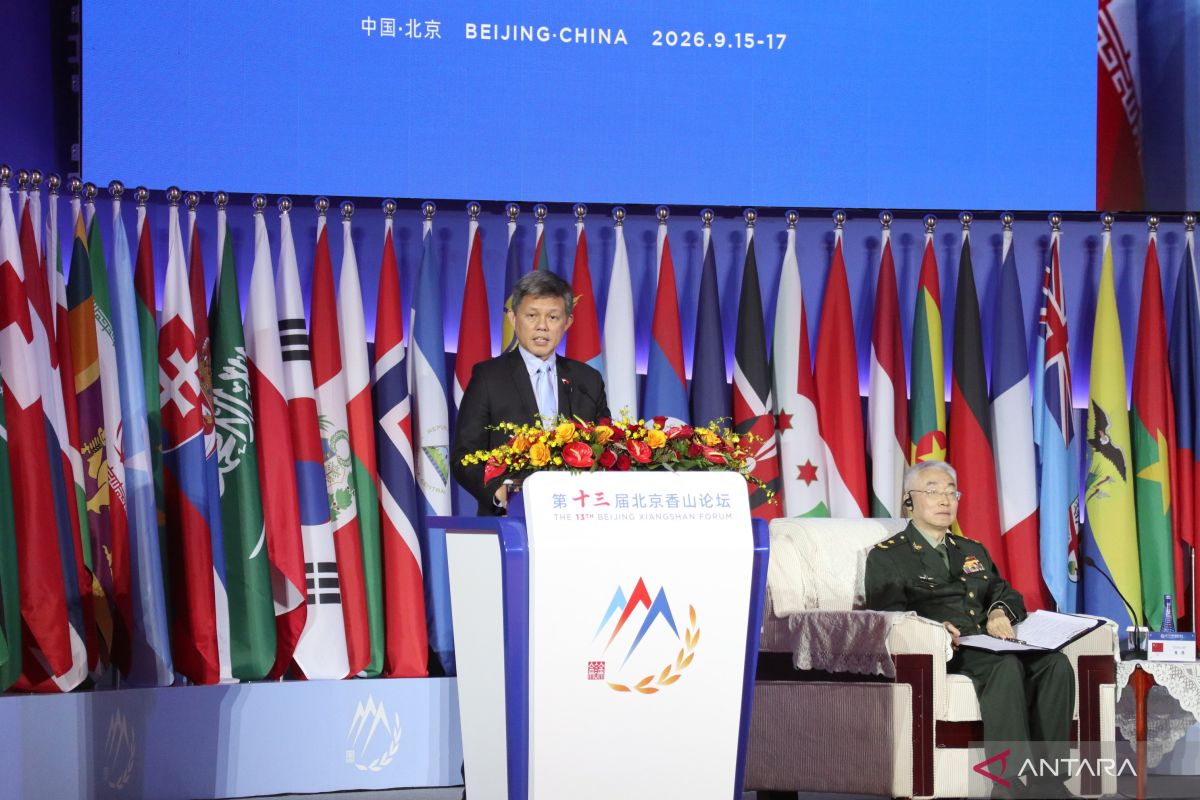
Beijing (ANTARA) - Singapore Defence Minister Chan Chun Sing stated that his country’s success in overcoming issues with Indonesia serves as an example of how diplomacy can be used to resolve geopolitical problems between nations.
“Like other countries, we have a number of historical issues with neighbouring nations. However, we work with them to resolve these issues harmoniously for national and regional interests. For example, we successfully achieved a diplomatic resolution with Indonesia, despite our relations facing various challenges during the early years of Singapore’s establishment,” said Chan Chun Sing in Beijing on Wednesday.
Defence Minister Chan made these remarks during the first plenary session of the Beijing Xiangshang Forum, themed “Building Consensus on Stability, Advancing Shared Security Governance.”
The forum, now in its 13th iteration, brings together hundreds of military officers, diplomats, and academics from Asia, Europe, and the Middle East to discuss security and the international order.
“Geopolitical changes, accompanied by our diplomatic efforts, have ultimately created space for Singapore to grow and achieve prosperity,” Chan stated.
He also outlined three fundamental principles to be remembered when facing this era of uncertainty.
First, domestic stability and external security are interconnected; if domestic conditions are good, it will strengthen foreign relations.
“Domestic confidence allows a country to cooperate with partners and act wisely in accordance with its long-term interests on the international stage. Conversely, a conducive external environment also influences domestic stability,” said Chan Chun Sing.
Singapore’s experience, according to him, illustrates this. When his country was founded in 1965, Singapore was born amidst crises such as ethnic tensions, security challenges, economic difficulties, and the Cold War.
“It was vital that our founding leaders succeeded in realising domestic political stability from the early stages. They took urgent and decisive steps to restructure the economy, meet the needs of the people, and earn their trust,” Chan noted.
The second principle is that interdependence creates stability.
“In the current situation, we might be tempted to view interdependence as a source of vulnerability. However, history shows that in the long run, interdependence expands shared interests between nations,” he said.
Chan Chun Sing noted that interdependence creates incentives to cooperate or, at the very least, to compete based on a set of agreed-upon rules.
“I must emphasise that competition and rivalry do not mean we must become enemies. If managed well, competition and rivalry can drive us all to become better. That is why, since the early days, Singapore has sought to build an open and inclusive external environment, such as working with neighbouring countries to build ASEAN and playing a constructive role in the development of international maritime law,” he explained.
For the same reason, Singapore continues to call for the maintenance of a rules-based international order, which serves as the foundation for global trade and exchange.
“For example, Singapore consistently supports the right of transit for ships passing through straits used for international navigation, such as the Strait of Hormuz,” he said.
The third principle is a well-known rule in medical ethics: first, do no harm, even if we are unable to resolve all problems.
“To build trust, we must first ensure that we do not damage it. Trust is vital, but also fragile. Trust is built through consistency, but can be lost in an instant,” said Chan Chun Sing.
When trust exists, Chan noted, a country can resolve difficult issues quietly behind the scenes.
“As the Mandarin saying goes, ‘Large problems are minimised and small problems are resolved.’ Without trust, small misunderstandings can quickly escalate. This can occur in the physical realm, particularly in contested environments,” Chan added.
This issue, according to Chan, is even more critical in the invisible realm, such as cyberspace, where the intent of an action is often unclear and the perpetrator is not easily identified.
“Allow me to summarise these three basic principles. Domestic confidence and stability allow us to cooperate at the external level, interdependence provides greater opportunities to build a strong and cooperative international system, while trust allows that cooperation to manifest.”
To realise all three, Chan Chun Sing also presented three proposals: first, that major powers demonstrate greater responsibility so that smaller nations have less cause for concern. Second, that we build trust through strategic patience by not pursuing short-term victories at the expense of long-term gains.
“Not every capability must be displayed. Not every advantage must be immediately exploited, and not every provocation demands an immediate response,” said Chan Chun Sing.
Third, nations must continue to find concrete ways to create value together by finding points of convergence and building real cooperation within areas of shared interest.
“Since the beginning, we have supported China’s policies of reform and openness, long before China became a member of the WTO…”
Source: jawawa.id (https://jawawa.id/newsitem/singapore-defence-minister-restoring-relations-with-indonesia-serves-as-a-model-of-success-1789546335)
Originally published by Antara (Indonesian) (https://www.antaranews.com/berita/5743541/menhan-singapura-pemulihan-relasi-dengan-ri-jadi-contoh-keberhasilan), translated from Indonesian