
Singapore Braces for Impact, Tightens Monetary Policy
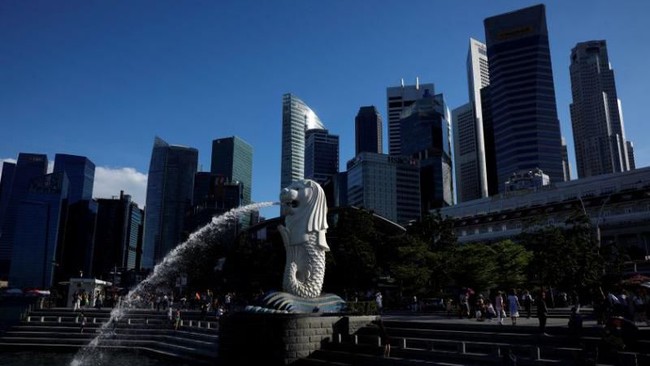
The Monetary Authority of Singapore (MAS) has tightened monetary policy for the second time in a row. The move is a response to the surge in global oil prices, which has reignited concerns over inflation.
In a statement on Monday (27/7/2026), MAS said it would slightly increase the rate of appreciation of the Singapore dollar nominal effective exchange rate (S$NEER). However, the width of the policy band and its midpoint will remain unchanged.
Unlike most central banks in the world that control interest rates, MAS conducts its monetary policy by managing the Singapore dollar’s exchange rate against a basket of currencies of its trading partners.
“In a situation still fraught with high uncertainty, this measured policy adjustment continues the tightening steps taken last April,” MAS wrote in its statement.
The decision was taken even though inflation in Singapore remains relatively low. Core inflation, which excludes accommodation and transport costs, rose to 1.6% in June from 1.4% in May. This figure is still at the lower end of MAS’s core inflation projection for this year, which is in the 1.5%-2.5% range. Meanwhile, headline inflation was recorded at 1.9%.
Nevertheless, MAS assesses that future inflation risks are increasing due to the surge in global energy prices.
According to BMI, a research unit of Fitch Solutions, the rise in fuel prices due to the United States (US)-Iran conflict was temporarily held back by slowing inflation in the services sector, such as healthcare, communications, and education. However, imported cost pressures are expected to be fully reflected in consumer prices only in the coming months.
“Imported cost pressures are usually passed through to consumer prices gradually, so we still expect inflation to rise in the coming months,” BMI wrote.
As a country that relies almost entirely on imports for its energy needs, Singapore is highly vulnerable to rising global oil prices. Brent crude oil prices breached US$100 per barrel again last week after the Houthi group attacked two Saudi Arabian tankers in the Red Sea.
The attack exacerbated market concerns over global oil supply disruptions, especially after the ceasefire in the Middle East ended. Despite facing pressure from geopolitical turmoil, Singapore’s economy has so far shown resilience.
Singapore’s gross domestic product (GDP) grew 5.7% year-on-year in the second quarter of 2026, higher than the median analyst forecast of 5.5% in a Reuters poll.
This achievement also far exceeded the Singapore government’s projection of economic growth for the full year in the range of 2%-4%.
The Lion City’s economic performance was mainly supported by strong global demand for electronics and semiconductor products, driven by the rapid development of artificial intelligence (AI) technology.