
Singapore Assures Energy Reserves Are Secure as Indonesian Gas Supplies Decline
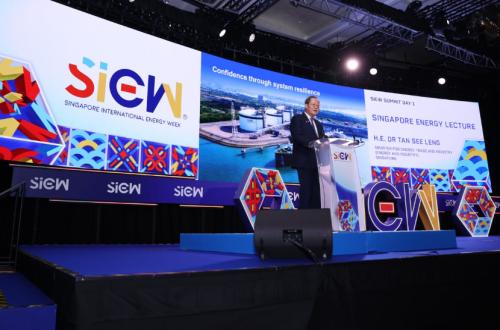
SINGAPORE — Singapore is strengthening its energy resilience by diversifying gas supplies, increasing fuel reserves and building strategic partnerships with energy-producing countries. These measures come amid rising uncertainty in global energy markets caused by disruptions to distribution routes and attacks on energy infrastructure.
Energy, Trade and Industry Minister Tan See Leng said the global energy crisis had once again highlighted the importance of ensuring reliable and affordable energy supplies. As a city-state dependent on energy imports, Singapore could not fully avoid the effects of global or regional volatility, he said.
“Energy is a vital priority. Our economic growth and quality of life depend on sustained access to reliable and affordable energy,” Tan said in a speech at Singapore International Energy Week (SIEW) 2026 on Monday (26 October 2026).
Tan highlighted disruptions to global energy flows following the closure of the Strait of Hormuz, as well as the potential for escalation after Houthi attacks on Saudi Arabian airports and energy infrastructure. The situation comes just four years after the global energy crisis of 2022.
According to Tan, supply disruptions should not be regarded as exceptional events that will never recur. Energy-importing countries must factor in the risk of distribution interruptions, including when supplier countries prioritise their own domestic needs.
He warned of rising resource nationalism, particularly if such policies undermine agreed supply contracts. This could increase business risks and hamper long-term investment in the energy sector.
To prepare for these risks, Singapore is establishing several layers of protection. One measure is to diversify its sources of natural gas imports.
When Singapore first began importing gas, it relied entirely on pipeline supplies from neighbouring countries. Today, about half of its imported gas is supplied as liquefied natural gas (LNG) from a range of global sources, including the United States, Africa, the Middle East and Australia.
Singapore’s LNG receiving capacity is also expected to increase by 50 per cent when its second LNG terminal begins operating before 2030. The additional capacity will give the country greater flexibility to obtain gas from a wider range of suppliers.
The government is also strengthening the role of Singapore GasCo, a company established to help procure gas for the power generation sector. Tan said GasCo had demonstrated its capabilities when gas deliveries from Qatar were disrupted this year.
GasCo’s team moved quickly to secure replacement supplies. In August 2026, the company also issued its first request for proposals to procure gas for Singapore’s needs after 2028, with the first contract targeted for 2027.
Tan stressed that supply reliability would be one of the main criteria in selecting gas suppliers. The government also requires power station turbines to be capable of operating on both gas and diesel, allowing diesel reserves to be used in the event of a serious gas supply disruption.
Alongside supply diversification, Singapore is expanding partnerships with energy-producing countries. Tan announced plans to work with Saudi Arabia to store Saudi crude oil at the Jurong Rock Caverns underground storage facility from the second half of 2027.
Source: jawawa.id (https://jawawa.id/newsitem/singapore-assures-energy-reserves-are-secure-as-indonesian-gas-supplies-decline-1793094755)
Originally published by Republika (https://ekonomi.republika.co.id/berita/tnk6yq423/pasokan-gas-ri-berkurang-singapura-pastikan-stok-energi-aman), translated from Indonesian