
Simplicity Wrapped in Exoticism: Green Kurban Distributes Sacrificial Animals to Kampung Oeue in Remote NTT
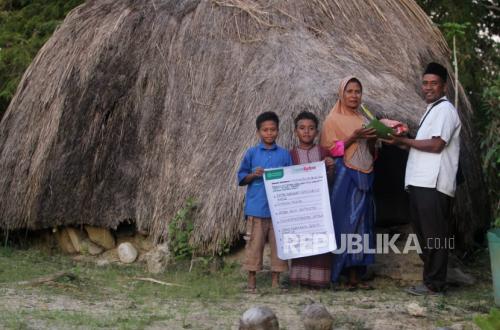
Syarifuddin Ridwan Nobisa has traversed the steep mountain roads many times to reach this remote village. As a preacher in the remote areas of East Nusa Tenggara (NTT), he frequently travels between small villages to spread Islamic teachings. However, his journey to Kampung Oeue, Mauleum Village, East Amanuban District, South Central Timor Regency, was different this time.
The scenery remained unchanged: rocky roads, corn and cassava crops that serve as the villagers’ daily sustenance, and traditional houses. Every element displayed the simplicity wrapped in the exoticism of the NTT landscape. The arrival of Ustadz Syarif, as he is commonly known, brought with him a sacrificial cow entrusted to him by the Green Kordban Sinergi Foundation. A lively and vibrant atmosphere welcomed him.
Residents of Kampung Oeue and the surrounding areas gathered at the designated site for the slaughtering process. The joy of the villagers was irrepressible; the moment they had awaited all year had finally arrived. The prospect of eating beef—something they cannot consume daily due to economic constraints—immediately stirred hunger, yet the residents waited patiently through the entire ceremony.
A simple ceremony involving the draping of a shawl over Ustadz Syarif, who arrived with the sacrificial cow, opened the proceedings. This ceremony held dual significance: first, as a traditional handover of the sacrificial animal, and second, as a symbol of the spiritual and physical bond of brotherhood between the recipients and the donors.
“There was also a specific message that this should not be the first and last time,” Ustadz Syarif added in a statement on Wednesday (10/6/2026). This message carried the hope that the recipients would always remember the presence of the remote villagers and be willing to facilitate future distributions.
Following the traditional rites, the sacrifice proceeded according to religious law. Chants, prayers, and takbir echoed throughout the process. This sequence of events generated not only enthusiasm and joy but also many questions, particularly from the new converts in Kampung Oeue. For those who have recently embraced Islam, both the concept of the sacrifice and the presence of the Green Kurban Sinergi Foundation felt both interesting and unfamiliar.
“Some asked how many times a year this sacrifice is held and what its purpose is; we explained it to them,” Ustadly Syarif told the Sinergi Foundation. This is one of the reasons Green Kurban chooses to distribute to remote areas like Kampung Oeue. Beyond the effort for equitable distribution, sacrifices in remote areas serve as a medium for social preaching, helping to strengthen faith while opening doors for new congregants.
Because every sacrifice event invites not only Muslim congregants but also non-Muslim neighbours, Ustadz Syarif noted that the impact is visible almost every Sunday, with residents arriving to express their intention to embrace Islam. “We are certain that this is divine guidance. However, there are also the causes of guidance. The cause of guidance is the social preaching we have built over time,” explained Ustadz Syarif.
Furthermore, the Green Kurban distribution to Kampung Oeue provides a rare opportunity for villagers to consume meat. According to Ustadz Syarif, residents usually only consume meat during specific celebrations. Their staple foods are corn and cassava, supplemented by vegetables such as moringa leaves. These ingredients are obtained by the villagers while working as farmers. They rely on their harvests for their livelihoods.
Villagers also produce tamarind and candlenut, which they sell as commodities to generate income. However, these crops are only harvested once a year, and selling them remains difficult due to the lack of transportation and road infrastructure. Consequently, life in Kampung Oeue remains very simple. The uncertain income from seasonal farming makes it difficult for them to purchase meat for home consumption.
These conditions underscore the significance of Green Kurban’s presence in this remote NTT village. In line with this year’s spirit of “Real Sacrifice, Empowered,” the impact of the sacrifice is multidimensional: fostering steadfastness in faith, increasing meat consumption, fostering warmth and togetherness, and evoking gratitude and brotherhood.
A sense of gratitude was shared by hundreds of beneficiaries in Kampung Oeue. One such resident, Tarsin Taneo, a Muslim woman from the village, expressed her thanks in their local language. Ustadz Syarif translated her words: “She, representing the congregation in Kampung Oeue, expressed her deepest gratitude to the Sinergi Foundation for distributing the sacrificial animal this year so that we could participate in the sacrifice again. Mama Tarsin Taneo prays that next year we can receive another distribution from the Sinergi Foundation.”
Kampung Oeue in NTT is one of dozens of remote villages serving as distribution points for Green Kurban in 2026. For years, Sinergi Foundation has consistently worked towards the equitable distribution of sacrificial meat, reaching remote areas through the Green Kurban programme. Additionally, Green Kurban aims for a multi-impact execution starting from the initial procurement process, including purchasing animals from small-scale farmers.