
Silvofishery in Bulungan: Transforming Tiger Prawn Farms with Mangroves
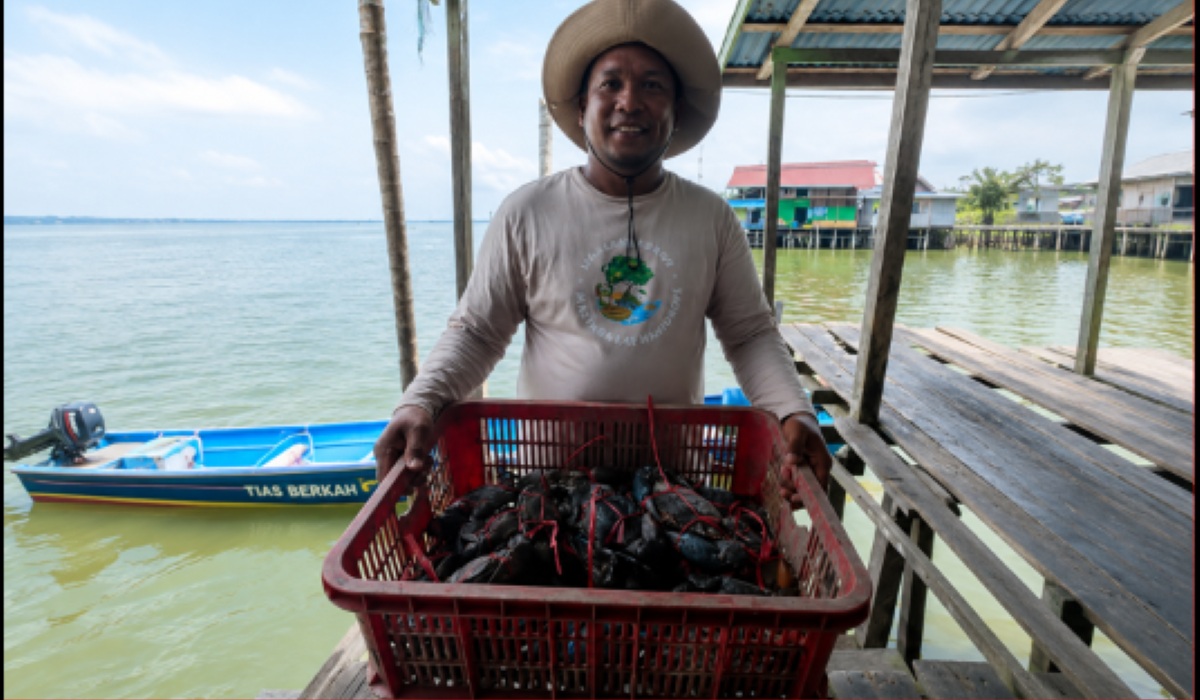
A vast expanse of traditional ponds stretches along the coastline of Tanjung Buka Village, Bulungan Regency, North Kalimantan. Here, Herman, chairman of the Tias Berkah Farmers Group (KTT), and his members depend on tiger prawns for their livelihood. However, after nearly 20 years of managing the ponds, Herman began to notice alarming environmental changes.
Tiger prawn harvests, the economic lifeblood of the community, were no longer stable due to deteriorating seawater quality. This situation forced Herman to find solutions to keep his ponds productive and sustainable for his family’s future.
New hope emerged in 2024 through the Mangroves for Coastal Resilience (M4CR) Programme. Herman and his group began adopting a sustainable aquaculture approach using the silvofishery method, a model that integrates mangrove planting within pond areas.
Initially, the transition was not smooth. Doubts lingered among the farmers. They worried that large mangrove roots would restrict prawn movement and reduce the effective pond area. However, through intensive mentoring, these concerns gradually faded.
The M4CR programme conducted outreach through the Free, Prior and Informed Consent (FPIC) process and in-depth education via field schools. Farmers were equipped with modern technical knowledge, from water gate management and salinity control to checking ideal water pH levels for prawn growth.
Armed with this new understanding, the Tias Berkah group rehabilitated 77 hectares of mangrove area with a planting density of 800 seedlings per hectare. Herman and his members consistently cared for the seedlings, replanted dead ones, and regularly cleared weeds.
The results have been remarkable. The ecological impact of the thriving mangroves was immediately felt in pond productivity. Sturdy mangrove roots now help stabilise the coastline against abrasion, improve water quality, and serve as a natural habitat for organisms that support the pond ecosystem.
For this dedication, the Tias Berkah group achieved an 87 percent mangrove survival rate. As a form of appreciation, the M4CR programme provided further support through a Matching Grants scheme for developing a mud crab fattening business.
“Mangrove ecosystem conservation must go hand in hand with coastal food security. When the environment recovers, food supply and income rise without having to sacrifice one another,” said Sarif, PPIU Manager of M4CR North Kalimantan.
The support provided includes a fibre boat with an outboard engine, mud crab seeds, fattening baskets, and other supporting equipment. With an increasingly healthy mangrove ecosystem, the community now has a solid alternative source of income through mud crab farming, proving that environmental preservation is the key to coastal prosperity.
Source: jawawa.id (https://jawawa.id/newsitem/silvofishery-in-bulungan-transforming-tiger-prawn-farms-with-mangroves-1786528236)
Originally published by Media Indonesia (https://mediaindonesia.com/nusantara/920969/silvofishery-di-bulungan-transformasi-tambak-udang-windu-lewat-mangrove), translated from Indonesian