
Silver Prices Slump as Investors Seek Alternative Assets
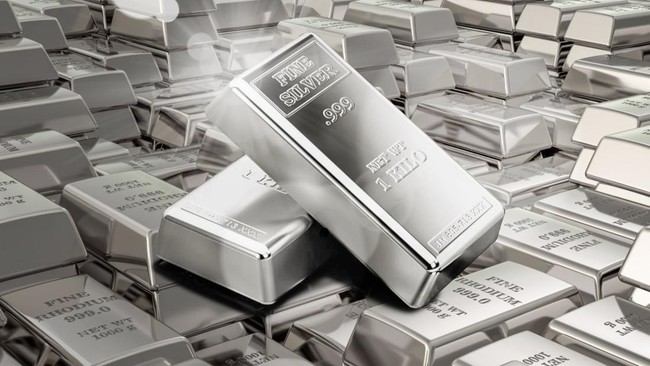
Global silver prices strengthened at the close of trading on Friday (25/09/2026), yet still recorded a weekly decline. Expectations of further interest rate hikes by the Federal Reserve (The Fed) and high US government bond yields continue to exert pressure on silver.
According to Refinitiv data, spot silver prices closed at US$64.2805 per troy ounce on Friday, an increase of 0.59% compared to the previous trading session. Converted to local terms, this price is equivalent to approximately Rp1.15 million per troy ounce or Rp37,028 per gram (US$1 = Rp17,917).
Pressure on silver stems primarily from growing market expectations that the Fed will continue its monetary policy tightening. Last week, the Fed raised interest rates by 25 basis points—the first increase in three years—and signalled that further hikes remain on the table.
The market has become increasingly aggressive in forecasting the next rate hike. Based on the CME FedWatch Tool cited by Reuters, market participants estimate a 6t6% probability of an interest rate hike in October, while the likelihood of an increase in December reaches 93%.
Hawkish signals have also emerged from several Fed officials. St. Louis Fed President Alberto Musalem previously stated that further rate hikes might still be necessary to curb inflationary pressures. US PCE inflation in July was recorded at 3.7%, still far from the Fed’s 2% target.
US Yields Burden Silver
Expectations of higher interest rates have also driven up US Treasury yields. The 10-year US government bond yield even touched its highest level in 19 years.
This condition has placed pressure on silver. Like gold, silver provides no yield; therefore, rising interest rates and bond yields increase the opportunity cost of holding the metal. Consequently, investors are finding alternative interest-bearing assets increasingly attractive.
This pressure was evident in silver’s price movement throughout the week. According to Refinitiv data, silver prices fell by 2.95% weekly, compared to the position on the previous Friday (18/09/2026) of US$66.2324 per troy ounce.
Silver prices have also corrected sharply from this year’s peak. Silver reached US$116.576 per troy ounce on 28 January 2026, its highest point this year. This means that by Friday’s close, silver prices had plummeted approximately 44.9% from their peak level.
Nevertheless, compared to the position one year ago, silver prices remain significantly higher. On 25 September 2025, silver stood at US$45.22 per troy ounce, meaning its annual price has still strengthened by approximately 42.2%.
Unlike gold, silver’s movement is also heavily influenced by industrial demand. The metal is used in various sectors, including solar panels, electronics, electric vehicles, and electrical infrastructure. Therefore, in addition to monetary policy, the outlook for global industrial activity is a determining factor for silver price movements.
Iran Conflict as a Deciding Factor
From a geopolitical perspective, developments in the US-Israel-Iran conflict remain a key sentiment for the precious metals market. The conflict has driven up energy prices and maintained concerns regarding inflationary pressures.
However, there are signs of easing energy supply risks. Quoting Reuters, negotiators in New York are exploring a phased way out of the war, which could involve the reopening of the Strait of Hormuz by Tehran and the lifting of US economic blockades against Iran.
The hope for easing the conflict has reduced concerns regarding energy supply disruptions. Oil prices fell by approximately 3% on Friday as some supply fears subsided.
For silver, these developments are a double-edged sword. Easing energy price pressure could help contain inflation and ultimately influence the direction of Fed monetary policy. On the other hand, reduced geopolitical uncertainty could decrease the demand for precious metals as defensive assets.
Therefore, silver’s movement next week will continue to be influenced by the direction of US Treasury yields, expectations of Fed rate hikes, US inflation developments, and the dynamics of the Middle East conflict. The outlook for global industrial demand also requires close monitoring, given silver’s dual function as both a precious metal and an industrial metal.