
Signs That Humans Are Being Replaced Are Growing Stronger in China
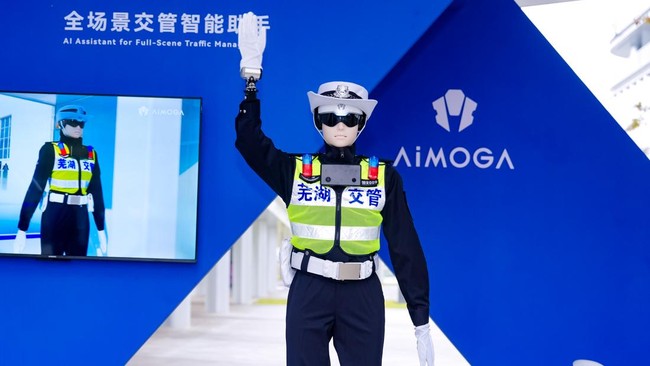
The era when robots merely ran, danced and performed somersaults in laboratories is over. Technology companies around the world, particularly Chinese and US giants, are now pouring billions of dollars into developing embodied artificial intelligence designed specifically to take over human jobs in factories, logistics and public services.
The phenomenon has fuelled an investment boom. According to ITjuzi, a research firm, Chinese embodied-AI companies raised 93.5 billion yuan (about 254 trillion rupiah) in the first half of 2026 alone. That was five times the total for the same period a year earlier.
Intense competition, which is driving down hardware prices, has led the industry to conclude that the key to automating the workforce lies not in the machines’ physical form but in their intelligence.
“Robot makers have concluded that the biggest profit margins no longer come from the hardware, but from the brains,” said Dermot McGrath, founder of Shanghai-based technology consultancy ZenGen Labs, as quoted by Reuters on Monday (2 November 2026).
The development is opening a new front in US-China technological rivalry. The country that most quickly integrates advanced AI into physical robots is expected to dominate global industrial supply chains, reduce dependence on human labour and reshape global productivity.
Robots begin doing human jobs in the real world
Trials of replacing human workers with advanced robots are no longer merely theoretical. In China, embodied-AI robots are beginning to work directly on production lines and in commercial services:
Automotive component manufacturing: Electric-vehicle battery giant CATL reported that robots developed by Spirit AI have taken over the task of fitting flexible cables during battery-pack testing at its Zhongzhou factory, achieving precision success rates of more than 99%.
Pharmaceuticals and services: Robbyant, Ant Group’s robotics unit, said its robots are now entrusted with managing and preparing medicine orders at two pharmacy chains in Shanghai. Human staff are responsible only for the final check before the medicines are dispatched.
High-precision operations: Robotics firm DexForce said its simulation system can train robots to perform high-precision industrial tasks in just six to eight hours, with a success rate of 99.9%.
Training robots’ ‘common sense’ through human behaviour
Unlike ordinary chatbots, which learn from online text, industrial robots need a deep understanding of human physical interactions. To speed up this transition, robotics companies are racing to collect thousands of hours of data on human movement.
Spirit AI, for example, employs about 1,000 people specifically to record everyday and industrial physical activities. ACE Robotics, meanwhile, fits human workers in shops and hotels with wearable sensors to record their grip styles and muscle movement.
“We want robots to move from being driven by rigid lines of code to being driven by common sense,” said Yang Qian, co-founder and chief operating officer of X Square.
Equipped with ‘common sense’, robots can do more than follow programmed instructions: they can also solve problems independently in the workplace. In an experiment by JoyIn Technology, when a robot failed to reach headphones on top of a tall cupboard, it studied a video demonstration by a human and then independently moved a wooden box to use as a step to reach the item.
A potential ‘ChatGPT moment’ for the global workforce
Industry figures predict that the robot-driven labour transition will accelerate dramatically in the near future. Unitree founder Wang Xingxing said that integrating next-generation language models such as GPT-6 and GPT-7 into physical robots would be a “ChatGPT moment” for robotics.
That pivotal point is expected to come when humanoid robots can complete 80% of complex tasks in 80% of new work environments using only spoken instructions from a supervisor.
However, Chinese developers still face major challenges, including US restrictions on exports of advanced AI chips and the need to validate the machines’ long-term reliability.
Although analysts believe that widespread commercialisation across all business sectors will take several more years, the direction of change is clear: the roles of human labourers and operational workers are gradually, but steadily, beginning to be replaced by physical forms of artificial intelligence.
Source: jawawa.id (https://jawawa.id/newsitem/signs-that-humans-are-being-replaced-are-growing-stronger-in-china-1793613051)
Originally published by CNBC Indonesia (https://www.cnbcindonesia.com/tech/20261102122558-37-781492/manusia-sudah-digantikan-tandanya-makin-kencang-di-china), translated from Indonesian