
SIG: Precision Interlock Bricks an innovation for affordable disaster-resistant housing
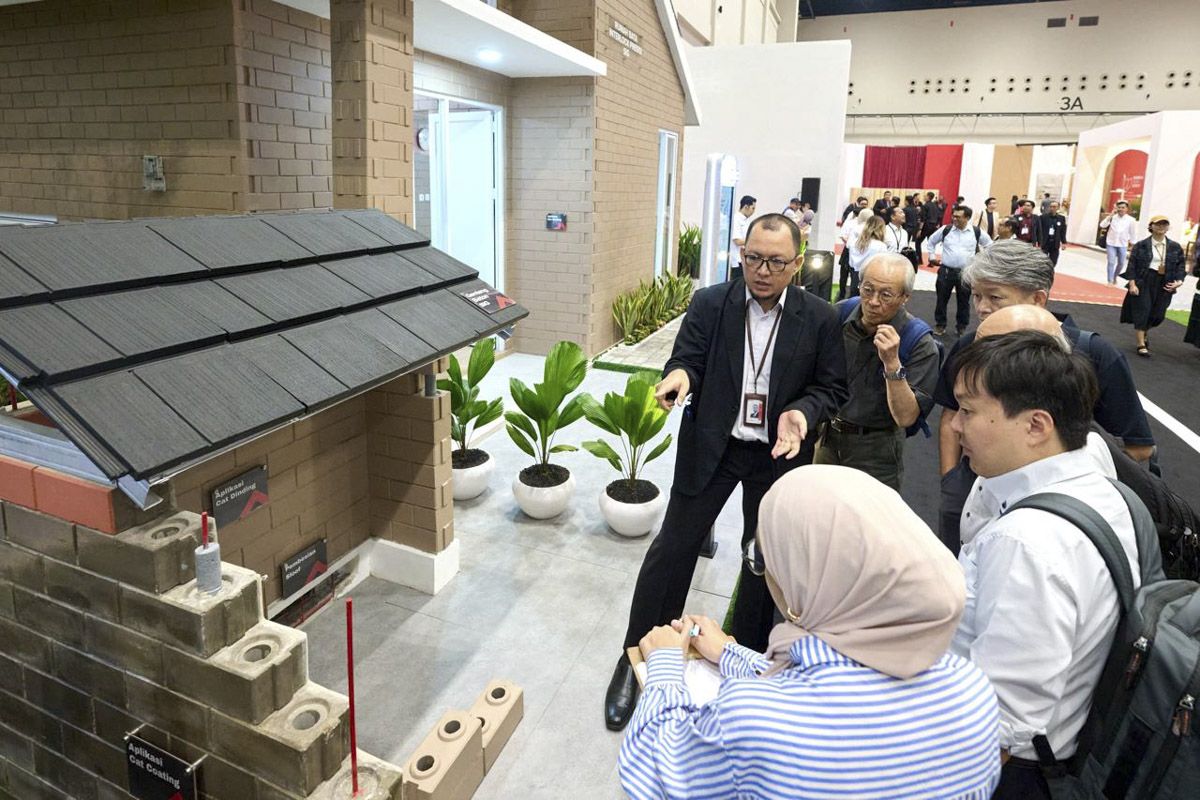
In the context of earthquake-prone areas and post-disaster recovery, the speed of building houses is very important. PT Semen Indonesia (Persero) Tbk, or SIG, has revealed that Precision Interlock Bricks (BIP) can be an innovation for affordable disaster-resistant housing. “In the context of earthquake-prone areas and post-disaster recovery, the speed of building houses is very important. Technologies such as BIP can be one alternative to accelerate the provision of housing while still paying attention to safety and building resilience aspects,” said SIG Sales and Marketing Director Dicky Saelan in a statement in Jakarta on Saturday.
Speed of construction is one of BIP’s advantages. SIG calculates that a type-36 house using BIP can be built in around 21–30 days, or about twice as fast as conventional methods. This time efficiency also has the potential to reduce labour costs. Based on SIG’s calculations, the construction cost of a type-36 house with BIP can be reduced by up to around 30 per cent.
Behind its ease of installation, BIP relies on precision as one of its main strengths. The brick has dimensions of 25 cm × 12.5 cm × 10 cm with tolerance control of up to 1 millimetre. This precision makes the brick-laying process easier while producing neat walls. BIP can also be used for exposed display needs as part of a home’s aesthetics, or non-exposed where it is then coated with finishing material.
“Precision is an important part of this technology. When the size and angle of each brick are maintained, the installation process becomes faster and the wall results are neater. So, efficiency occurs not only in construction time, but also in the quality of the final result,” he said.
BIP’s advantages are increasingly relevant for Indonesia, which is located in an earthquake-prone region. The interlocking system on the bricks is designed to strengthen the inter-brick connection, while certain elements can function as ring beams and practical columns with the use of reinforcement and mortar every 80–120 cm. BIP is also able to withstand pressure of at least 70 kg/cm².
SIG claims that BIP has passed the Cyclic Test of Interlock Brick Walls and 2D Modular from PUSKIM in accordance with SNI 1726-2012 for PIB Houses, obtained a Technology Clearing certificate for Interlock Brick Houses from the Directorate General of Human Settlements at the Ministry of Public Works and Public Housing (PUPR), and has received approval from the Ministry of PUPR and BNPB for earthquake-resistant houses.
At the Danantara Housing Expo 2026, SIG presented BIP, a construction material innovation by the nation’s own people with a Domestic Component Level (TKDN) of almost 100 per cent. SIG presented a model of a landed house built using BIP. Each brick has a pin/lock system on the side and top so that the bricks can interlock with one another. The installation method resembles assembling Lego blocks: precise, interlocking, and not requiring a process as complicated as conventional methods.
This technology allows house construction to proceed up to twice as fast while still prioritising the structural resilience of the building. “We developed Precision Interlock Bricks to answer the need for construction that is fast, efficient, and has good structural resilience. With the interlocking system, the house construction process becomes simpler and more precise because the bricks simply need to be arranged and locked according to the design,” said Dicky.