
SIG Expands 'Recycle for Good' Program, from Waste Sorting Habits to Preventing Marine Litter
The journey of a piece of used packaging does not always end in the bin. Without adequate sorting and collection systems, materials that still possess value can escape into the environment, flow through rivers, and ultimately end up in the ocean.
In an archipelagic nation like Indonesia, this issue extends beyond mere cleanliness. Protecting the ocean requires building a waste management system that operates from upstream to downstream—ranging from habits of sorting at home, schools, and communities, to the availability of collection networks and recycling facilities capable of processing such materials.
Driven by this need, SIG, alongside its project partners—Plastic Bank, the Wuppertal Institute for Climate, Environment and Energy, and Decision Context—is expanding the ‘Recrol for Good’ programme in Indonesia. This expansion is part of the regional project ‘Recycle for Good – Prevent Marine Litter’, funded through ZUG on behalf of the German Federal Ministry for the Environment, Nature Conservation, Nuclear Safety and Consumer Protection.
Following its initial implementation in Jakarta and its surrounding areas, the programme now reaches more regions, including West Java, Surabaya and Malang in East Java, West Nusa Tenggara, and Bali. This expansion is aimed at strengthening the recycling ecosystem through the sorting, collection, and processing of waste, while simultaneously broadening the involvement of communities and stakeholders throughout the packaging waste value chain.
Building the habit of waste sorting is a vital step, but it is not the only solution. Sorted waste requires a reliable collection system and facilities capable of processing it to restore its utility. Therefore, ‘Recycle for Good – Prevent Marine Litter’ is designed to reach various stages of the waste management system.
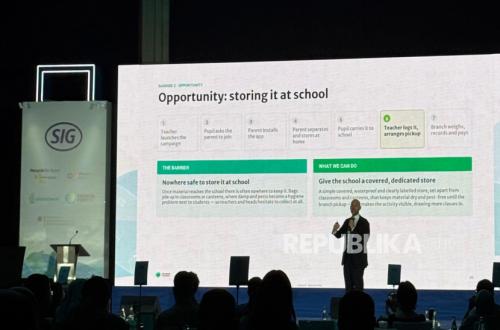
The programme includes education and incentives for responsible waste sorting and disposal at the household, school, and community levels. Simultaneously, the programme strengthens collection systems, supports the development of recycling infrastructure, and encourages collaboration between waste collectors, recyclers, businesses, institutions, and communities.
To date, the initiative has been implemented in 389 locations, supported by a diverse network of partners ranging from schools, communities, and cafes to businesses, religious institutions, and waste collectors. Their involvement is crucial to expanding public access to recycling and integrating sustainable waste management practices into daily life.
‘Recycle for Good – Prevent Marine Litter aims to make recycling more accessible, practical, and beneficial for people in Indonesia. The problem of marine litter cannot be solved through awareness alone. It also requires better sorting, stronger collection networks, capable recycling infrastructure, and sustained participation from communities and partners along the value chain,’ said Noer Wellington, Commercial Director Asia Pacific South, Japan and Korea at SIG.
According to him, collaboration is essential to ensure more used packaging enters the correct recovery and recycling streams. ‘Together with our partners, SIG strives to ensure more used packaging enters the proper recovery and recycling flows, while encouraging recycling habits that provide sustainable environmental and social benefits,’ he added.
Within the recycling ecosystem, waste collectors and local collection networks play a vital role. They serve as the link between materials discarded by the public and the recycling industry that requires raw materials. Through this programme, SIG and its partners seek to strengthen the connectivity between community-based collection systems and more formal recycling channels.
This approach is expected to not only increase material recovery but also support the livelihoods of communities dependent on the recycling ecosystem. The programme also utilises digital tools, community engagement activities, and incentive-based mechanisms to expand participation. The goal is not merely to host one-off activities, but to help build more consistent and sustainable recycling habits.
Efforts to strengthen the collection-level system are running alongside investments in recycling infrastructure. As part of this development, SIG is collaborating with Eco-Paper to upgrade pulping equipment at its recycling facility. This upgrade is intended to strengthen the processing capacity for used beverage cartons and help create a more effective recovery stream for collected packaging.
Thus, the journey of packaging does not end when a consumer discards it. There is an effort to ensure that these materials remain within a cycle—collected, processed, and reused productively.
The development of ‘Recycle for Good – Prevent Marine Litter’ is also aligned with Indonesia’s direction in promoting waste reduction, preventing marine pollution, implementing Extended Producer Responsibility (EPR), and developing a circular economy. The programme’s approach covers various stages of waste management, from behavioural change and sorting at the source to collection, strengthening recycling infrastructure, and stakeholder collaboration.