
Shrinking Reservoir Water Reveals Ancient Graves in Wonogiri
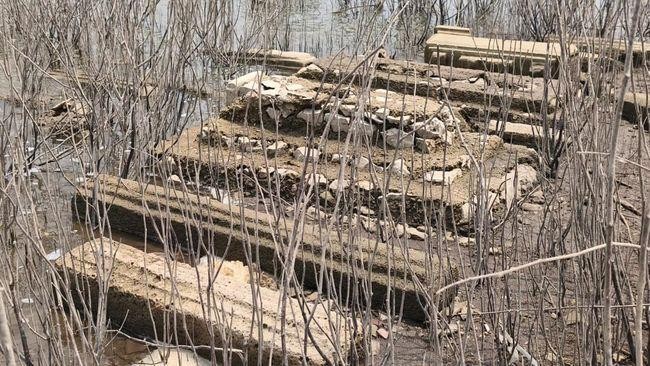
A number of ancient graves have become visible again in the Gajah Mungkur Reservoir area, Wonogiri, Central Java. The emergence of these graves occurred after the reservoir’s water level receded due to the dry season.
According to local residents, these graves have been visible for the past few days. However, not all parts of the graves have surfaced, as some remain submerged under the water.
“They have been visible for a few days now because the water has receded. But not everything is visible yet; only part of them, as many are still underwater,” said Karni, a resident of Wuryantoro Village, Wuryantoro District, Wonogiri Regency.
Dozens of graves are now clearly visible at the bottom of the reservoir, while others remain submerged. These graves are believed to be made of limestone.
The condition of the graves varies; some remain intact, while others have been eroded by time and water currents. On several headstones, carvings and inscriptions are still visible, although most have become difficult to read.
The shapes of the headstones are relatively similar, with sizes varying from approximately half a metre to two metres.
The appearance of these ancient graves often attracts visitors wishing to see historical traces within the reservoir. However, according to Karni, the number of tourists visiting the site has not been particularly high.
“Not many tourists have come yet; perhaps only one or two people come to take photos. Most people who come here are fishermen or farmers heading to the fields,” he added.
Access to the grave site is quite difficult to reach. Visitors must walk across the dried reservoir bed through terrain that remains muddy and wet.
According to the Head of Wuryantoro District, Soemardjono Fadjari, the appearance of ancient graves in the Wonogiri reservoir is an annual phenomenon during the dry season.
“Every dry season, these graves usually begin to appear, but only partially at this stage because the water level is still quite high,” he said.
Soemardjono added that these graves are typically visible since August. However, during this year’s dry season, their appearance was only noted in September because the recession of the water has been slower.
“Usually, they start appearing in August. This year, the recession has been somewhat slow, so not all of them have emerged,” he stated.
For context, the Gajah Mungkur Reservoir was constructed by submerging 51 villages across seven districts in the Wonogiri Regency. The location of these dozens of ancient graves was originally a public cemetery that has resurfaced as the water levels drop.