
Shivaji in Khalid's Heart
History often fares like an old house bequeathed to many children. As long as all agree to care for it, the house becomes a shared shelter. But when each feels like the sole owner, the same house turns into a field of dispute. What is contested is no longer the walls or the roof, but the right to say, ‘This is mine.’ Such is the fate of Chhatrapati Shivaji Maharaj in India today. The greater the reverence for him, the fiercer the contest over the meaning of his legacy.
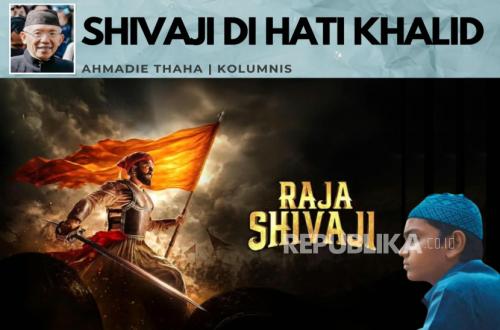
In the past two years, two films have emerged that both tell the story of a great Indian king named Shivaji, but take very different paths. A feature-length film, Shivaji Raje Bhosale, is even being prepared for release in 2028. The film Raja Shivaji (2026) presents the story of a king as epic films typically do: a warlord, a conqueror of forts, a symbol of Maratha glory. In contrast, the film Khalid Ke Shivaji (2025) invites audiences to see Shivaji, a Hindu king, through the eyes of a fifth-grade Muslim boy named Khalid.
The difference in perspective seems simple, but therein lies the courage of Khalid Ke Shivaji. It does not ask how Shivaji won battles, but rather how Shivaji’s values can live in the heart of a child of a different faith. That choice has unsettled many. The trailer for Khalid Ke Shivaji sparked protests from right-wing Hindu groups because it contained dialogue mentioning Muslim guards in Shivaji’s army and the existence of a mosque at Raigad. Some historians themselves caution that several of these claims lack strong primary evidence.
Such academic debate is natural. History advances precisely through the courage to test sources, not through a willingness to accept every story without criticism. The problem arises when scholarly discussion turns into demands for bans, political pressure, and even censorship of artistic works before the public has had a chance to watch them in full.
Here we need to distinguish between two things that are often conflated. Questioning historical accuracy is the work of scholars. But rejecting an idea simply because it seeks to present a historical figure as belonging to all citizens is a different matter. The former safeguards the integrity of knowledge. The latter risks turning history into a fence of identity. Yet a figure as great as Shivaji did not become great because he was loved by only one group, but because his influence transcended the boundaries of his own community.
Interestingly, the controversy seems to mirror the film’s own storyline. In the fictional world, Khalid is challenged because he is a Muslim who admires Shivaji. In the real world, Khalid Ke Shivaji suffers a similar fate. Yet the message Raj Pritam More seeks to convey is actually very simple, and for decades was even taught as history in Indian schools: that Shivaji was a leader who sought to unite his people without distinction of religion, caste, or social class.
But amid the strengthening of identity politics, an idea once considered ordinary has now become controversial. Shivaji, for centuries regarded as the pride of Maharashtra, is slowly being seized as an exclusive symbol of Hindutva, so that any attempt to portray his inclusive side is immediately suspected as an ideological threat.
The film is also clever because it does not begin with religious conflict, but with a far more grounded issue. In a small village in Maharashtra, residents complain about damaged roads and difficulty accessing clean water. Instead of addressing these basic needs, the village head proposes building a temple. Interestingly, both Hindu and Muslim residents question that priority. This brief scene seems to satirise the reality of modern politics: ordinary people are often more sensible than their leaders.
Raj More seems to suggest that everyday life actually provides ample space for living together, but that space is continually narrowed by identity politics more preoccupied with symbols than with the welfare of the people. From that point, Khalid’s journey becomes increasingly moving. He is not raised in a fanatical family. His parents live simply and do not place much emphasis on religious ritual. But once his friends begin mocking him as ‘Afzal Khan’, he is suddenly forced to bear a burden of identity too heavy for an eleven-year-old child.
His history teacher, Salve, tries to console him by saying that those who have no history will have no present, and even answers Khalid’s question about Afzal Khan’s religion with a simple sentence: ‘What does it matter?’ But therein lies the film’s irony. It is the adults who make that question important. Raj More shows how prejudice is not born of great hatred, but of mockery considered ordinary, of labels repeated over and over, until a child learns to see himself as ‘the different one’.
When Khalid’s father says, ‘A true king places humanity above religion,’ Khalid replies softly, ‘If only we had lived in that era.’ That simple sentence becomes a sharp critique of India today: perhaps what is growing distant is not Shivaji’s legacy, but society’s ability to inherit his spirit.