
Ships Increasingly Reject US Military Escort in Strait of Hormuz Amid Safety Fears
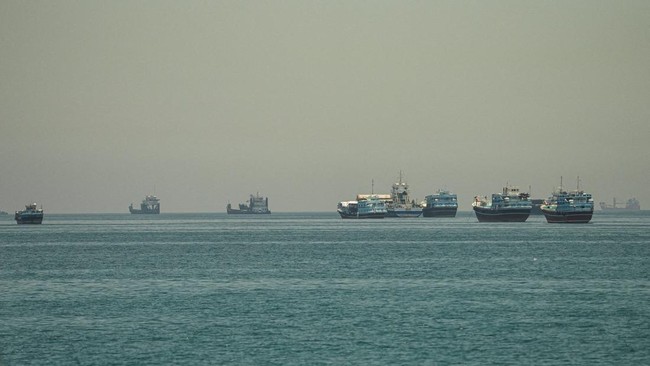
Jakarta, CNBC Indonesia — Global shipping companies are beginning to avoid the American military escort scheme for transiting the Strait of Hormuz after a wave of Iranian attacks on commercial vessels triggered serious concerns over shipping safety.
Seven sources from the shipping and maritime security industries told Reuters that ship operators now consider the US-protected routes to be increasingly risky, even though Washington claims the effort has succeeded in keeping energy trade flowing.
For decades, ships entering and leaving the Persian Gulf used the safe shipping lanes in the middle of the Strait of Hormuz designated by the International Maritime Organization (IMO) in 1968 through a Traffic Separation Scheme.
However, since the Iran war began on 28 February, Iranian forces have reportedly laid mines in the area, forcing vessels to use two alternative routes closer to the coast of Iran or Oman.
In June, Reuters reported that the US military helped ships transit through covert operations using aerial drones, maritime drones and helicopters to guide tankers. The operation also involved dozens of ship-to-ship oil transfers to ensure that Gulf states’ energy exports continued to flow.
The scheme enabled the export of tens of millions of barrels of oil, helping to temper the spike in energy prices caused by the largest ever disruption to oil and gas supplies.
But the security situation deteriorated again after a series of attacks on ships in Omani waters.
On Tuesday, Iran’s Revolutionary Guard Corps claimed responsibility for attacks on two supertankers owned by the United Arab Emirates (UAE). Since 7 July, at least five vessels have been attacked in Omani waters — three crude oil tankers, one LNG carrier and one container ship — according to an analysis of incident data from the UN shipping agency.
It is not yet clear whether all of those ships were sailing under the US escort scheme.
What is certain is that one shipping industry source said the company had decided to stop crossing the Strait of Hormuz altogether.
“The United States appears to no longer have control over the situation,” the source said.
The source added that the decision was taken for the safety of crews amid a deteriorating security situation.
Torbjorn Solvedt, a Middle East analyst at Verisk Maplecroft, assessed that Iran’s ability to attack ships on the Omani route makes the solution offered by President Donald Trump’s administration unlikely to succeed.
“Iran’s continued ability to attack vessels sailing through the Oman route suggests the Trump administration’s proposed solution to keep shipping going will most likely not succeed,” he said.
Nevertheless, the White House insists the Strait of Hormuz remains open.
White House spokesperson Olivia Wales said the Strait of Hormuz remains open and oil continues to flow. “Iran is committing international terrorism by firing on merchant ships sailing peacefully, targeting and killing innocent civilians, and the United States is responding with decisive action.”
A US defence official, speaking on condition of anonymity, said that in the past seven days more than 100 ships have coordinated directly with the US military to transit the Strait of Hormuz, while more than 300 vessels have passed through the area generally.
According to the official, the data shows the US-led operation is still running effectively, although shipping volumes have not returned to pre-war levels.
However, on Wednesday, Iran threatened to halt more energy exports from the region after the US reimposed a naval blockade on Iranian ports, with both sides launching fresh attacks in a struggle for control of the Strait of Hormuz.
Tehran also signalled it could use its ally, the Houthi group in Yemen, to close the Bab el-Mandeb Strait connecting the Red Sea to the Gulf of Aden. Should that happen, the world’s two most important energy shipping routes would come under threat simultaneously.
Another shipping industry source said about nine LNG tankers operated by Greek companies are now trapped in the Persian Gulf after entering through the Strait of Hormuz to take on cargo.
In addition, two other tankers have also been attacked in open waters outside the Strait of Hormuz since 7 July.
Last week, the US Navy-led Joint Maritime Information Centre raised the risk level for shipping in the Strait of Hormuz to “severe” from the previous “substantial”, just one notch below the highest level of “critical”.
The upgrade came after three tankers were targeted in attacks.
In guidance issued by the US Navy after the escort scheme was launched last month, shipping companies were reminded that the military would attempt to provide threat information to crews, but “may not be able to convey information regarding threats to a vessel directly”.
Five Reuters sources said the US military has not provided adequate clarity on the level of risk faced by vessels using the Oman route.
One maritime security source said the US assertion that the Strait of Hormuz is not closed and remains open to shipping has left ship operators anxious and uncertain.
“Of course every company must carry out its own risk assessment, but the situation is clearly not safe. So why is it still being said that the strait is open?”
Greek maritime security firm Diaplous, in an advisory published on Tuesday, even recommended shipping companies postpone all voyages through the area until Saturday.
Meanwhile, another Greek maritime security firm, MARISKS, warned that “at this stage, there is no guarantee that transit through the Strait of Hormuz can be undertaken with an acceptable level of security.”
Source: jawawa.id (https://jawawa.id/newsitem/ships-increasingly-reject-us-military-escort-in-strait-of-hormuz-amid-safety-fears-1784163032)
Originally published by CNBC Indonesia (https://www.cnbcindonesia.com/news/20260716061324-4-751147/ramai-ramai-kapal-tolak-kawalan-militer-as-di-selat-hormuz-kenapa), translated from Indonesian